

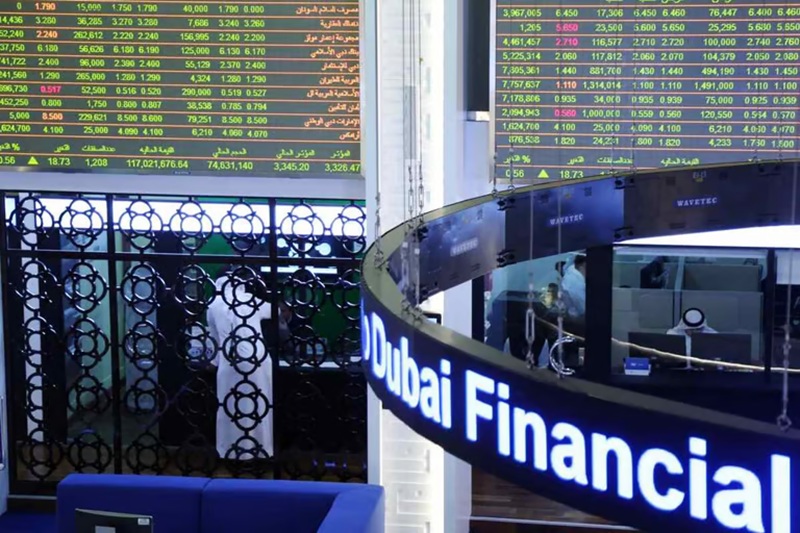
Stocks across the United Arab Emirates suffered one of their sharpest sell-offs in years on Wednesday as trading resumed in Dubai and Abu Dhabi following a two-day market closure triggered by Iranian drone and missile attacks on the country.
The selloff has amplified concerns that the rapidly escalating conflict could inflict lasting economic damage on the Gulf’s second-largest economy.
Dubai’s benchmark index tumbled 4.9%, marking its steepest single-day decline since May 2022. In Abu Dhabi, the main index slid more than 3%, its sharpest intraday fall since August, while the Nasdaq UAE 20 index dropped 4.3%. The breadth of losses pointed to widespread de-risking rather than isolated sector weakness.
Register for Tekedia Mini-MBA edition 20 (June 8 – Sept 5, 2026).
Register for Tekedia AI in Business Masterclass.
Join Tekedia Capital Syndicate and co-invest in great global startups.
Register for Tekedia AI Lab.
In Dubai, state-owned lender Emirates NBD fell 5.2%, leading declines among heavyweight financial stocks. In Abu Dhabi, Al Buhaira National Insurance Company and Umm Al Qaiwain General Investments slumped 9.6% and 8.7% respectively, reflecting pressure on insurance and investment-linked counters. Budget carrier Air Arabia dropped around 5% as airspace closures and flight cancellations weighed on aviation-related shares.
Ahead of the market open, both exchanges announced temporary adjustments to their lower price limit thresholds, setting them at -5% for securities. The move, effectively tightening circuit breakers, signaled regulatory efforts to contain disorderly selling and prevent a cascade of panic-driven trades in thin liquidity conditions following the two-day halt.
The sell-off came after Iran launched waves of missile and drone attacks over the weekend targeting the UAE, in retaliation for U.S.-Israeli strikes that killed Supreme Leader Ali Khamenei. Iranian strikes reportedly hit civilian and commercial infrastructure, including Dubai International Airport, hotels, and data centers operated by Amazon. The targeting of high-profile commercial assets struck at the heart of the UAE’s positioning as a secure regional hub for finance, logistics, and tourism.

For an economy built on connectivity, the aviation disruption was particularly jarring. Airspace closures led to thousands of flight cancellations, disrupting passenger traffic and cargo flows. Aviation and tourism together account for a significant share of Dubai’s GDP, while Abu Dhabi has increasingly leaned on business travel and global investment conferences to diversify away from oil revenues. Even temporary suspensions can dent quarterly earnings, especially if rebookings and insurance claims create additional cost burdens.
Analysts at Citigroup warned that the escalation could have “a profound and potentially long-lasting impact on the MENA region.” They identified Dubai developer Emaar Properties and Abu Dhabi-based Aldar Properties as among the most exposed to earnings-per-share risks in a protracted conflict scenario. Within banking, they pointed to the National Bank of Kuwait and Emirates NBD as having significant downside exposure.
“Valuation impact could vary (and could potentially be more severe) as stocks derate driven by increase in perceived equity risk premium,” Citi’s analysts said.

The reference to equity risk premium is central to understanding the intensity of Wednesday’s decline. As geopolitical uncertainty rises, investors demand higher returns to compensate for holding assets in affected jurisdictions. That repricing often manifests in immediate multiple compression — lower price-to-earnings ratios — even before earnings forecasts are formally revised. In markets such as Dubai and Abu Dhabi, where foreign institutional investors play a prominent role, and liquidity can thin quickly in risk-off episodes, outflows can amplify volatility.
Citi added that while real estate sales may weaken if property demand and pricing soften, near-term revenue may not immediately collapse because developers recognize income from previously secured sales backlogs. “For real estate developers, while sales might drop as property prices and demand for properties decline, the immediate revenue from the current situation might be less severely impacted (since revenue is based on conversion of backlog on sales already made),” the bank wrote.
That nuance underscores a potential lag effect: earnings could appear resilient in the short term even as forward indicators deteriorate. Should insecurity persist, off-plan sales — a key funding mechanism for developers — may slow, affecting cash flows and new project launches.
Beyond individual sectors, the broader macroeconomic implications are significant. The UAE has long marketed itself as a safe and stable gateway to the Middle East, attracting multinational headquarters, sovereign wealth allocations, and expatriate professionals. Damage to airports, hospitality assets, and digital infrastructure challenges that narrative, even if reconstruction is swift and state finances remain robust.
From a fiscal perspective, the UAE retains substantial buffers, supported by oil revenues and sovereign wealth. However, Abu Dhabi’s hydrocarbon wealth does not fully insulate Dubai, whose economy is more exposed to tourism, trade, and financial services. If the conflict disrupts regional trade corridors or triggers sustained travel advisories, service-sector revenues could face a prolonged squeeze.
The sell-off in the UAE mirrored broader unease across global markets. Asian equities extended declines on Wednesday, while European stocks opened higher after two consecutive days of losses. In the United States, futures pointed to a weaker open after major indexes closed in negative territory on Tuesday. Investors globally are recalibrating exposure amid fears that the conflict could widen and unsettle energy markets.
Oil prices remain a pivotal variable. Any perceived threat to production facilities or shipping lanes in the Gulf could send crude prices sharply higher, feeding into global inflation expectations. Higher oil prices can bolster Gulf fiscal balances, but they also risk dampening global growth, which in turn would weigh on trade and investment flows into the region.
What the markets are currently grappling with is a combination of immediate operational disruptions and the more abstract but powerful force of rising geopolitical risk. This is expected to weigh heavily on investor confidence — at least — in the near term.