

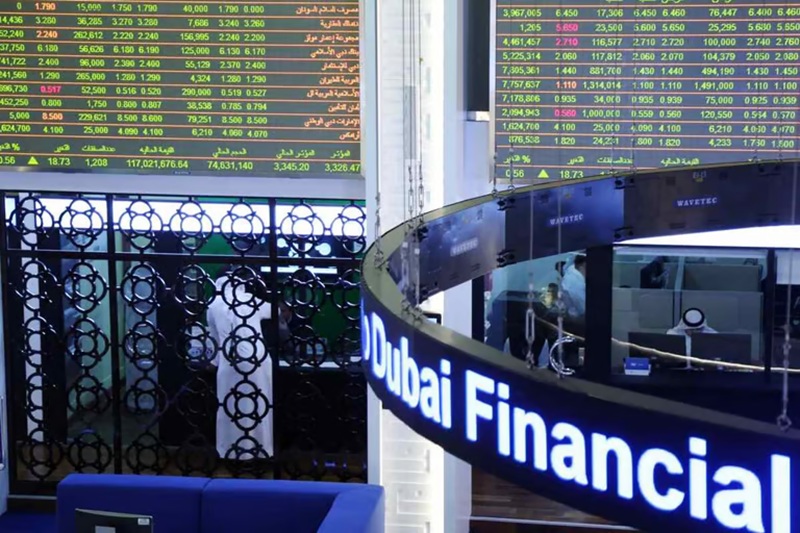
Stock markets in the United Arab Emirates closed sharply lower on Friday, extending a week of heavy losses as investors confronted escalating geopolitical tensions and the growing economic fallout from the expanding Middle East conflict.
The selloff came as hostilities between Israel and Iran intensified, raising fears of a wider regional war that could further disrupt energy flows, aviation networks, and financial markets across the Gulf.
Israel launched heavy airstrikes on Hezbollah-controlled southern suburbs of Beirut and began what it described as a “broad-scale” wave of attacks targeting infrastructure in Tehran on Friday. Iran said it retaliated by firing missiles toward central Tel Aviv.
Register for Tekedia Mini-MBA edition 20 (June 8 – Sept 5, 2026).
Register for Tekedia AI in Business Masterclass.
Join Tekedia Capital Syndicate and co-invest in great global startups.
Register for Tekedia AI Lab.
The confrontation widened overnight when Iranian drones targeted the Al Udeid Air Base — the largest U.S. military base in the Middle East — according to Qatari officials. No casualties were reported, but the incident underscored the growing risk of the conflict spilling across the Gulf.
The renewed fighting has shaken investor confidence in Gulf markets that had previously benefited from strong economic growth, rising oil revenues, and large infrastructure spending programs.
Dubai’s benchmark index, the Dubai Financial Market General Index, dropped 3.2% on Friday. Shares of property giant Emaar Properties fell 4.8%, while low-cost carrier Air Arabia slid 4.9%.

The losses capped the market’s worst week in nearly six years. Even after a two-day trading halt earlier in the week triggered by missile and drone attacks on the Gulf, Dubai’s market still finished the week down roughly 9%, reflecting the speed at which geopolitical shocks can ripple through regional financial systems.
Abu Dhabi’s benchmark, the FTSE ADX General Index, also ended lower, declining 1.4%. Real estate developer Aldar Properties dropped 4.9%, while Abu Dhabi Commercial Bank fell 2.9%. Telecom heavyweight Emirates Telecommunications Group declined 3.8%.
For the week, the Abu Dhabi index lost more than 5%, highlighting how quickly geopolitical risk has begun to weigh on investor sentiment in a region normally seen as a relatively safe haven during global turbulence.

Authorities attempted to contain the volatility by introducing temporary trading safeguards. Both the Dubai and Abu Dhabi exchanges imposed a 5% daily price-limit rule to prevent deeper selloffs and curb panic-driven trading.
The Aviation Industry Takes A Hit
The market turmoil coincides with severe disruptions to global aviation routes passing through the Gulf — a region that serves as one of the world’s most critical air transit corridors.
Major carriers Emirates and Etihad Airways resumed limited flights to international destinations from their UAE hubs on Friday, even as airlines scrambled to adjust routes to avoid missile threats and closed airspace.
The disruptions have exposed how concentrated global aviation networks are around a handful of strategic hubs, particularly Dubai International Airport, the world’s busiest airport for international passengers. Any prolonged shutdown or operational limitation there could ripple through airline networks across Europe, Asia, and Africa.
Investors are also watching the broader financial implications of the conflict. Rising oil prices — a common reaction to Middle East instability — typically benefit Gulf energy exporters but can simultaneously trigger market volatility if the conflict threatens infrastructure or shipping routes.
Another concern is the potential economic fallout from financial sanctions tied to the conflict. According to a report by The Wall Street Journal, authorities in the UAE are considering freezing billions of dollars in Iranian assets held within the country’s financial system.
Such a move could further restrict Tehran’s access to foreign currency and international trade, intensifying economic pressure on Iran while potentially reshaping capital flows in regional banking centers such as Dubai and Abu Dhabi.
Market analysts say the sharp selloff largely reflects short-term panic rather than a deterioration in the UAE’s underlying economic fundamentals.
Samer Hasn, senior market analyst at XS.com, said markets could rebound once the initial shock subsides and investors begin reassessing valuations that have fallen rapidly during the crisis.
“As geopolitical sentiment stabilizes, investors may rotate into undervalued blue-chip names,” Hasn said, noting that the recent drop has created new entry points in sectors tied to the UAE’s long-term economic growth.
The UAE has spent years positioning itself as a global financial and logistics hub linking Asia, Europe, and Africa, with large sovereign wealth funds and deep capital markets that often attract foreign investors during global uncertainty.
Still, analysts warn that the trajectory of Gulf markets will depend heavily on how the conflict evolves.
If the fighting expands further — especially if energy infrastructure, shipping lanes, or major population centers are targeted — financial markets across the Middle East could face sustained volatility. Conversely, any signs of de-escalation would likely trigger a rapid rebound as investors return to markets backed by strong fiscal reserves and ongoing economic diversification efforts.