

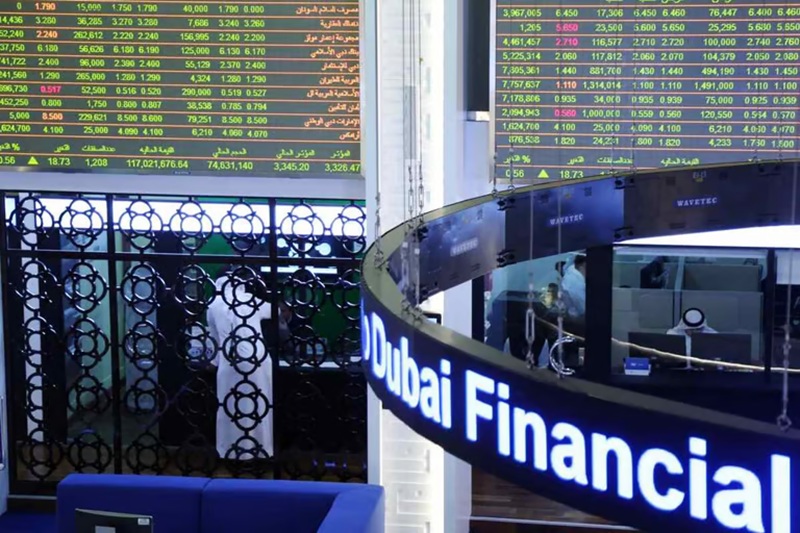
The United Arab Emirates entered 2026 with one of the strongest growth profiles among major Middle Eastern economies, as aggressive diversification efforts, booming construction activity, expanding financial services, and strong trade flows helped lift economic output well beyond regional peers.
Fresh data released by the Federal Competitiveness and Statistics Centre showed the UAE’s real gross domestic product expanded by 6.2% in 2025 to 1.9 trillion dirhams ($517.3 billion), while non-oil GDP grew an even faster 6.8% to 1.5 trillion dirhams ($408.4 billion). The figures reinforce the country’s transformation from a hydrocarbon-dependent economy into one increasingly driven by finance, tourism, logistics, manufacturing, technology, and real estate.
For years, the UAE has presented itself as the Gulf’s premier business gateway, attracting multinational corporations, global investors, hedge funds, technology firms, and wealthy migrants seeking stability, low taxes, and access to international markets. The latest GDP figures suggest that the strategy was yielding tangible results before regional tensions escalated.
Register for the next Tekedia Mini-MBA.
Register for Tekedia AI in Business Masterclass.
Join Tekedia Capital Syndicate and co-invest in great global startups.
Construction emerged as the fastest-growing sector in 2025, expanding by 11.1%, highlighting the scale of infrastructure spending, housing development, and commercial projects underway across the federation. Finance and insurance grew by 10.4%, while real estate expanded by 7.9%, and transport and storage rose by 7.8%. These sectors have become central to the UAE’s growth model as the country seeks to build a knowledge-based economy less vulnerable to oil market swings.
Trade remained the single largest contributor to non-oil GDP, accounting for 16.9%, followed by finance and insurance at 13.2%, construction at 12.9%, and manufacturing at 12.8%. The figures underline how deeply the UAE has integrated itself into global commerce, serving as a hub linking Asia, Europe, and Africa through its ports and financial centers.
Economy Minister Abdulla Bin Touq Al Marri said the results reflected the success of the country’s long-term economic strategy.

“The national economy continues to deliver exceptional performance, with results reflecting the success of the country’s economic vision in building a more diversified, sustainable and competitive development model, driven by accelerating non-oil activity,” he said.
The performance also aligns with broader ambitions under the UAE’s “We the UAE 2031” strategy, which aims to double the country’s economic output and cement its status among the world’s leading business destinations. Government officials have repeatedly highlighted diversification as the central pillar of future growth, with non-oil sectors now accounting for nearly four-fifths of total GDP.
Yet the strong headline numbers may not fully capture the growing risks now confronting the economy.

The UAE’s economic rise has largely been built on its reputation as a neutral, stable, and predictable commercial hub in a turbulent region. But that image is facing increasing strain following the widening U.S.-Iran conflict, which has rattled markets, disrupted trade routes, and heightened security concerns across the Gulf.
Apart from allowing the U.S. to use its air bases to facilitate attacks on Iran, the UAE itself has reportedly carried out “dozens” of covert airstrikes against Iran, according to the Wall Street Journal. This is believed to have fueled the barrage of attacks from Iran, targeting the UAE’s ports and oil facilities.
The conflict has already triggered sharp swings in oil prices, raised shipping and insurance costs, and intensified concerns over maritime security around the Strait of Hormuz, one of the world’s most important energy and trade corridors. The UAE’s position as a logistics, aviation, and financial center leaves it particularly exposed to prolonged instability.
Signs of strain were already emerging before the latest escalation. Business surveys previously showed growth in the UAE’s non-oil sector slowing amid geopolitical tensions, weaker tourism flows, and softer client spending as companies delayed investment decisions. New business orders expanded at their slowest pace in several years as uncertainty weighed on commercial activity.
The risks extend beyond trade and tourism. Dubai and Abu Dhabi have spent years marketing themselves as safe havens for global capital, attracting multinational headquarters, family offices, cryptocurrency firms, and wealthy individuals fleeing political and economic instability elsewhere. Sustained regional conflict threatens that value proposition.
Investors and corporations typically gravitate toward jurisdictions that offer both economic opportunity and geopolitical predictability. If the Gulf becomes increasingly associated with military confrontation, some capital flows could shift toward alternative financial centers in Asia, Europe, or North America.
The conflict also complicates inflation dynamics. Higher energy prices can initially boost hydrocarbon revenues for Gulf producers, but they also raise business costs, pressure supply chains, and reduce global economic growth. For a country whose diversification strategy depends heavily on international trade, tourism, and foreign investment, prolonged geopolitical instability could offset some of the gains from stronger oil receipts.
That challenge is significant because much of the UAE’s recent success has come from sectors tied directly to global confidence. Construction, financial services, logistics, aviation, and real estate thrive when international investors view the country as a long-term destination for capital and business expansion.
For now, the UAE remains one of the region’s fastest-growing economies, with diversification continuing to deliver measurable results. But the trajectory that produced 6.2% growth in 2025 increasingly faces a test that economic reforms alone cannot control.
Analysts warn that if tensions between Washington and Tehran persist or deepen, the UAE may find that its greatest economic asset, its status as a global business crossroads insulated from regional turmoil, becomes harder to sustain, potentially altering the growth path that has underpinned its economic transformation over the past decade.