

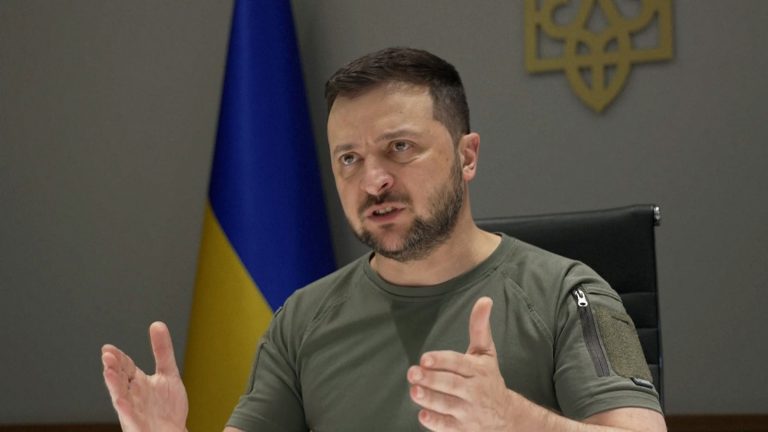
In a move that has placed Ukraine in its most precarious situation since the war with Russia began, the United States has halted military aid to Kyiv following a dramatic fallout between President Donald Trump and Ukrainian President Volodymyr Zelenskyy.
The unexpected development has left Ukraine, which has been heavily reliant on U.S. military support to sustain its defense against Russian aggression, scrambling for alternatives as its war effort faces new uncertainties.
An anonymous White House official and a U.S. official confirmed to CNBC’s partner network NBC News on Monday that military support had been paused while the situation is assessed.
Register for Tekedia Mini-MBA edition 20 (June 8 – Sept 5, 2026).
Register for Tekedia AI in Business Masterclass.
Join Tekedia Capital Syndicate and co-invest in great global startups.
Register for Tekedia AI Lab.
“The president has been clear that he is focused on peace. We need our partners to be committed to that goal as well. We are pausing and reviewing our aid to ensure that it is contributing to a solution,” the officials stated.
While the White House has not publicly commented, Ukraine’s Prime Minister Denys Shmyhal expressed Kyiv’s resolve to continue diplomatic efforts to secure support.
“Regardless of the discussions about the possibility of stopping [military aid] — we will absolutely calmly continue to work with the U.S., Congress, with the Trump administration and with him personally through all available diplomatic channels so that Ukraine and the U.S. continue our struggle for a just, lasting, stable peace in Ukraine, on the European continent,” Shmyhal said on Tuesday.

The decision to pause aid, if confirmed, would mark an unprecedented shift in U.S. policy, particularly in light of the critical role American military assistance has played in bolstering Ukraine’s defense. The fallout follows a contentious meeting at the White House on Friday, where President Zelenskyy abruptly left without signing a multi-billion-dollar critical minerals deal — a moment seen by many as a diplomatic disaster.
A Huge Setback for Ukraine
For Ukraine, the pause in U.S. military aid could not come at a worse time. With over three years of war with Russia, Kyiv requires a steady supply of weapons and munitions to maintain its front lines. Defense analysts warn that a prolonged cessation of U.S. support could lead to severe consequences on the battlefield.
“This decision is not about economics. It is driven fundamentally by Trump’s view that Russia is willing to do a peace deal, and only Ukraine is the obstacle,” said Malcolm Chalmers, deputy director-general at defense think tank RUSI. “But there is no evidence that Russia would be prepared to accept a deal, and what that would be. Indeed this decision will encourage Putin to ask for more — including Ukrainian demilitarization and neutrality.”

The Kremlin, seizing on the situation, indicated it hoped the move would push Ukraine toward a peace deal. “If this is true, then this decision could indeed push the Kyiv regime toward the peace process,” Kremlin Press Secretary Dmitry Peskov told reporters, according to an NBC News translation.
Is Ukraine Now Doomed?
Defense strategists at the Center for Strategic and International Studies (CSIS) described the prospects for Ukraine as “bleak.” Analysts Mark F. Cancian and Chris H. Park explained that while equipment from previously announced commitments may still be delivered, there is a risk that the Trump administration could halt these shipments.
“The bottom line: Prospects for Ukraine are bleak. In the best case, U.S. and European aid continues, which is enough for Ukraine to stabilize the front lines, blunt Russian attacks, and buy time for a negotiated settlement,” they noted. “In the worst case, the United States cuts off shipments of equipment. What Ukraine receives from the Europeans, other global sources, and its own industry will keep its forces in the field but with declining capabilities. Russian attacks will gain more and more territory; at some point, Ukrainian lines will break. Ukraine will have to accept an unfavorable, even draconian peace.”
The Kiel Institute for the World Economy, a respected source tracking Ukraine aid, estimated that Europe had already overtaken the U.S. in total support, allocating 70 billion euros ($73.6 billion) in financial and humanitarian aid and 62 billion euros in military aid. Comparatively, the U.S. has provided 64 billion euros in military aid and 50 billion euros in financial and humanitarian allocations.
Europe’s $840 Billion Defense Plan As A Lifeline
With the U.S. stepping back, Ukraine’s hopes now rest on the European Union, which is preparing a massive urgent defense funding initiative that could raise up to 800 billion euros ($840 billion). Part of this fund is expected to support Ukraine, but analysts caution that the country’s ability to continue fighting will heavily depend on how quickly the EU can mobilize this funding.
European Commission President Ursula von der Leyen announced on Tuesday the EU’s intention to boost defense spending, emphasizing both immediate support for Ukraine and the long-term goal of enhancing European security.
“Europe is ready to massively boost its defense spending. Both to respond to the short-term urgency to act and to support Ukraine but also to address the long-term need to take on much more responsibility for our own European security,” she said.
However, despite these ambitious plans, there is concern that bureaucratic delays and the deteriorated state of Europe’s defense industry could hinder rapid assistance to Ukraine. The CSIS strategists warned, “The bad news is that the Europeans are already supplying as much as they can. Further, if the United States ceases aid, many European countries will also likely scale back.”
Can Europe Step Up?
As the situation unfolds, the EU faces mounting pressure to step into the gap left by the U.S. The CSIS notes that Europe has been a significant contributor to Ukraine’s defense, supplying roughly $1.8 billion per month in military aid. European aid was particularly crucial during late 2023 and early 2024 when U.S. funds were exhausted amid congressional debates.
The EU has also approved the use of frozen Russian sovereign assets to support Ukraine’s military needs, a move that demonstrates its commitment to Kyiv’s defense. However, the extent to which Europe can fill the void left by the U.S. remains uncertain.
European leaders have already convened emergency meetings to discuss their role in Ukraine’s defense and the broader implications of a potential U.S.-Russia peace deal that could sideline Kyiv and Europe altogether. For now, the question remains whether Europe can act swiftly enough to prevent Ukraine from being forced into a disadvantageous settlement.