

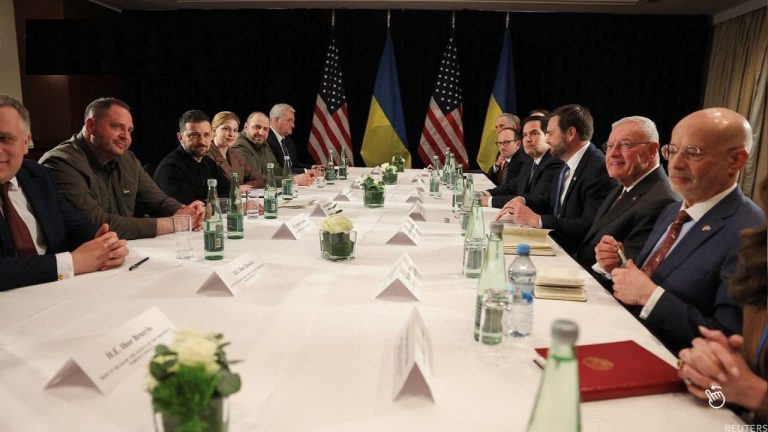
Ukraine is reportedly prepared to sign a deal with the United States that would involve sharing revenues from its natural resources, though the agreement would not include security guarantees. This development, noted in early 2025, reflects Ukraine’s efforts to secure economic support amid ongoing challenges, including its conflict with Russia and ammunition shortages.
The deal has sparked discussions about Ukraine’s strategic alignment and resource management, with some suggesting it could exacerbate tensions with other global players like Russia. However, details remain limited, and the agreement’s scope and implications are still unfolding.
India-Pakistan Tensions
Register for Tekedia Mini-MBA edition 20 (June 8 – Sept 5, 2026).
Register for Tekedia AI in Business Masterclass.
Join Tekedia Capital Syndicate and co-invest in great global startups.
Register for Tekedia AI Lab.
Tensions between India and Pakistan have escalated significantly following a deadly militant attack on April 22, 2025, in Indian-administered Kashmir, which killed 26 people, mostly tourists. India has accused Pakistan of supporting the attack, pointing to the involvement of the Kashmir Resistance (also known as The Resistance Front), which India claims is a front for Pakistan-based groups like Lashkar-e-Taiba. Pakistan denies these allegations and has called for an independent probe, a stance supported by China.
India suspended the 1960 Indus Waters Treaty, closed the main border crossing, revoked visas for Pakistani nationals, and conducted naval missile drills. Prime Minister Narendra Modi has vowed to pursue the attackers “to the ends of the earth,” with indications that India may be building a case for military action.
Pakistan closed its airspace to Indian airlines, suspended trade, and warned that any disruption of water flow from the Indus River system would be considered an “act of war.” Pakistan’s military has also claimed “credible intelligence” of an imminent Indian strike within 24-36 hours as of April 30, 2025. Both sides have exchanged gunfire along the Line of Control (LoC) for six consecutive nights, with no reported deaths but heightened alertness. Pakistan shot down an Indian drone, and India reported test missile strikes to demonstrate readiness.

International Reactions
The United States, through Secretary of State Marco Rubio, is urging both nations to de-escalate and work toward a “responsible solution,” maintaining diplomatic channels with both governments. The U.S. has expressed support for India against terrorism but has not criticized Pakistan directly. China has backed Pakistan’s call for a neutral investigation, while the Trump administration’s broader focus on countering China in the Indo-Pacific may influence its approach, with analysts noting a closer U.S.-India partnership compared to a more distant relationship with Pakistan.
The Ukraine deal and India-Pakistan tensions highlight complex geopolitical dynamics. The U.S.-Ukraine resource agreement could be seen as a pragmatic move to bolster Ukraine’s economy, but it risks entangling the U.S. in further regional disputes without addressing Ukraine’s core security needs. Meanwhile, the India-Pakistan conflict, rooted in historical disputes over Kashmir, is dangerously close to military escalation, with both sides leveraging nationalist rhetoric and nuclear capabilities. The U.S. and other powers have historically played a mediating role, but the current global focus on Ukraine, Gaza, and U.S.-China rivalry may limit attention to this crisis, potentially allowing it to spiral.
The lack of concrete evidence linking Pakistan to the Kashmir attack and the tit-for-tat measures suggest both sides are posturing for domestic audiences, but miscalculations could lead to catastrophic consequences given their nuclear arsenals. The geopolitical impacts on Europe from the Ukraine-US resource deal and the escalating India-Pakistan tensions are multifaceted, influencing energy security, economic stability, security policies, and diplomatic alignments.

The reported readiness of Ukraine to sign a resource revenue-sharing deal with the US, without security guarantees, has several implications for Europe. Ukraine’s natural resources, including natural gas and minerals, are of interest to Europe, which has been grappling with energy diversification since reducing reliance on Russian gas post-2022 invasion. If the US gains preferential access to Ukrainian resources, European countries like Germany, Poland, and France may face increased competition or higher costs for these resources.
This could strain EU-Ukraine relations, as Europe has been a major financial and military backer of Ukraine. Potential delays or cost increases in Europe’s energy transition and supply chain stability, especially if the deal prioritizes US interests over European ones.
The deal could deepen Ukraine’s economic ties with the US, potentially reducing Europe’s influence over Kyiv’s policies. European nations, particularly those in the EU, have invested heavily in Ukraine’s reconstruction and integration (e.g., through EU candidacy status). A US-centric deal might lead to perceptions of Ukraine drifting toward Washington, complicating EU cohesion on Ukraine policy.
Increased diplomatic tensions within the EU and between the EU and US, with Eastern European states like Poland possibly aligning more closely with the US, while Western Europe (e.g., France, Germany) pushes for stronger EU autonomy. The absence of security guarantees in the deal could signal to Europe that the US is prioritizing economic gains over NATO’s collective defense commitments in Eastern Europe. This may prompt European NATO members to bolster their own defense capabilities, especially given Russia’s ongoing aggression.
Countries like Poland and the Baltic states, already wary of Russian threats, may push for greater EU defense integration or bilateral US security pacts. Accelerated European defense spending and calls for a stronger EU military framework, potentially straining budgets and diverting resources from other priorities like climate or social programs.
Russian Reaction
Russia, already antagonistic toward Western involvement in Ukraine, may view the US deal as a further provocation, potentially escalating cyberattacks, disinformation campaigns, or hybrid warfare targeting Europe. This could include disruptions to energy infrastructure or increased pressure on Eastern European states. Heightened cybersecurity risks and potential for localized escalations near NATO’s eastern flank, prompting Europe to reinforce its eastern borders.
The escalating conflict between India and Pakistan, particularly following the April 22, 2025, Kashmir attack and subsequent diplomatic and military actions, has indirect but significant consequences for Europe. India and Pakistan are key players in global trade routes, and any escalation could disrupt supply chains, particularly for energy (e.g., LNG from the Middle East transiting near South Asia) and goods like textiles and pharmaceuticals, where India is a major supplier. A full-scale conflict or prolonged closure of trade routes (e.g., Pakistan’s airspace ban on Indian flights) could increase costs for European consumers and industries.
Rising inflation pressures in Europe, already strained by post-Ukraine war economic recovery, and potential shortages of critical goods like generic medicines. A worsening conflict could trigger refugee flows from South Asia, particularly if violence spills beyond Kashmir. Europe, already managing migration challenges from the Middle East and Africa, could face increased asylum pressures. Additionally, the involvement of militant groups like The Resistance Front raises concerns about terrorism, as such groups could inspire or coordinate with cells in Europe.
Stricter European border policies, increased counterterrorism measures, and potential social tensions over migration, straining liberal democratic frameworks. Both India and Pakistan are nuclear-armed, and any miscalculation risks catastrophic escalation. Europe, as a key player in global non-proliferation and crisis diplomacy, would face pressure to mediate or support UN-led de-escalation efforts. However, Europe’s attention is already stretched by Ukraine and Middle Eastern conflicts, limiting its bandwidth. A nuclear incident would have global economic and environmental fallout, severely impacting Europe.
Increased European diplomatic engagement in South Asia, potentially diverting resources from other crises, and heightened public anxiety about nuclear risks. The India-Pakistan crisis is intertwined with US-China rivalry, as the US backs India and China supports Pakistan. Europe, caught between maintaining transatlantic ties and managing economic dependence on China, faces a delicate balancing act. If the US pushes for stronger anti-China measures in the Indo-Pacific, European NATO members like the UK and France may feel obliged to contribute, while neutral EU states like Ireland resist.
Strains on EU foreign policy cohesion, with potential for transatlantic tensions if Europe resists deeper involvement in US-led Indo-Pacific strategies. Europe is navigating a precarious geopolitical landscape where the Ukraine-US deal and India-Pakistan tensions exacerbate existing challenges. The Ukraine deal underscores Europe’s vulnerability to US strategic priorities, pushing the EU toward greater self-reliance in energy and defense but at significant cost. Meanwhile, India-Pakistan tensions highlight Europe’s exposure to distant conflicts through trade, migration, and security risks, with limited capacity to influence outcomes.
Both situations reflect a broader trend: Europe’s struggle to assert strategic autonomy amid a multipolar world dominated by US-China competition and regional flashpoints. Without proactive diplomacy and investment in resilience (e.g., diversified supply chains, robust defense), Europe risks being a reactive player, buffeted by external shocks.