

A convincing vintage family portrait begins with how the people relate to one another. The faded colors can come later. For an imagined family scene, an AI image generator lets you describe a shared glance, familiar clothing, and the light across a porch or living room. Those choices give the picture its character before you add a film-like finish.
Natural Expressions Start With a Shared Moment
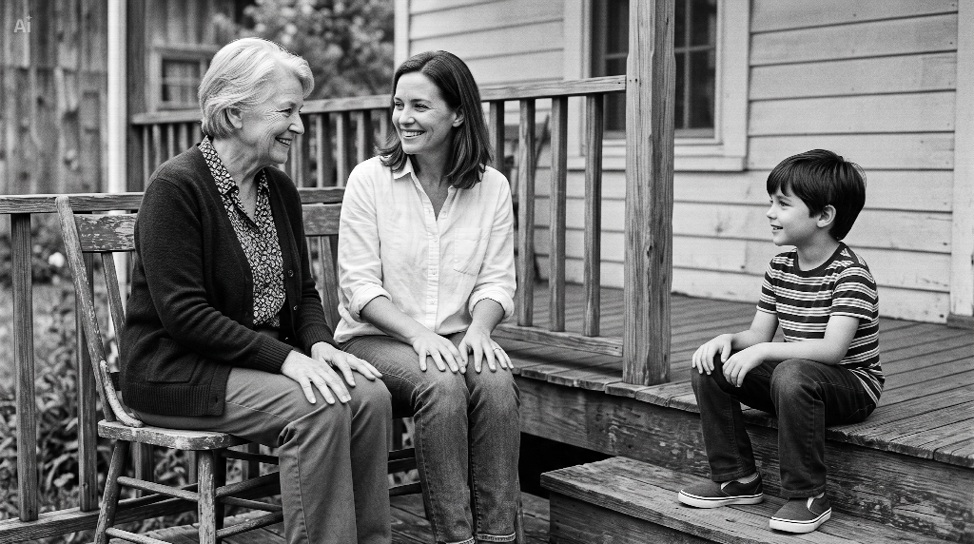
In the porch portrait, the adults exchange a smile while the child looks toward them. Their different lines of sight make the group feel connected without requiring everyone to face the camera. The setting is modest enough to remain part of the moment rather than competing with it.
Write the relationship into the action. “A grandmother and her adult daughter share a quiet smile as a child listens” is more useful than “a happy family.” It establishes who is responding to whom. You can also choose a more reserved moment, such as siblings sitting close together and looking toward someone outside the frame.
Specify the number of people and where each sits or stands. With three subjects, placing the child slightly lower can create a readable arrangement of faces. Keep the hands in simple positions on laps or knees, especially when several bodies overlap. Avoid giving every person a separate activity that needs its own set of props.
A Few Period Details Are Enough
Choose a broad period before describing clothing and surroundings. For an understated 1980s-inspired portrait, plain cotton shirts, a knit cardigan, and a weathered porch can establish the direction without turning the family into costume characters. Use differences in fabric and tone to distinguish people while keeping their outfits plausible together.
The background should agree with that choice. A modern phone in someone’s hand can interrupt the intended period more quickly than subtle grain can establish it. Ask for a simple setting with only the details you need. You do not have to fill the frame with recognizable vintage objects.
Be equally selective about aging effects. Heavy scratches, torn borders, and strong yellowing describe the condition of a damaged print. If the goal is a natural family photograph, begin with an intact image and restrained texture. The expressions should remain easier to see than the effect applied over them.
One Prompt for a Relaxed Porch Portrait
Open CapCut’s AI image generator and use a complete scene description rather than entering only “vintage family photo.” CapCut supports creating images from text, so an invented group is a straightforward starting point. Describe the people first, then their arrangement and the photographic treatment.
Create a horizontal, photorealistic black-and-white family portrait with a subtle 1980s film-photo feeling. Show exactly three fictional people on a covered wooden porch: a silver-haired grandmother in a dark cardigan, her adult daughter in a light cotton blouse, and a young boy in a striped shirt seated on a lower step. The adults exchange a relaxed smile while the boy looks toward them. Keep all faces visible, with natural age differences and hands resting separately on their own knees. Include weathered boards and plain house siding. Use soft open-shade daylight, gentle highlights, clear midtones, and fine grain. Keep skin texture natural. No additional people, pets, modern devices, lettering, scratches, or decorative border.
The clothing contrast has a practical role in this monochrome version. A light blouse separates the daughter from the darker cardigan beside her. If two people blend together, change one garment’s tone before asking for stronger contrast across the entire picture.
Warm Color Changes the Feeling of the Room
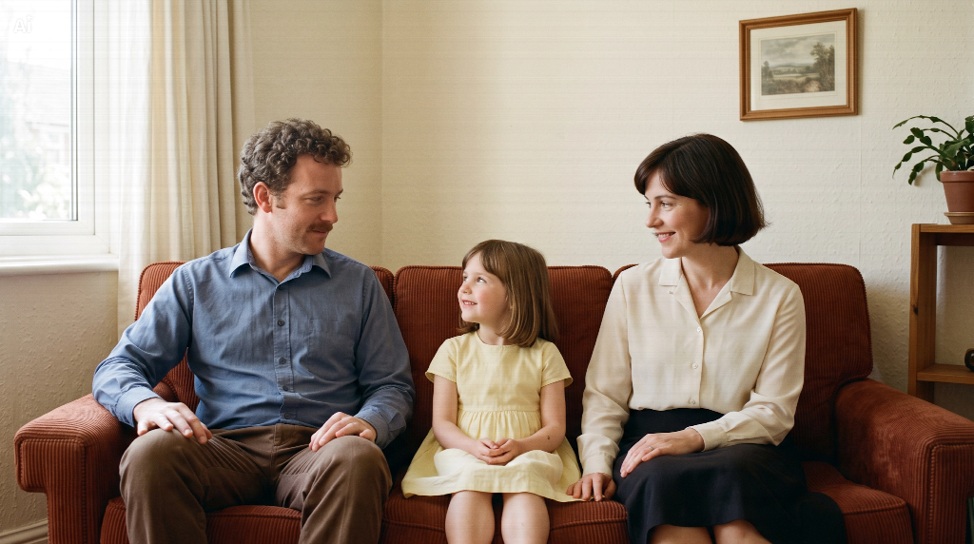
A muted color version can draw attention to the home as well as the faces. A rust-colored sofa and softly colored clothes give the room warmth, while a side window keeps the lighting connected to a visible part of the setting. The family still needs a shared moment; color alone cannot supply that interaction.
To explore this direction, replace the porch description with a simple living room and choose a quiet exchange on the sofa. Ask for warm, restrained colors with believable skin tones. Keep the shadows neutral enough that dark hair and clothing remain distinct. Avoid requesting an orange cast over the whole image.
Use this adaptation for the tone and setting: “An early-1980s-inspired living room with a rust-colored fabric sofa. Two parents sit with their child between them, exchanging relaxed glances. Soft daylight enters from a side window. Use muted warm colors, gentle contrast, and fine film-like grain, with clear facial features and no distressed-print effects.”
This is a separate imagined family scene, so you can change the people and their arrangement along with the room. If you instead want to work from your own family photograph, use a reference you have permission to upload and specify which expressions and relationships you want to retain.
A Shared Laugh Can Replace a Formal Pose
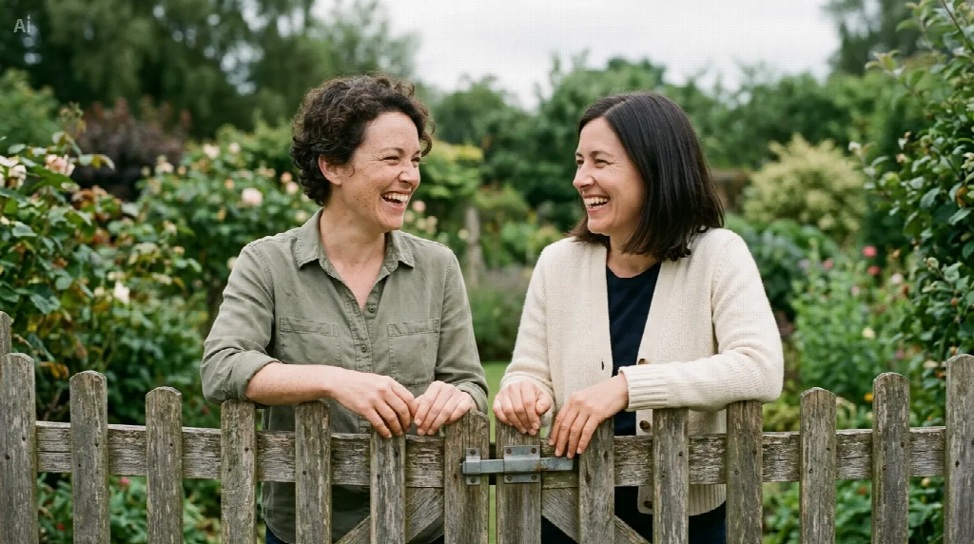
A portrait of adult siblings can feel familiar without including a whole household. Here, two imagined sisters lean on a garden gate and laugh toward each other. Their faces, shoulders, and resting hands belong to the same small exchange. The fence gives their arms a natural place to settle, while the softened foliage keeps attention on the expressions.
This is a different kind of moment from the quieter porch and sofa scenes. Describe the instant during the laugh, not a sequence of talking, turning, and laughing. Let the two expressions differ slightly; matching smiles and identical head angles can make an otherwise informal arrangement feel posed.
To try a late-1970s-inspired outdoor variation, specify two adult siblings beside a weathered gate, simple cotton and knit clothing, and soft overcast light. Ask for restrained color and faint grain rather than a yellowed finish. Keep their hands below their faces so the eyes and mouths remain unobstructed. You can suggest closeness through inward-facing shoulders and shared attention without adding an embrace or extra objects.
Film Grain Should Not Hide Facial Details
When reviewing a result from an AI photo generator, first look at the group from normal reading distance. Can you follow who is looking at whom? Are the ages, seated heights, and body positions believable? Then enlarge the faces and hands. Texture should not hide those details.
For a focused adjustment in CapCut, describe the change in relation to the image: “Reduce the grain over the faces while keeping the soft monochrome tones,” or “Keep the warm sofa, but make the skin tones less orange.” Inspect the revised result before changing anything else. Download the version whose expressions still feel natural when the image is viewed small.
Summary
Vintage family portraits feel personal when the interaction is clear and the period details stay understated. Start an imagined scene with CapCut’s AI image generator, then choose soft monochrome or restrained warm color. Keep the film texture subtle enough for the family to remain the focus.