

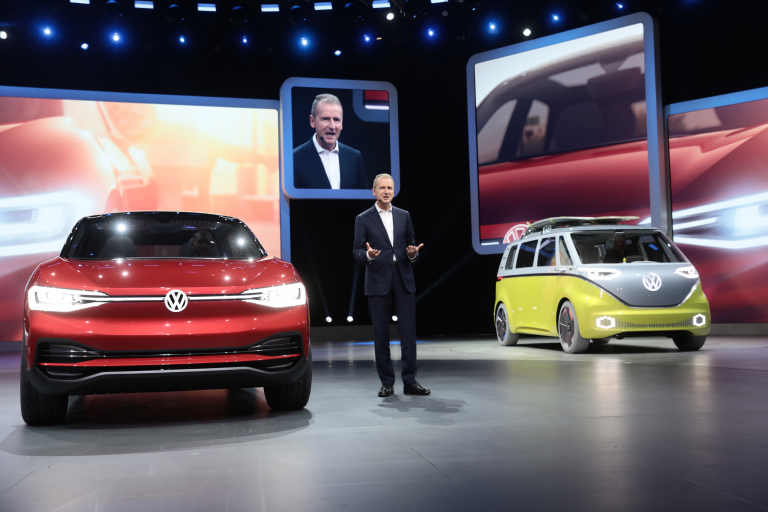
Tesla’s position as the king of electric vehicles in Europe has come under serious threat—now from Volkswagen, which overtook Elon Musk’s company in battery electric vehicle (BEV) registrations during the first quarter of 2025.
According to data from JATO Dynamics, the German automaker saw 65,679 BEVs registered in Europe from January to March, a staggering 157% jump from the same period last year. Tesla, by contrast, registered 53,237 vehicles, marking a sharp 38% decline, the steepest among the 30 most registered brands on the continent.
That market defeat lands at a time when Tesla is still reeling from one of its worst quarterly financial results on record. The American EV giant reported a 71% drop in profits for Q1 2025, missing Wall Street expectations and raising fresh questions about how long the company can hold off rising global competition, investor fatigue, and deepening reputational wounds.
Register for Tekedia Mini-MBA edition 20 (June 8 – Sept 5, 2026).
Register for Tekedia AI in Business Masterclass.
Join Tekedia Capital Syndicate and co-invest in great global startups.
Register for Tekedia AI Lab.
While one bad quarter might not define Tesla’s future, this moment seems less like a bump and more like a brewing crisis. Musk’s blame game, aired during the company’s recent investor call, only deepened the sense of turmoil.
The Political Fallout Driving Sales Down
In that earnings call, Musk struck a defensive and combative tone, accusing protesters of orchestrating a campaign to hurt Tesla’s business.
“The protests that you’ll see out there, they’re very organized. They’re paid for,” he said, offering no proof.

Demonstrators have gathered at Tesla dealerships across the world, voicing outrage over Musk’s political activities—especially his public support for far-right politicians and his funding of President Donald Trump’s 2024 reelection campaign.
In the U.S., Tesla once had a tight grip on the progressive, climate-conscious EV demographic. That support has eroded. Many left-leaning consumers, long loyal to Tesla’s innovation and environmental brand, have grown disillusioned with Musk’s politics and are now actively avoiding his vehicles. The so-called “Tesla Takedown” protests have spread rapidly, becoming a way for critics of Trump’s policies to make a statement with their wallets.
And the damage isn’t limited to America. In Europe, Musk’s alignment with far-right ideologies, most notably his recent tacit endorsements of Germany’s nationalist Alternative for Germany (AfD) party, has also triggered a backlash. European consumers, particularly in countries with strong environmental and democratic traditions, have begun shunning Tesla in noticeable numbers. The brand’s sales have slumped by double digits across several EU countries.

Volkswagen’s Timely Rise
Volkswagen’s resurgence could not have come at a better time. While Tesla stumbles, VW has pressed forward with a clear and reliable EV rollout strategy. It has expanded production capacity, launched updated versions of its popular ID lineup, and remained relatively scandal-free. Unlike Tesla, whose marketing often revolves around its polarizing CEO, Volkswagen has kept the focus on vehicles, affordability, and customer service.
The ID.4, the company’s flagship EV SUV, has climbed to the third-most registered EV in Europe. While it still trails behind Tesla’s Model Y and Model 3, the gap is shrinking fast. In March alone, Model Y registrations fell 43%, while Model 3 inched up 1%. By contrast, VW’s ID.4 came within 2,000 units of overtaking the Model 3 for the quarter.
Volkswagen’s position in Europe has always been strong, but now, it’s evolving into a dominance driven by substance and market sentiment rather than just legacy brand power. EV buyers want affordability, functionality, and alignment with their values—and for now, VW is checking all those boxes.
Tesla’s Future Is Muddled
Back in the U.S., Tesla is also facing growing competition from Ford, Hyundai, and GM, all of which now offer EVs that match or exceed Tesla in range, performance, and price. The American EV space no longer revolves around Musk, and that spells trouble for a company still priced in the market like a tech giant rather than a carmaker.
One potential bright spot, a long-awaited affordable Tesla, is reportedly in the works. But there’s little buzz around the project, partly because Musk seems more focused on launching a self-driving “robotaxi” fleet. The first of these autonomous vehicles is expected to debut in June in Austin. However, experts warn that the viability of such a service depends entirely on Tesla’s ability to move its current models in large numbers. Without steady vehicle sales, there’s no cash to fund these grand ambitions.
That tension between Musk’s futuristic promises and Tesla’s present-day problems is becoming harder to ignore. The company helped invent the modern EV industry, but its dominance is no longer guaranteed. Consumers now have options. And in a politically divided global market, what used to be a tech icon is becoming, for many, a symbol of what they want to resist.