

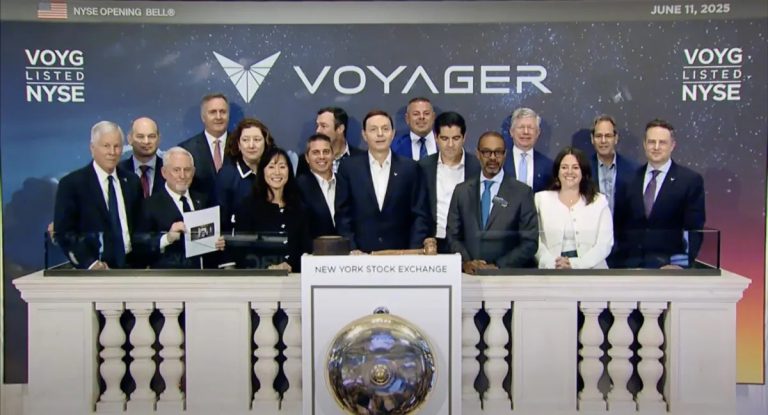
Voyager Technologies soared in its U.S. stock market debut on Wednesday, more than doubling in value and closing with a $3.8 billion valuation—a dramatic entry that underscores investor enthusiasm for the defense and space sector amid growing government support under President Donald Trump.
Shares of the Denver-based company opened at $69.75, jumping 125% from the IPO offer price of $31. The upsized offering raised $382.8 million after Voyager sold approximately 12.4 million shares. The company, which provides mission-critical defense and space technologies, is listed on the Nasdaq under the ticker symbol VOYG.
Founded in 2019, Voyager has quickly become a major player in U.S. defense infrastructure, securing contracts with both the Department of Defense and NASA. Its market entry comes at a time of sweeping policy changes in defense and space spending driven by Trump’s push for strategic autonomy and missile defense expansion.
Register for Tekedia Mini-MBA edition 20 (June 8 – Sept 5, 2026).
Register for Tekedia AI in Business Masterclass.
Join Tekedia Capital Syndicate and co-invest in great global startups.
Register for Tekedia AI Lab.
One of the largest drivers of optimism around Voyager’s public debut is Trump’s proposed $175 billion Golden Dome project, a vast missile defense shield designed to protect the U.S. homeland from long-range threats. The administration has framed the plan as central to its national security strategy, with a focus on technologies like space-based sensors, propulsion systems, and precision optical guidance—areas in which Voyager specializes.
“Strategic government backing amid increased defense spending somewhat shields these firms from tariff-induced supply chain risks,” said IPOX research associate Lukas Muehlbauer.
As of March 31, Voyager reported a backlog of $179.2 million in contracted work, an indicator of sustained demand for its offerings in a sector marked by long development cycles and high entry barriers. The company’s business spans propulsion systems, satellite guidance, spacecraft design, and orbital defense systems.

In 2024, Lockheed Martin selected Voyager to supply critical propulsion and optical systems for missile interceptors, a role integral to the U.S. effort to defend against hypersonic and long-range missile threats. In parallel, Voyager has been tapped by NASA for a $217.5 million project to develop Starlab, a modular orbital outpost intended as a successor to the International Space Station. Voyager is leading the project in partnership with Airbus, Mitsubishi, and Palantir.
The IPO marks the most high-profile space-related listing in months, following the successful debut of Karman, another defense and aerospace firm, whose shares have also doubled since going public. Voyager’s entry confirms growing investor confidence in the commercial space and defense industry, especially companies that are seen as aligned with Trump’s military modernization strategy.
“This IPO is a significant milestone for the broader space sector, indicating its progression towards greater commercial maturity,” said Rob Desborough, managing director at Seraphim Space Investment Trust, one of Voyager’s backers.

The administration’s defense budget proposals, which prioritize space superiority and high-tech military deterrents, have created fertile ground for firms like Voyager. Analysts point out that such strategic policy moves make companies in the sector more resilient to economic uncertainty, including inflationary pressure and international trade tensions.
“Although high entry barriers in the defense sector naturally limit the pool of IPO candidates, the current environment is encouraging established companies to go public,” Muehlbauer added.
Voyager’s offering was further boosted by early commitments from institutional investors. Janus Henderson and Wellington Management had each expressed interest in acquiring up to $60 million worth of Voyager shares, providing an anchor that helped strengthen market confidence ahead of the listing.
The surge in stock price also reflects renewed enthusiasm for space infrastructure investments, which had cooled in recent quarters. The Trump administration’s consistent push for re-militarizing space and insulating defense suppliers from foreign reliance appears to be resetting investor expectations.
While the broader market remains volatile, Voyager’s debut signals a bullish outlook for companies at the intersection of commercial innovation and national security, particularly those backed by strong federal contracts and future-facing projects like orbital habitats and missile defense.
With its debut, Voyager not only joins the growing league of publicly listed space companies—it does so with a war chest and policy tailwinds that suggest its trajectory is only beginning.