

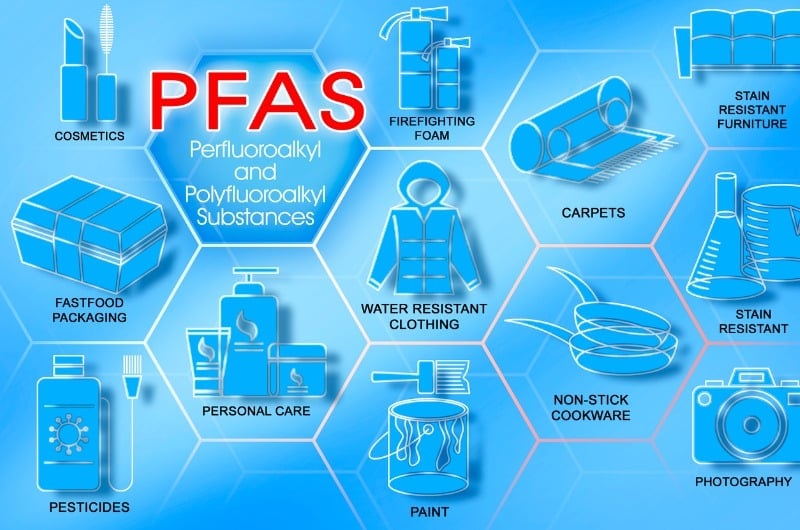
Many industrial breakthroughs appear to be pure progress at launch. They solve stubborn engineering problems, scale quickly, and quietly become the default across sectors. Per- and polyfluoroalkyl substances (PFAS), a large family of fluorinated chemicals, fit that pattern. They offered reliability in high-heat, high-stress environments and spread through manufacturing, consumer goods, and public safety supply chains.
Years later, PFAS are now a case study in how technical success can mature into long-tail exposure for companies, insurers, and governments. The lesson is uncomfortable: when the full lifecycle cost of a chemical is unknown or ignored, the eventual bill tends to arrive through healthcare, cleanup, regulation, and courts.
Why PFAS Became Ubiquitous in High-Risk Industries
PFAS were prized for durability. Their chemistry helps repel water, resist heat, and reduce friction. Those properties made them attractive for applications ranging from coatings and packaging to industrial processes. In public safety, they became closely associated with aqueous film-forming foam (AFFF), which is designed to quickly suppress fuel fires in aviation, refineries, and military settings.
Once a performance advantage becomes embedded in standards and procurement checklists, it is hard to unwind. Buyers rarely have incentives to ask what happens decades later, especially when the downsides are diffuse, delayed, and difficult to measure.
That is how a “best tool for the job” can become a systemic liability shared across manufacturers, distributors, employers, and public institutions.
The Unpriced Cost of “Forever Chemicals”
PFAS are often called “forever chemicals” because many of them persist in the environment and can accumulate over time. Persistence changes the economics of risk. A spill that would normally dissipate becomes a multi-year remediation project. A one-time purchase decision becomes a long-running exposure pathway for workers and communities.
Regulators and researchers continue to refine what is known about health and environmental impacts, but even uncertainty carries a price. It raises compliance costs, expands disclosure obligations, and pushes insurers to reprice coverage or tighten exclusions.
For businesses, the most important point is not the chemistry. It is the externality. When harms land outside the balance sheet at the time of sale, they usually reappear later as legal and economic risk.
Firefighters as a Case Study in Innovation Risk Transfer
Firefighters make the risk-transfer problem visible. AFFF was used in training and response where speed matters and failure is costly. Over time, repeated contact with foams and contaminated environments created a pathway for claims that link occupational exposure to serious illnesses.
This matters beyond the individual stories. Firefighters sit inside public-sector budgets, union negotiations, disability systems, and municipal procurement. When an innovation becomes a suspected exposure driver, it draws in employers, product makers, and public agencies.
In the U.S., that dynamic is playing out through mass tort litigation tied to AFFF and PFAS exposure. For affected individuals and families trying to understand their options, some will choose to hire a PFAS foam cancer attorney to assess eligibility, timelines, and the practical steps involved in pursuing claims.
For executives and policymakers, the takeaway is broader: if the people closest to a product’s real-world use become plaintiffs, the debate shifts from technical merit to accountability, disclosure, and duty of care.
The Legal Fallout: From Product Liability to Public Budgets
PFAS litigation has expanded from individual injury claims into a wider contest over who pays. Product liability arguments focus on what manufacturers knew, what they disclosed, and whether safer alternatives were feasible. Separate disputes target environmental contamination, cleanup costs, and impacts on drinking water systems.
Even when companies settle, the economic effects spread. Legal costs and settlement reserves can affect valuations. Insurers face multi-year uncertainty. Procurement teams get new compliance requirements. Governments must decide whether to absorb costs, pursue reimbursement, or change standards for acceptable materials.
Regulatory Failure and the Cost of Delayed Action
PFAS also illustrate a timing problem in policy. Regulation often trails adoption, partly because agencies lack data early, and partly because industrial ecosystems move faster than rulemaking. The longer the delay, the more entrenched the material becomes, and the harder it is to substitute without disrupting supply chains.
In practical terms, delayed action increases downstream exposure. More users adopt the chemical. More sites become potential contamination points. More people become potential claimants. When regulators later tighten standards, the transition costs hit everyone at once.
A useful reference point is how public agencies describe the challenge. The EPA’s PFAS overview highlights both the breadth of PFAS use and the difficulty of assessing risks across thousands of related compounds.
Lessons for Innovators, Policymakers, and Investors
PFAS should change how innovation risk is priced. Three lessons stand out.
First, lifecycle thinking should be treated as a competitive advantage. Firms that test, disclose, and track downstream effects early tend to face fewer surprises later, even if their short-term costs are higher.
Second, substitution needs governance. Replacing one compound with a close cousin can repeat the same story under a new label. Procurement standards and regulatory frameworks should be designed to prevent “regrettable substitutions” that keep liability alive.
Third, global markets import each other’s problems. African airports, energy facilities, and industrial sites often purchase equipment and materials that conform to U.S. and EU standards. As those regions tighten rules and litigation expands, supply chains and insurance terms shift worldwide.
Our readers have seen related dynamics in debates about hazardous products moving toward weaker enforcement environments, including Tekedia’s forum discussion on toxic chemical exports.
Innovation Without Accountability Is a Balance Sheet Risk
PFAS are a reminder that industrial success can create long-term liabilities that outlive product cycles, executive tenures, and even corporate strategies. The costs show up in areas leaders tend to underestimate: remediation, insurance constraints, procurement disruptions, and years-long litigation.
The next wave of materials science, from advanced polymers to next-generation coatings, will face the same question. Performance will always matter. Accountability, disclosure, and lifecycle risk will increasingly determine whether innovation compounds value or compounds liability.