

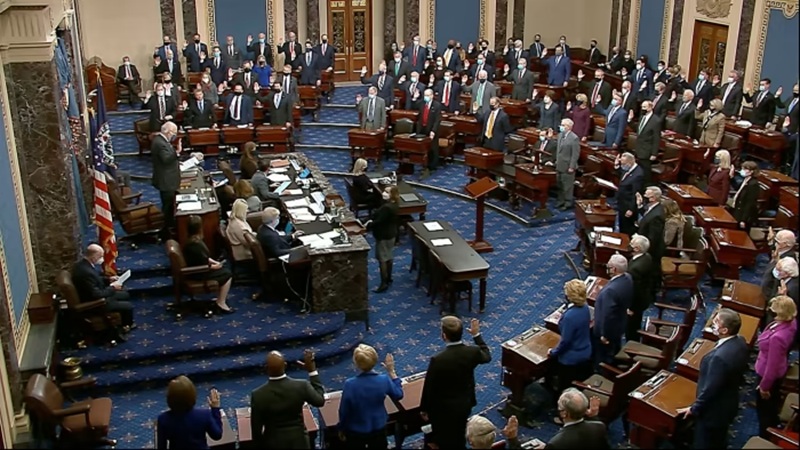
The United States Senate has passed a resolution aimed at ending unauthorized military action against Iran, marking a significant moment in the ongoing debate over war powers, national security, and the role of Congress in foreign policy.
The move reflects growing concerns among lawmakers about the risks of military escalation in the Middle East and underscores the constitutional principle that decisions regarding war should involve legislative oversight rather than unilateral executive action.
The resolution comes amid heightened tensions between Washington and Tehran. Over the years, relations between the two countries have been marked by disputes over Iran’s nuclear program, regional influence, sanctions, and military activities.
These tensions have periodically raised fears of direct military confrontation, with incidents involving missile strikes, naval encounters, proxy conflicts, and attacks on strategic infrastructure across the region.
Register for the next Tekedia Mini-MBA.
Register for Tekedia AI in Business Masterclass.
Join Tekedia Capital Syndicate and co-invest in great global startups.
Supporters of the Senate resolution argue that the United States should avoid becoming entangled in another prolonged conflict in the Middle East without a clear mandate from Congress.
They contend that while the president possesses authority to defend American personnel and interests from imminent threats, launching or continuing broader military operations against Iran requires explicit congressional approval.
This position is rooted in the U.S. Constitution, which grants Congress the power to declare war and serves as a check on executive authority. Advocates of the measure also emphasize the potentially severe consequences of a direct conflict with Iran.

Unlike many previous regional adversaries, Iran possesses a substantial military capability, a network of allied groups throughout the Middle East, and influence over critical shipping routes such as the Strait of Hormuz. A large-scale confrontation could disrupt global energy markets, threaten regional stability, and draw multiple countries into a wider conflict.
By passing the resolution, senators seek to reduce the likelihood of unintended escalation and encourage diplomatic solutions. Critics of the resolution, however, argue that it could limit the president’s flexibility in responding to emerging threats.
They maintain that military deterrence is an essential component of national security and that restricting executive authority may send a signal of weakness to adversaries. Some lawmakers also contend that the commander-in-chief must retain the ability to act swiftly in situations where American lives or strategic interests are at risk.
The resolution does not necessarily guarantee an immediate end to all military-related activities involving Iran.

Depending on its legal framework and subsequent political developments, implementation may face challenges from the executive branch. In some cases, similar resolutions have encountered presidential vetoes or disputes over their practical effect.
The Senate’s action carries substantial political significance by expressing the legislative branch’s position on the use of force and setting the stage for broader debate in Congress. Beyond domestic politics, the decision is likely to be closely watched by international allies and rivals alike.
Many countries in Europe, Asia, and the Middle East have long advocated for diplomatic engagement and de-escalation between the United States and Iran. A congressional effort to restrain military action may be interpreted as a signal that Washington is seeking to prioritize political and diplomatic mechanisms over armed conflict.
The Senate’s passage of the resolution highlights a fundamental question at the heart of American governance: who has the authority to decide when the nation goes to war? As tensions with Iran continue to evolve, the debate over military action, congressional oversight, and diplomatic engagement will remain a central issue shaping U.S. foreign policy and regional stability in the years ahead.