

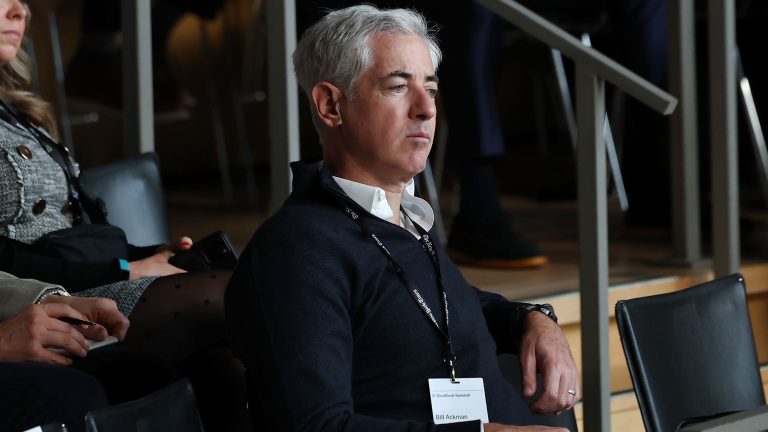
Billionaire hedge fund manager Bill Ackman has put forward what he calls a more practical and strategic alternative to the Trump administration’s sweeping tariff policy, warning that the current path could drag the global economy into a “self-induced, economic nuclear winter.”
In a lengthy social media post titled “How’s this for a simple approach?”, the Pershing Square CEO called for an immediate 90-day pause in reciprocal tariff escalation, arguing that such a window would allow for private negotiations with trade partners. His intervention comes amid mounting concerns from economists and business leaders over the long-term implications of President Donald Trump’s protectionist agenda.
Ackman criticized both the intent and execution of the tariff strategy, saying the administration’s formula for measuring foreign tariffs inflated their size “four times larger than they actually are.” That miscalculation, he said, is now steering the U.S. toward what could be a major economic misstep.
Register for Tekedia Mini-MBA edition 20 (June 8 – Sept 5, 2026).
Register for Tekedia AI in Business Masterclass.
Join Tekedia Capital Syndicate and co-invest in great global startups.
Register for Tekedia AI Lab.
“The global economy is being taken down because of bad math,” Ackman wrote. “The President’s advisors need to acknowledge their error before April 9th and make a course correction before the President makes a big mistake based on bad math.”
Tariff Pause and Realignment
At the core of Ackman’s proposal is the idea of a modest, across-the-board 10% tariff for countries doing business with the U.S.—a blanket fee meant to compensate for America’s longstanding investments in global security and health, as well as past trade deficits. But beyond that, he urged for a targeted, case-by-case approach.
“We keep the pressure on China to resolve materially unfair trading practices, IP theft, currency manipulation, and other practices that have disadvantaged our nation,” he said, emphasizing the need for specificity and diplomacy rather than blanket punishment.

The plan, he noted, would begin with a 90-day halt in tit-for-tat tariff escalation, focusing instead on bilateral talks with countries whose policies have most impacted U.S. competitiveness, especially in manufacturing.
Rethinking Trade Deficits
Ackman also challenged some of the foundational ideas that have shaped Trump’s hardline approach to trade, particularly the obsession with reducing the U.S. trade deficit on a country-by-country basis.
“It does not make sense to have balanced trade with countries that are smaller than us and that have fewer resources to spend on U.S. goods,” he argued. “We will forever be buying more from Madagascar than they will buy from us.”

He warned against using export-import parity as a benchmark, calling it a misguided target for a country like the U.S., which has the largest economy and highest standard of living in the world. Instead, Ackman urged the administration to recognize the value of less visible American exports—such as software, intellectual property, and financial services—that don’t show up in traditional trade data but contribute significantly to the economy.
“If these were included, the balance of trade statistics would look much more balanced,” he said.
He added that U.S. multinationals that operate subsidiaries abroad also generate returns in the form of profits, dividends, and strategic influence, even though those revenues are often missing from standard trade metrics.
Manufacturing Realities
Ackman, whose investment firm manages billions in assets, also dismissed the idea of bringing low-wage manufacturing back to the U.S., calling it economically unrealistic and strategically flawed.
“Attempting to bring back jobs in low-wage manufacturing is not good for America,” he said, noting that countries like Bangladesh and Vietnam are naturally better suited for industries such as textile and footwear production.
Instead, he encouraged U.S. policymakers to embrace high-value services and technology exports as the new face of global competitiveness.
A Plea for Prudence
In his closing remarks, Ackman acknowledged the flaws in the existing global trade system but cautioned against tearing it down without a viable plan to replace it.
“The current trading system, while far from perfect or fair to the U.S., has served us extremely well,” he wrote. “We need to be prudent in how we change it so as not to upset the world order in such a manner that it disadvantages our country over the long term.”
The post shared just days before a critical April 9th deadline for the next wave of tariff decisions marks one of the strongest warnings yet from a Wall Street heavyweight about the potential cost of Trump’s approach.
However, it is not clear if the Trump administration will take the advice. Trump has doubled down on the tariff policy, calling on Americans to support it as it’s meant to make the economy better.
“The United States has a chance to do something that should have been done DECADES AGO. Don’t be Weak! Don’t be Stupid! Don’t be a PANICAN (A new party based on Weak and Stupid people!). Be Strong, Courageous, and Patient, and GREATNESS will be the result!” The president said on Monday.
However, with global markets showing signs of strain and recession alarms sounding in key economies, the pressure is mounting for a recalibration. Ackman, like several other investors, is calling for a replacement of hardline posturing with intelligent recalibration, before the U.S. ends up isolating itself in a trade war of its own making.