
DD
MM
YYYY

PAGES

DD
MM
YYYY

spot_img

PAGES

Home Blog

What Artemis II’s Success Means for Private Space Companies

0

NASA’s Artemis II mission, which successfully concluded its 10-day lunar flyby on April 11, 2026, has officially cleared the path toward establishing permanent human operations on the Moon. As the first crewed lunar expedition since 1972, it was both a significant scientific milestone and a driver for reshaping the space industry by providing new business opportunities to private firms like SpaceX and Blue Origin.

Artemis II — the first mission of NASA’s extended lunar exploration program — was a 10-day mission to the Moon. Unlike future operations, it did not include a landing, but aimed to test essential systems and validate the Orion spacecraft and life-support technologies for future Moon landing missions. As a whole, the program had two main goals: bring humans back to the Moon and create a permanent lunar base that will later serve for future Mars missions. This serves as a vital link between previous uncrewed missions and upcoming landing operations.

The successful execution of Artemis II has provided the architectural validation necessary to move from experimental flights to advanced mission phases, including lunar landings and base construction operations. The mission represented a fundamental transformation in the space industry, affecting all aspects of space research activities.

It operated through NASA’s Space Launch System (SLS) and Orion spacecraft, built by traditional aerospace contractors. These systems faced criticism as their launch costs reached between $2 billion and $4 billion and depended on non-reusable equipment. The situation became critical, highlighting how existing systems rely on outdated methods, while new commercial systems opt for reusable components to reduce operational costs — creating an opportunity for private players to step in.

The Artemis program gave significant advantages to SpaceX and Blue Origin within the operational framework, as these firms have essential functions for future missions. NASA has already awarded contracts to these companies to develop lunar landing systems, making them essential partners for the next program development stages. Given this strategic support and industry leadership, Musk’s company may effectively appear on market and premarket movers lists once it completes its IPO, which is expected later this year.
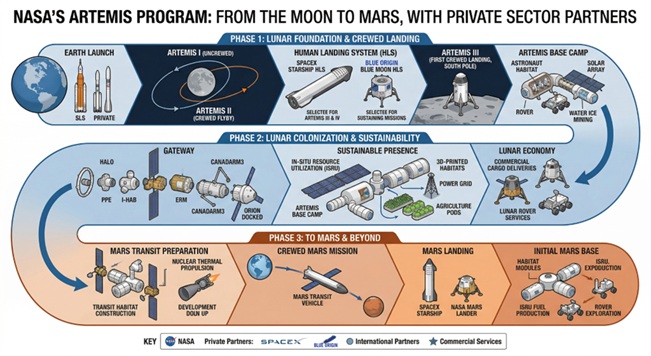
The Artemis II mission demonstrated spacecraft design for permanent Moon operations, enabling private companies to enhance their capabilities across transportation activities, cargo handling tasks, and infrastructure building.

The implications are far-reaching. Artemis II reflected how space exploration has evolved from a government-exclusive domain into a new system in which private companies play a leading role. By showing what traditional systems can achieve and where their limits lie, the mission provided evidence that commercial providers should receive greater operational control over space activities. This development will potentially intensify competition across the industry, resulting in lower costs and creating a lunar economy that involves multiple business partners.

The system confirms NASA’s current technological capabilities while accelerating the integration of commercial partners into the project, thereby creating a new era of cooperation between government and private companies aimed at expanding human presence beyond Earth.


How Nordic Casino Sites Keep Up With New Web Trends

0

Nordic casino sites once felt like wood cabins in deep snow. Locals played a quick round there after work. Now they feel like bright online halls that stay open day and night on every screen. That change did not come in one rush. It grew from better tech and faster web speed. Users also wanted games near them on the bus or late at night. Many people who search for Revolut Casino picks read reviews on norge-casino.com first. Those reviews help them check fees and bonus deals before they try poker plans. Site teams watch how users sign in, pay in, and chat with friends. That gives them a view of what feels easy, safe, and fun. This piece looks at four shifts: phone design, new pay tools, smart data use, and fair rules. Put them side by side, and you can see how a cold region stays hot in online play.

The Shift To Phone First Design

Back in 2013, a Nordic casino lobby on a phone felt slow and awkward. Users had to zoom in on tiny keys and wait for loud ads to load. Now the same lobby opens fast and fits the hand with less fuss. Sites in Sweden, Norway, and Finland are now built for small screens first. Then they scale the look up for large screens. Icons stay big for a thumb. Menus fold into clean bars. Game tiles fit tall phone screens and do not hide the prize size. Teams now use HTML5, not old plug-ins, so a phone does not lose charge so fast. Push notes matter too. Users get soft alerts when a weekend event starts. They also get them when a loved slot hits a top mark. These steps do more than look new. They help users stay, because three easy taps feel far better than one bad minute.

Using New Local Ways To Pay

Fast and known ways to pay matter almost as much as the games. Nordic users like tools that move at the same pace as local bank apps. Casino sites saw that need and moved with it. Cards still have a place. Many sites now add fast bank moves through Trustly and phone wallets like Vipps. Some Finnish sites test e-ID tools that check the user and payment at once. That cuts forms and keeps key data safe. Revolut and other new banks also gain ground. They let users hold more than one cash type in one app. They also trim swap fees on bets across borders. When sites link open bank tools to the cash desk, users see funds in seconds. Some also get cash out by the next cup of coffee. That speed builds trust fast. Sites pair it with fraud checks that spot odd acts, like a late spree from a new phone.

Using Data To Shape The Visit

Luck may rule a spin, yet data shapes the trip that leads to it. Nordic casino sites track liked games and stay time. Some also note the sound level each user likes best. Then they use that view to shape the next visit. Instead of a flat wall of random slots, the lobby may show the user’s top games first. It may also add a new game with a close feel. These match tools work a bit like film apps. They study what many users pick and find links in those moves. Bonus deals follow the same path. A live blackjack fan may get free chips for the next live table. That works better than a weak slot gift. Sites still keep data care near the top. Nordic lands take data rights with care. Sites hide names in files and let users turn off tracking with one click. That leaves users seen, not chased, and the visit feels fresh, fair, and fun.

Safe Play And The Rules Ahead

Online growth brings new duties. Nordic law teams keep changing rules so quick play does not bring quick harm. Casino sites answer by putting safe play tools deep in the site from the first step. Pay caps, time notes, and fast self-ban keys show up at sign-up. Users do not need to hunt through menus to find them. Some sites test mood checks that read mouse speed and key slips to spot stress. When risk goes up, the site stops the game and gives the user a short break. That pause can save cash before a bad run gets worse. Ad rules have changed as well. Sweden now limits bonus deals and blocks loud pop-up ads that may push calm users too hard. Norway also blocks pay paths from sites with no local right to serve users. To sum up, these rules may feel strict, yet they build trust that lasts. Many experts now expect shared Nordic rules, plus fair checks and game logs users can test in seconds.

How Distributed Energy Systems Are Reshaping Everyday Infrastructure

0

Energy systems are changing in ways that are no longer limited to large power plants or utility networks. Today, energy is increasingly generated, stored, and used at the household level, creating what is known as distributed energy systems. These systems include technologies like rooftop solar, battery storage, and solar-powered hot water, solutions that are quietly transforming how homes operate.

In Australia, this shift is particularly visible. With abundant sunlight and strong policy support for renewables, households are becoming active participants in energy production rather than just consumers. This transformation is not only reshaping infrastructure but also redefining how everyday systems inside the home function.

What Distributed Energy Systems Actually Mean

Distributed energy systems refer to energy sources that are located close to where the energy is used, rather than being generated at a central location and transmitted over long distances. In practical terms, this means homes producing their own energy through solar panels or storing energy in systems like batteries and hot water tanks.

This approach reduces reliance on the traditional grid while improving efficiency. Instead of energy being lost through transmission, it is used directly where it is generated.

In Australia, this model is becoming increasingly common, especially in suburban areas where rooftop solar installations are widespread. It represents a shift toward more resilient and self-sufficient homes.

How Solar Hot Water Fits Into This Shift

One of the most practical examples of distributed energy in everyday life is solar hot water. Unlike traditional systems that rely entirely on electricity or gas, solar hot water uses sunlight to heat water directly, reducing both energy costs and environmental impact.

For homeowners exploring ways to upgrade their systems, choosing to use solar hot water brisbane is not just about efficiency, it reflects a broader move toward integrating renewable energy into daily routines. These systems operate quietly in the background, yet they significantly reduce reliance on external energy sources.

In regions like Queensland, where sunlight is abundant, solar hot water systems have become a practical and widely adopted solution.

Turning Everyday Systems Into Energy Assets

One of the most interesting developments in distributed energy is the idea that everyday household systems can act as energy storage. Hot water systems, for example, can store energy in the form of heat, which can be used later when needed.

Research supported by the Australian Renewable Energy Agency shows that smart hot water systems can be used to absorb excess solar energy during the day and reduce strain on the electricity grid.

This means that something as routine as heating water can play a role in stabilising energy supply and improving overall efficiency. It transforms everyday infrastructure into an active part of the energy system.

Reducing Costs and Environmental Impact

Photo by Red Zeppelin on Unsplash

One of the main drivers behind distributed energy adoption is cost. Systems like solar hot water significantly reduce energy bills by using renewable energy instead of grid electricity or gas.

In Australia, where water heating accounts for a large portion of household energy use, switching to solar can lead to substantial savings over time. Studies show that solar hot water systems can reduce water heating costs by a large margin while also lowering greenhouse gas emissions.

Beyond financial benefits, these systems contribute to a broader reduction in environmental impact. Lower reliance on fossil fuels means fewer emissions and a smaller carbon footprint for households.

Designing Homes Around Decentralised Energy

As distributed energy becomes more common, homes are increasingly designed with these systems in mind. Instead of adding solar or storage solutions as upgrades, new builds are integrating them from the start.

This includes positioning roofs for optimal solar exposure, incorporating efficient plumbing layouts, and ensuring compatibility with energy storage systems. The goal is to create homes that are not only energy-efficient but also capable of adapting to future technologies.

In Australia, this approach is becoming part of modern building practices, particularly in regions where sustainability and energy independence are priorities.

The Future of Infrastructure Starts at Home

The shift toward distributed energy is changing the definition of infrastructure itself. Instead of relying solely on large-scale systems, energy is now being generated and managed at the household level.

This decentralisation creates a more flexible and resilient system overall. Homes can reduce their dependence on the grid, manage their own energy use, and even contribute to stabilising the broader network.

As technologies continue to evolve, the role of everyday systems, like solar hot water, will become even more important. What was once considered a simple household function is now part of a much larger transformation.

In the end, distributed energy systems are not just about technology, they are about changing how homes interact with energy. By integrating these systems into daily life, households are shaping a future where infrastructure is smarter, more efficient, and built around the needs of everyday living.


Hedge Fund, Jain Global, Returns Capital, Strike Exclusive Mandate with Millennium in Shift Toward Platform Model

0

A marquee hedge fund launch is changing course less than two years after its debut, with Jain Global set to return external capital and run money solely for Millennium Management—a move that highlights the growing pull of large, centralized trading platforms over standalone firms.

The arrangement, outlined in an internal memo from Millennium and confirmed by people familiar with the matter cited by Business Insider, will give Millennium exclusive access to Jain Global’s full investment capacity once the transaction closes in the coming months. The firm will keep its own investment processes, operating model, and staff, but will no longer manage money for a broad base of outside investors.

“Under the proposed agreement, Millennium will have exclusive access to the full investment capacity of Jain Global’s multi-strategy business,” wrote president and chief operating officer Ajay Nagpal. “Jain Global will remain an independent firm, retaining its own investment processes, operating model and talent base.”

The pivot comes after a difficult start for one of the industry’s most ambitious recent launches. Backed by $5.3 billion in commitments at inception in 2024, Jain Global built out a global operation spanning six offices and more than 400 employees, roughly half of them investment professionals. It now oversees about $6 billion across seven trading businesses covering a wide range of asset classes.

Yet scale has not translated into competitive returns. The firm gained 3.7% in 2025, its first full year of trading, trailing peers as high operating costs, staffing, data, technology, and execution infrastructure cut into performance. Those pressures have become more acute as institutional investors demand tighter fee structures and more consistent risk-adjusted returns.

The decision to return capital underlines that reality. Running a multistrategy firm with hundreds of employees requires a steady base of funding and a tolerance for early-stage volatility that many investors have become less willing to absorb. By stepping away from external capital, Jain Global removes the immediate pressure to meet redemption cycles and performance benchmarks set by a diverse investor base.

Founder Bobby Jain, a former co-chief investment officer at Millennium, told staff the transition would be operationally straightforward.

“The way we have structured our business, our processes, our risk it all rhymes with Millennium’s. That makes this as smooth a transition as possible,” he said on an internal call, according to a person familiar with the discussion.

For Millennium, the deal offers a different form of expansion. Instead of hiring and building new trading teams internally, it secures access to an existing platform with established strategies and personnel. The firm has long been a dominant force in the so-called pod model, allocating capital across semi-autonomous teams while tightly controlling risk and leverage at the central level.

This approach has reshaped the industry’s competitiveness. Large platforms like Millennium provide traders with capital, technology, execution capabilities, and risk oversight, allowing them to focus on generating returns. In exchange, the platform captures a share of profits and maintains strict controls over drawdowns.

Replicating that infrastructure is costly and time-consuming for independent firms. Jain Global’s experience underscores how difficult it has become to build a multistrategy business outside that ecosystem, even with a high-profile founder and significant initial backing.

The partnership effectively blends the two models. Jain Global retains its identity and internal processes, but gains access to Millennium’s balance sheet, infrastructure, and long-term capital base.

“For Jain Global, this partnership unlocks the full platform advantages of Millennium, including our infrastructure, resources and stable longer-term capital structure,” the memo said. “We collectively believe this partnership will materially accelerate Jain Global’s growth while reinforcing the attributes which have contributed to its early success.”

The move also reflects a broader consolidation trend in the hedge fund industry. Over the past decade, capital has increasingly flowed toward large, diversified platforms that can offer steadier returns and tighter risk management. However, rising costs, from data and compliance to technology and talent, have raised the barrier to entry for new firms.

In that environment, the traditional path of launching a standalone hedge fund and scaling through external allocations is becoming less viable. Instead, managers are either joining established platforms or forming closer partnerships with them, trading independence for stability and operational support.

Jain Global’s pivot illustrates that shift in stark terms. What began as a high-profile attempt to build a multibillion-dollar firm from the ground up is now evolving into a more integrated model, tied to one of the industry’s largest players.

The situation raises questions about access for investors. Returning capital means fewer opportunities to allocate to new multistrategy platforms, while reinforcing the dominance of firms like Millennium that already command significant market share. It also signals industrial recalibration. Scale, infrastructure, and capital stability are becoming as important as investment performance in determining which firms can endure. In that context, the line between independent hedge funds and platform affiliates is becoming increasingly blurred.

Spotify Moves Into Digital Fitness With Peloton Partnership, Testing New Revenue Model Beyond Streaming

0
London, UK - August 01, 2018: The buttons of Spotify, Podcasts, Netflix, WhatsApp and Music on the screen of an iPhone.

Spotify has struck a wide-ranging partnership with Peloton Interactive to bring more than 1,400 instructor-led classes onto its platform, marking a deliberate expansion into the global wellness market as it looks to reduce reliance on music and podcast revenues.

The integration will give Spotify Premium users access to Peloton’s catalogue of workouts, including strength training, yoga, Pilates, barre, and meditation — directly within the app. The content will sit alongside Spotify’s existing audio and video offerings, extending its role from passive listening to structured, habit-driven engagement.

The shift is rooted in user behavior. Spotify says more than 150 million fitness playlists are already active globally, while nearly 70% of its Premium subscribers report exercising monthly.

“Fitness is a natural extension of how people already use Spotify today — to get motivated, recover and reset,” a company spokesperson said.

What is changing is how that behavior is being monetized. Fitness content, unlike music streaming, is not bound by the same licensing economics that have historically constrained margins. It is also inherently repeatable, lending itself to subscription layering, premium tiers, and targeted advertising tied to user routines. In effect, Spotify is moving into a category where it can exercise greater control over pricing and content distribution.

The company is also extending its creator model into the fitness space. By working with instructors such as Yoga With Kassandra, Caitlin K’eli Yoga, Sweaty Studio, and Chloe Ting, Spotify is positioning fitness creators within the same ecosystem that has supported podcast growth. The aim is to build a marketplace where instructors can monetize audiences through subscriptions and engagement tools, while Spotify captures a share of that value.

For Peloton, the agreement indicates a structural pivot. Once defined by its connected fitness equipment, the company has been reorienting toward a content-led model as hardware sales stabilize. The Spotify partnership offers distribution at scale without the friction of hardware ownership or standalone app subscriptions.

“As we continue to forge a path deeper into wellness, our work with Spotify is just our latest move to expand our reach and capture new revenue streams through Peloton’s unmatched experience, content and instruction,” said chief commercial officer Dion Camp Sanders.

Chief executive Peter Stern underscored the reach advantage, noting: “Spotify provides a global stage for our instructors, in which they have now the ability to meet hundreds of millions of Spotify Premium subscribers.”

The commercial logic for both sides is tied to scale. Peloton gains access to a global audience without incurring the same customer acquisition costs associated with direct subscriptions. Spotify, in turn, strengthens user retention by embedding itself deeper into daily routines, from commuting and leisure to exercise and recovery.

The move also places Spotify more directly in competition with platforms that already blend content and wellness, including Apple’s fitness ecosystem and video-driven fitness communities on YouTube. Unlike those rivals, Spotify’s advantage lies in its recommendation engine and existing user base, which can be leveraged to surface fitness content with minimal friction.

But there are broader implications for the streaming model. For years, Spotify has faced pressure over margins due to high royalty payouts to music rights holders. Expanding into adjacent verticals, such as fitness, offers a pathway to diversify revenue while maintaining engagement within a single platform. It also comes as part of a wider industry trend where large technology platforms are evolving into multi-purpose ecosystems rather than single-category services.

Thus, the challenge for Peloton will be maintaining brand identity and pricing power as its content becomes more widely distributed. Greater reach can drive growth, but it also risks commoditizing premium offerings if not carefully managed.

Neither company disclosed financial terms, but the partnership signals a clear alignment of priorities: Spotify is building a broader digital environment anchored in daily habits, while Peloton is repositioning itself as a global fitness content provider rather than a hardware manufacturer.

The outcome is expected to rely largely on users’ attitudes. If users adopt structured workouts within a platform originally designed for entertainment, Spotify will convert the engagement into sustained revenue.