DD
MM
YYYY

PAGES

DD
MM
YYYY

spot_img

PAGES

Home Blog

Best Crypto to Buy Now: DeepSnitch AI Surpasses HYPE and STABLE With 150% Price Surge as the DOJ Concludes $400M Seizure

0

The Department of Justice (DOJ) has finalized a court order declaring the United States government the titleholder of seized cryptocurrencies and digital assets associated with Helix’s operations from 2014 to 2017.

This development comes as DeepSnitch AI overshadows major cryptocurrencies, with its price surging 150% amid its ongoing presale. The rally propelled the price to $0.03755 as the project raised $1.41 million.

Many now say DeepSnitch AI may be on the verge of soaring one hundred-fold as they anticipate its exchange debut. As a result, DeepSnitch AI could be the next crypto to buy now.

DOJ concludes $400M seizure in Helix case

According to a report on January 29, the US Department of Justice closed the case against the Bitcoin-era darknet mixing service provider Helix, sanctioning the forfeiture of over $400 million in cryptocurrencies and digital assets.

The assets were seized from Helix operator Larry Harmon between 2014 and 2017. Helix was developed to hide Bitcoin transactions on darknet markets.

On January 21, the US District Court for the District of Columbia issued an order that formally transferred ownership of the seized assets to the government. Henceforth, all assets previously owned by Helix have become properties of the United States.

Which of the trending coins this week can rise 100x in 2026?

1. DeepSnitch AI poised as the next crypto to 100x as demand jumps

DeepSnitch AI is taking a systematic approach to reduce guesswork in trading and investing and replace it with actionable, data-driven execution.

By leveraging five AI agents that gather real-time intelligence across several chains, DeepSnitch AI can help retail investors make well-informed investment decisions based on market sentiment and institutional demand.

SnitchScan, SnitchGPT, SnitchCast, SnitchFeed, and AuditSnitch are the five AI agents DeepSnitch AI creators built, and each has been integrated into a live dashboard that allows them to function simultaneously.

To access them, you have to be a DSNT holder. DSNT is currently in stage four of its presale, selling for $0.03755, with over $1.41 million raised.

Recently, DeepSnitch AI launched a bonus program for presale investors, allowing them to increase their holdings up to 3x right after purchase. This bonus is one of the reasons DeepSnitch AI is among the trending coins this week.

2. Hyperliquid price prediction: Commodity market explosion drives 24% rally

Following an explosion in commodity trading on Hyperliquid, HYPE surged 37.3% to $31.20. Silver became the most traded asset on the exchange during the Asian session.

Around the same time, Bitcoin and Ethereum recorded the highest trading volume among cryptocurrencies on Hyperliquid. This surge in activity prompted a response from the exchange’s CEO, Jeff Yan.

Also, the co-founder of Hyperliquid, Jeff, noted that Hyperliquid had become the most liquid market for crypto price discovery. Due to this momentum across the board, HYPE is expected to keep increasing in market value.

3. Stable price prediction: Why is the asset pumping?

Stable is one of the trending coins this week and possibly one of the top cryptocurrencies to buy today. Over the past seven days, Stable has gained 30% in value, hitting $0.025.
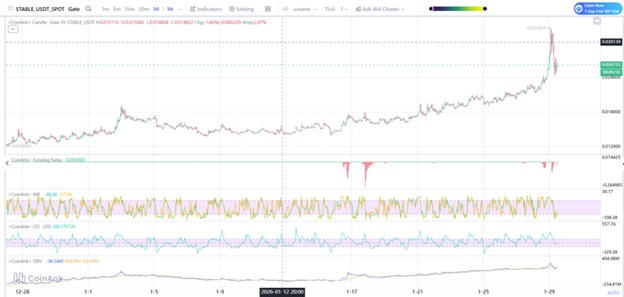
This upswing has been attributed to a confirmed imminent network upgrade and short liquidation in the Stable perpetual market.

The Stable team announced that the v1.2.0 mainnet upgrade is scheduled for February 4, switching gas fees to USDT0 and eliminating extra wrap and unwrap steps on the network.

With these improvements, Stable could surge even higher, probably touching $0.030 in the coming days.

The bottom line

Despite the positive performance of HYPE and STABLE, DeepSnitch AI outperformed both altcoins, posting a 150% gain while still in its presale stage. This performance has stoked forecasts that it could be the next crypto to 100x.

DeepSnitch AI’s native token currently costs $0.03755, but not for long, as demand continues to accelerate. Also, the recent bonus structure, which allows investors to use the codes DSNTVIP150 or DSNTVIP300 to claim 150% and 300% bonuses on purchases above $10k and $30k, respectively, further adds to the allure.

Visit the official website for more information, and join X and Telegram for community updates.

FAQs

1. What is the best crypto to buy now?

The best crypto to buy now, based on market preference, is DeepSnitch AI, a presale token with potential to be the next crypto to 100x.

2. What are the top cryptocurrencies to buy today?

Based on the last seven days’ performance metrics, DeepSnitch AI, Stable, and HYPE would be the top cryptocurrencies to buy today due to their resilience amid the marketwide drawdown.

3. Which of the trending coins this week can soar 100x?

Given its low-cap status, growing retail attention and adoption, and clear utility, many predict DeepSnitch AI could rise 100x before this year ends.


India Considers Teen Social Media Ban as Global Momentum Builds After Australia’s Move

0

A proposal by an ally of Indian Prime Minister Narendra Modi to ban social media use for children is gaining attention not just for its domestic implications, but for what it could mean globally if the world’s most populous country follows a growing international trend sparked by Australia.

The draft legislation, introduced by lawmaker L.S.K. Devarayalu of the Telugu Desam Party, would prohibit anyone under the age of 16 from holding a social media account, placing full responsibility for age verification and enforcement on the platforms themselves. While the bill is a private member’s proposal and not formal government policy, its emergence reflects a broader political and regulatory shift underway in multiple countries after Australia’s decision to impose the world’s first nationwide ban on social media access for teenagers.

Australia’s move, enacted last month, has become a reference point in global policy circles. The government framed the ban as a response to mounting evidence linking excessive social media use among teens to anxiety, depression, cyberbullying, and sleep disorders. Early indications from Australia — including strong public support from parents and educators and the absence of major social disruption — have emboldened other governments to consider similar restrictions, even in the face of fierce opposition from technology companies.

France has moved quickly. Its National Assembly has backed legislation to bar children under 15 from accessing social media platforms, arguing that existing self-regulation by tech firms has failed to protect minors. In Britain, the government is examining age-based access limits as part of a broader review of online safety laws, while Denmark and Greece have launched policy studies focused on youth mental health and digital addiction. Canada, Germany, and Ireland have also reopened debates around minimum age requirements, parental consent frameworks, and stricter enforcement obligations for platforms.

Against this backdrop, India’s entry into the debate carries outsized significance. With roughly one billion internet users and about 750 million smartphones in circulation, India is the largest growth market for global platforms such as Meta’s Facebook and Instagram and Alphabet’s YouTube. Any meaningful restriction on youth access would immediately affect tens, if not hundreds, of millions of users — far more than in Australia or any European country.

Devarayalu has framed the issue as both a child-safety concern and a question of national interest. He has argued that Indian children are becoming addicted to social media at the same time the country is supplying enormous volumes of behavioral data to foreign companies. That data, he said, is then used to build advanced artificial intelligence systems, with the economic and strategic benefits accruing outside India.

His bill explicitly shifts the burden of compliance onto social media companies, requiring them to disable underage accounts and prove they have effective age-verification systems in place.

The proposal also aligns with a growing narrative within the Modi administration around data sovereignty and digital self-reliance. India has repeatedly signaled discomfort with a model in which global technology firms extract value from Indian users without commensurate local benefits. The government’s chief economic adviser reinforced this view last week by saying India should consider age-based access policies to tackle what he called “digital addiction,” a remark that suggested the issue is now being discussed at the highest levels of economic policymaking.

Technology companies have responded cautiously. Meta has said it supports parental oversight and age-appropriate experiences but has warned that outright bans could drive teenagers toward unregulated or less safe online spaces. Alphabet’s YouTube and X have declined to comment on the Indian proposal, while India’s IT ministry has so far remained silent, indicating that the government may be weighing its options rather than rushing to endorse the bill.

Enforcement remains a central challenge, particularly in a country as large and diverse as India. Critics of similar laws elsewhere argue that age verification at scale raises privacy concerns and may be difficult to implement without excluding legitimate users or creating new risks. Supporters counter that Australia’s experience shows governments can move beyond voluntary safeguards and force platforms to take responsibility for the harms linked to youth engagement.

What distinguishes India from other countries considering similar bans is sheer scale. If New Delhi were to adopt age-based restrictions on social media, it would not only reshape the daily digital habits of millions of children but also alter the growth trajectory of global platforms that increasingly depend on emerging markets. For Big Tech, an Indian ban would represent a far more serious commercial and strategic shock than Australia’s, simply because of the size of the user base involved.

Even if Devarayalu’s bill does not pass in its current form, it is likely to trigger sustained parliamentary debate and push the government closer to formal action. However, India’s deliberations suggest that age limits on social media are moving from the fringes of policy discussion into the global mainstream – following Australia’s lead.

Presco Reports N178.56 Billion Profit Before Tax for FY 2025

0

Presco Plc’s 2025 full-year numbers tell the story of an agro-industrial company that has moved decisively into a higher earnings bracket, leveraging scale, pricing power, and regional expansion to deliver one of the strongest performances on the Nigerian Exchange in the past year.

The palm oil producer reported a profit before tax of N178.56 billion for the year ended December 31, 2025, a 57.3% jump from N113.53 billion in 2024, according to its unaudited financial statements filed with the Exchange on January 30, 2026. That growth came despite sharply higher costs, rising finance charges, and a more volatile operating environment, underscoring how far Presco’s earnings capacity has expanded.

At the heart of the performance was revenue, which surged by nearly 60% to N331.19 billion from N207.50 billion a year earlier. Almost all of that came from crude and refined palm oil sales, which contributed N330.94 billion, highlighting how central Presco’s vertically integrated palm oil value chain has become to its growth story. Higher volumes, firmer pricing, and increased refining output combined to lift top-line performance, even as inflation continued to push up input costs.

The strength of the year was particularly evident in the final quarter. After a softer third quarter that reflected seasonal factors and cost pressures, Presco posted a sharp rebound in the last three months of the year, effectively carrying full-year earnings. That late surge helped cement management’s confidence to propose a N72 billion dividend, reinforcing the company’s standing as one of the Exchange’s most consistent and generous dividend payers.

Operationally, the numbers point to strong leverage. Operating profit before finance costs rose by 70.1% to N214.39 billion, compared with N126.10 billion in 2024. Gross profit climbed 63.1% year on year to N228.21 billion. These gains show that Presco was able to grow earnings faster than costs, even as inflation, logistics challenges, and currency pressures continued to weigh on Nigerian manufacturers.

Net profitability was even more striking. Profit after tax jumped by 76.7% to N138.12 billion from N78.10 billion, pushing basic earnings per share to N134.38, up from N74.01 in the prior year. For equity investors, this combination of earnings growth and dividend expansion has significantly altered Presco’s valuation profile, shifting it from a steady agro-industrial stock into a clear high-growth income play.

That said, 2025 was not without pressure points. Costs rose sharply as the company expanded capacity and deepened its regional footprint. Cost of sales increased by 81.7% to N102.98 billion, reflecting higher fertilizer prices, energy costs, and general inflation across agricultural inputs. Administrative expenses rose by 48.8% to N53.72 billion, while selling and distribution costs nearly tripled to N4.02 billion as Presco invested more heavily in logistics, market development, and workforce expansion.

Finance costs were one of the fastest-growing line items, climbing to N43.62 billion from N12.79 billion in 2024. This jump was driven by higher borrowings, used largely to fund expansion projects and acquisitions. While this weighed on net margins, the impact was cushioned by strong operating cash flows and the sheer scale of earnings growth during the year.

The balance sheet expansion in 2025 was just as dramatic as the income statement. Total assets ballooned to N833.40 billion from N475.10 billion a year earlier, reflecting both organic growth and strategic transactions. A major driver was Presco’s decision to acquire the remaining minority stake in Ghana Oil Palm Development Company, taking its ownership from 52% to 100%. That move not only simplified the group structure but also gave Presco full control over one of West Africa’s key palm oil assets.

Current assets more than tripled, pointing to higher inventories, receivables, and cash balances as operations scaled up. Shareholders’ equity surged to N426.66 billion from N211.20 billion, supported by retained earnings and fresh capital raised through a rights issue. The capital raise strengthened financial flexibility, giving Presco room to invest in plantations, mills, and refining capacity without over-stretching its balance sheet.

Borrowings more than doubled to N18.04 billion from N8.90 billion, contributing to higher liabilities and explaining part of the rise in finance costs. Even so, leverage remains modest relative to earnings, suggesting the company still has headroom to fund further expansion if needed.

Geographically, Presco’s expansion across West Africa is beginning to show up in the numbers. Full control of Ghana Oil Palm enhances regional scale and positions the group to tap export markets more aggressively, particularly in Europe, where demand for sustainably sourced palm oil remains strong. This regional footprint also provides some insulation against localized shocks in Nigeria, although it exposes the company to broader currency and regulatory risks.

The dividend story remains central for shareholders. The proposed N72 billion dividend for 2025 marks another step up in payouts, following N42 billion paid for the 2024 financial year and roughly N26.3 billion distributed in 2023. Over three years, Presco has more than doubled its dividend payout, mirroring the rapid expansion of its profit base and reinforcing its reputation as a reliable income stock.

Overall, Presco’s 2025 results show a company that has successfully scaled its operations at a time when many manufacturers are struggling with costs and demand uncertainty. The challenge ahead will be sustaining this momentum as rising finance costs, ongoing inflationary pressures, and the execution risks that come with regional expansion will test management in 2026.

Still, with a stronger balance sheet, expanding assets, and a proven ability to convert growth into cash returns for shareholders, Presco enters 2026 from a position of strength rather than defense.

China’s Factory Activity Slides Back Into Contraction, Exposing Fragile Recovery and Mounting Policy Dilemmas

0

China’s manufacturing sector stumbled at the start of the year, reinforcing concerns that the economy is entering 2026 with weakening momentum and unresolved structural strains, even as policymakers intensify efforts to pivot growth toward domestic demand.

Official data released on Saturday showed the manufacturing purchasing managers’ index (PMI) fell to 49.3 in January from 50.1 in December, slipping back below the 50 mark that separates expansion from contraction, according to Reuters. The reading undershot market expectations of 50.0 and marked a clear reversal from the modest improvement seen at the end of last year, suggesting that factories are once again struggling to secure sufficient demand to sustain output.

The deterioration was evident across key sub-components. New orders dropped to 49.2 from 50.8 in December, pointing to a slowdown in domestic demand at the very start of the year. New export orders declined further to 47.8 from 49.0, highlighting renewed pressure on external demand despite exports having played a crucial role in propping up growth through much of 2025. Together, the data signal that both domestic and overseas demand are faltering simultaneously, a combination that leaves manufacturers with few buffers.

Weaknesses extended beyond factories. The non-manufacturing PMI, which captures services and construction activity, slid to 49.4 from 50.2 in December, its lowest level since December 2022. That decline underscores that services consumption, which authorities increasingly view as the next engine of growth, is also losing momentum. Construction activity remains constrained by the prolonged property downturn, while consumer-facing services continue to suffer from cautious household spending.

Huo Lihui, a statistician at the National Bureau of Statistics, noted that some manufacturers typically enter a seasonal lull in January and said market demand remains weak. While seasonality may partly explain the slowdown, economists say the scale and breadth of the contraction point to more persistent issues, particularly the lack of confidence among households and private firms.

China met its official growth target of about 5% last year, an outcome that offered political reassurance but masked growing imbalances. Export strength, helped by competitive pricing and firms rushing shipments ahead of anticipated trade restrictions, offset domestic softness. That strategy now looks increasingly fragile as trade tensions with the United States intensify under President Donald Trump’s renewed tariff push, and as global demand shows signs of cooling.

At home, consumption remains the weakest link. Retail sales growth softened further toward the end of last year, contributing to fourth-quarter GDP growth slowing to its weakest pace in three years. Job insecurity, subdued wage growth, and lingering stress in the property sector have continued to weigh on household confidence. For many consumers, precautionary saving remains a rational response to uncertainty, blunting the impact of policy support.

Beijing has begun deploying targeted fiscal measures in response. Authorities recently front-loaded 62.5 billion yuan ($8.99 billion) from ultra-long special treasury bonds to fund subsidies encouraging consumers to replace goods such as home appliances, vehicles, and smartphones. The programme is designed to stimulate spending without resorting to broad cash transfers, which policymakers remain reluctant to adopt.

Monetary policy has also been nudged toward accommodation. Earlier this month, the central bank cut several sector-specific interest rates and signaled it has scope this year to reduce banks’ reserve requirement ratios and implement broader rate cuts if conditions warrant. These steps are aimed at lowering financing costs, supporting credit growth, and easing pressure on indebted firms, though officials remain wary of reigniting financial risks.

As authorities struggle to lift spending on manufactured goods, attention is increasingly shifting toward service consumption. Policymakers hope sectors such as tourism, healthcare, education, culture, and elderly care can absorb excess industrial capacity and provide new sources of employment. The January PMI data, however, suggest that this transition is proving difficult, with services activity also slipping into contraction territory.

Analysts remain cautious about the outlook. Ting Lu, chief China economist at Nomura, said Beijing will need to do significantly more in the coming months to secure growth above 4.5% in 2026. He warned that as policymakers exhaust easily implemented tools, more comprehensive measures will take time to prepare, raising the risk of a prolonged period of subpar growth.

Strategically, Beijing has made boosting domestic demand its top economic priority this year, alongside accelerating efforts to achieve technological self-reliance. President Xi Jinping has urged officials to push ahead with advanced manufacturing while also making domestic demand the main driver of growth, a balancing act aimed at reducing exposure to external trade pressures and supply-chain disruptions.

Even so, stimulus is likely to remain measured. According to the South China Morning Post, China is expected to set its 2026 growth target between 4.5% and 5%, signaling a cautious approach as policymakers weigh growth support against concerns over asset bubbles and financial stability.

Looking ahead, investors will closely monitor private-sector indicators for confirmation or contrast. Analysts surveyed by Reuters expect the Caixin/RatingDog manufacturing PMI to edge up to 50.3 in January from 50.1 previously, when it is released on February 2. A divergence between official and private surveys could again highlight uneven conditions, with smaller, export-oriented firms potentially faring better than state-linked manufacturers tied more closely to domestic demand.

WisdomTree Expands Access to Tokenized Funds to Solana

0

WisdomTree, a major global asset manager with around $150 billion+ in assets under management has expanded its tokenized fund offerings to the Solana blockchain.

This move, allows both institutional and retail investors to mint, trade, hold, and manage the company’s full suite of regulated tokenized real-world assets (RWAs) directly on Solana. Tokenized funds now natively supported on Solana include regulated money market funds, equities, fixed-income, alternatives, and asset allocation products.

This is part of WisdomTree’s multichain strategy, previously available on networks like Ethereum, Arbitrum, Avalanche, Base, Optimism, and Stellar. Clients can purchase, hold, and manage positions onchain, with stablecoin conversion (e.g., USDC) for subscriptions/redemptions.

Users can on-ramp USDC directly from Solana, buy tokenized funds without traditional banking rails, and hold in self-custody wallets. Benefits highlighted include faster settlements, lower costs, thanks to Solana’s high throughput, direct onchain utility, and potential integration with Solana-native apps/protocols (subject to risk controls). This expansion aligns with growing institutional interest in tokenized RWAs, where traditional financial products are brought onchain for efficiency and accessibility.

Solana’s performance advantages (speed, low fees) make it appealing for these use cases, and the news has been celebrated in the crypto community as a win for the network—especially as tokenized assets on Solana reportedly surpass $1B in some categories.

For example, quotes from sources note this as a “significant milestone” for Solana supporting regulated financial activity at scale. A major asset manager with over $150 billion in AUM deploying regulated products (money market, equities, fixed-income, alternatives, and asset allocation funds) on Solana signals strong confidence in its infrastructure.

This is especially notable as one of WisdomTree’s largest non-EVM like Arbitrum/Base/Optimism and Stellar. Solana’s high throughput, low fees, and fast settlements often sub-second finality make it ideal for frequent minting/redemptions and onchain interactions. This could drive more institutional RWA activity, as faster/cheaper transactions reduce operational costs and counterparty risk compared to slower chains.

Solana already holds a substantial portion of tokenized stocks/equities (reports suggest around 38-39% in some categories), and this move accelerates its role as a preferred settlement layer for RWAs. Combined with prior growth, it positions the network as a go-to for compliant, high-volume financial products.

Community reactions on X highlight excitement, viewing it as validation of Solana’s “structural dominance” (user base, developer activity, on-chain revenue). This could contribute to positive sentiment and inflows, especially amid broader RWA trends.

This aligns with WisdomTree’s push to meet investors “where they are,” reducing reliance on any single blockchain and enhancing resilience/accessibility. It builds on existing platforms like WisdomTree Connect (institutional/B2B) and WisdomTree Prime (retail app with self-custody and USDC on-ramps).

Regulated funds now offer direct onchain utility enabling faster settlements without traditional rails. Retail users can buy/hold yield-generating assets entirely onchain, while institutions manage positions natively. As more asset managers enter RWAs, WisdomTree strengthens its position by offering a broad, compliant suite across chains. This could attract more capital to its tokenized products, which have seen steady AUM growth in prior expansions.

Tokenization bridges real-world yields (e.g., Treasuries in money market funds) with blockchain efficiency, potentially unlocking trillions in value. This move contributes to the narrative of TradFi “on-chaining” cashflow-generating assets, reducing friction and enabling 24/7 access/composability.

Easier entry via WisdomTree Prime (USDC on-ramp, self-custody, no banking exits for purchases). Institutional — Lower costs, real-time transparency, and integration potential.

While Solana’s uptime has improved dramatically, any network congestion or reliability concerns could affect perception. Regulatory hurdles remain for widespread adoption, and tokenized products carry standard investment risks (e.g., market volatility, no FDIC-like insurance on yields).

More regulated activity could spur developer innovation on Solana, increase TVL, and draw further institutional partnerships. This is a milestone in blending regulated finance with high-performance blockchain tech. It reinforces Solana’s shift from retail/DeFi dominance toward institutional-grade capital markets infrastructure.