Over the past decade, the technology industry has witnessed one of the most significant waves of infrastructure transformation in its history. While much attention is often given to the emergence of new programming languages, databases, and cloud platforms, a more revealing story lies in the technologies that companies have chosen to migrate to. Technology migration is more than a technical exercise, it is a strategic decision that reflects changing business priorities, evolving customer demands, and the relentless pursuit of scalability, performance, and resilience.
An analysis of more than 300 publicly documented technology migration cases between 2011 and 2025 reveals clear patterns in how ICT companies have modernised their technology stacks. The findings show that organisations are increasingly moving away from traditional monolithic architectures and toward cloud-native, distributed, and highly scalable technologies capable of supporting modern digital services.
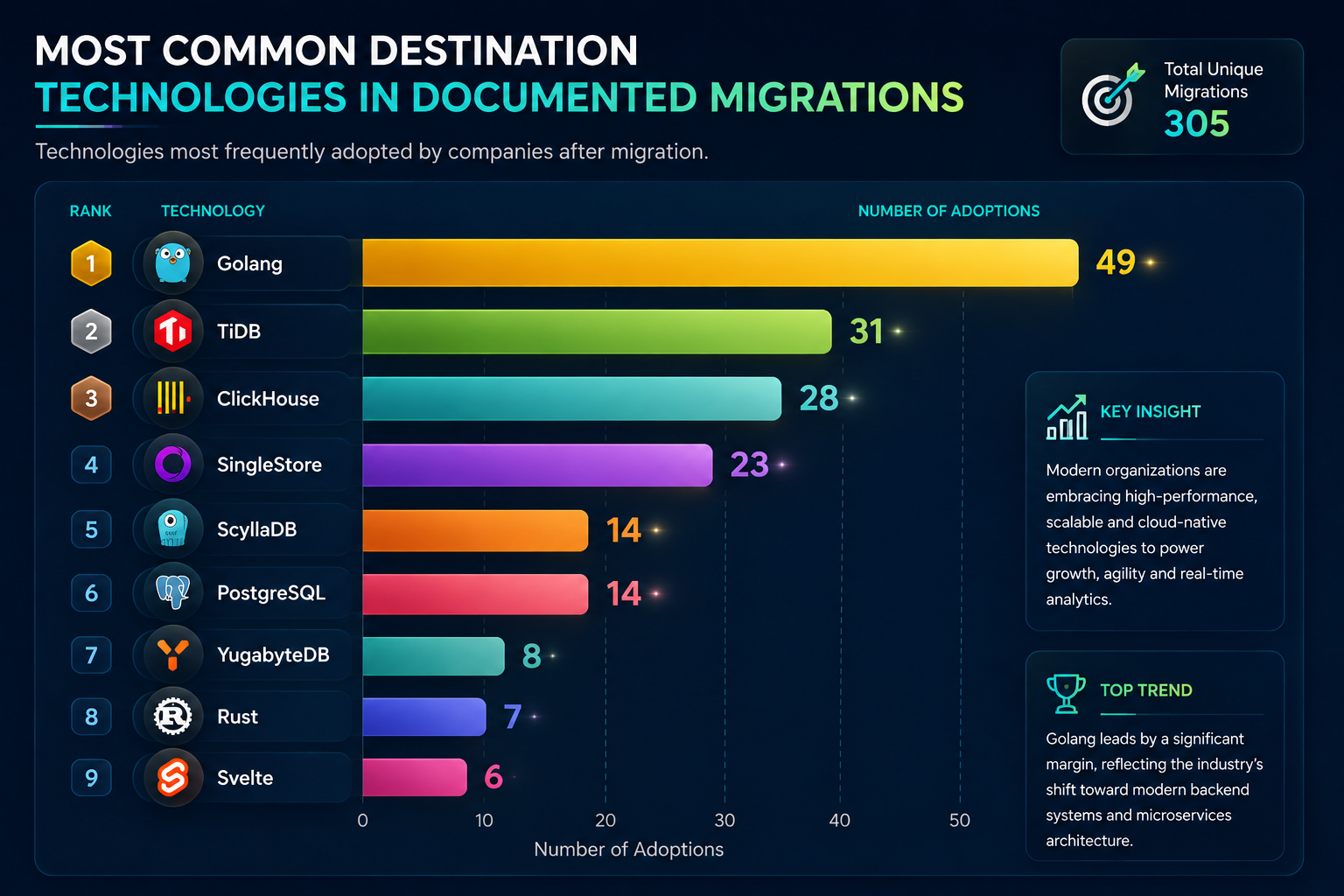
Perhaps the most striking trend is the dominance of Golang as the preferred destination technology. Nearly fifty documented migrations involved organisations replacing existing backend technologies with Go, making it the most frequently adopted programming language in the dataset. This trend reflects a broader industry shift towards high-performance, concurrent programming that supports microservices, containerisation, and cloud-native application development. As digital platforms expand to serve millions of users, organisations increasingly value technologies that deliver predictable performance while reducing operational complexity.
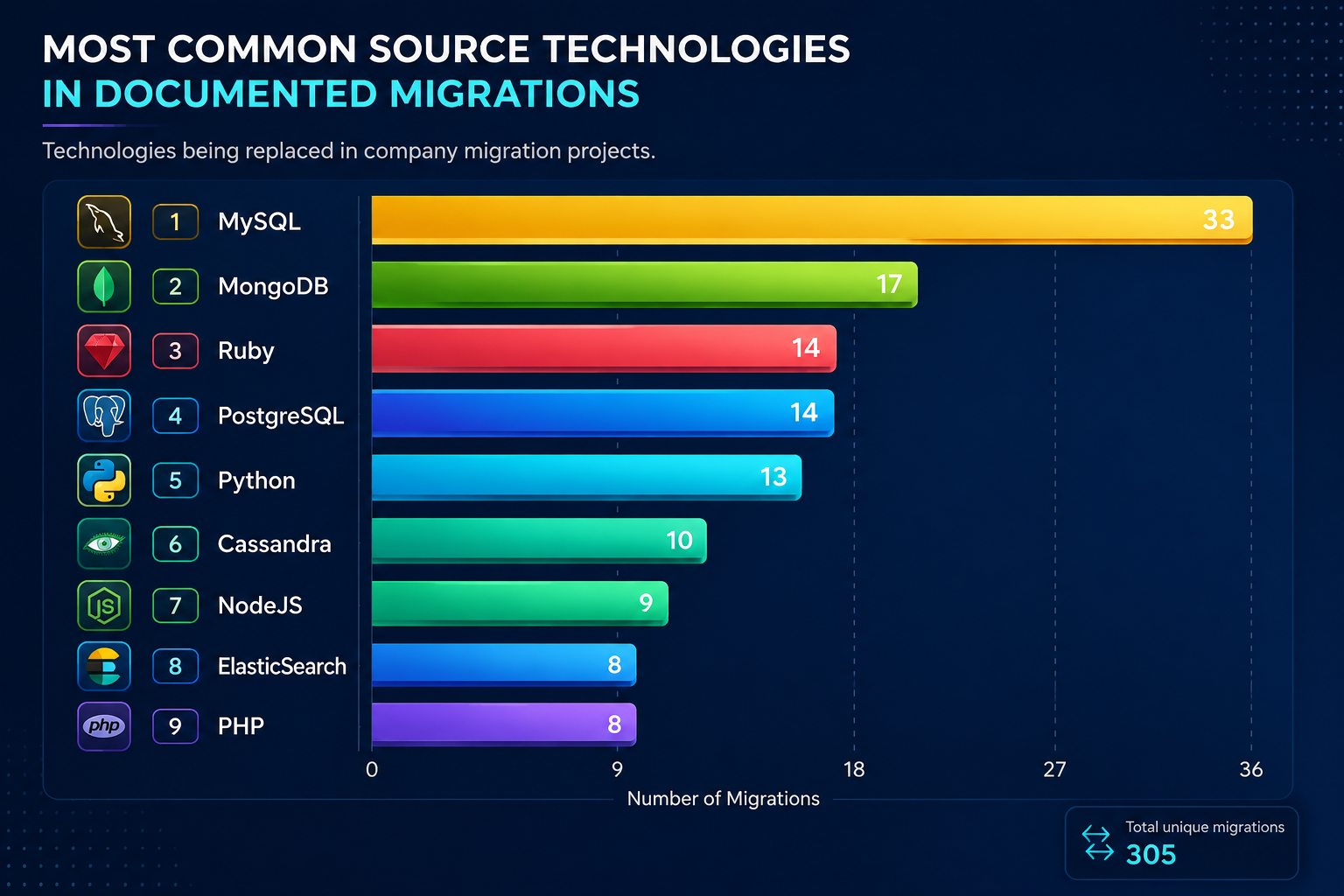
The database ecosystem has experienced an equally profound transformation. Traditional relational and NoSQL databases such as MySQL, MongoDB, and Cassandra frequently appeared as technologies organisations migrated away from. In their place, companies increasingly adopted distributed databases such as TiDB, YugabyteDB, ScyllaDB, SingleStore, and analytical databases like ClickHouse. These migrations are not necessarily indictments of legacy databases. Rather, they illustrate the natural evolution of organisations as their data volumes, transaction rates, and analytical requirements outgrow the capabilities of earlier systems.
One important lesson emerging from the data is that technology choices are closely linked to organisational maturity. Start-ups and rapidly growing companies often begin with proven technologies that enable rapid product development and lower development costs. As user bases expand and business operations become more sophisticated, these same organisations encounter new challenges involving scalability, availability, fault tolerance, and operational efficiency. Technology migration therefore becomes an inevitable stage in organisational growth rather than an admission of previous technological failure.
The years between 2020 and 2021 represent the peak period of documented technology migrations. This surge coincided with accelerated digital transformation across industries, driven by cloud adoption, remote work, increased online transactions, and heightened demand for digital services. Organisations could no longer rely solely on systems designed for traditional enterprise workloads. Instead, they required architectures capable of supporting distributed teams, continuous deployment, real-time analytics, and global-scale applications. The migration wave during this period demonstrates how external disruptions often accelerate technological innovation.
Another noteworthy finding is the growing emphasis on performance engineering. Technologies such as Rust and Go continue to attract organisations seeking greater computational efficiency, lower memory consumption, and improved reliability. As computing costs continue to rise alongside increasing user expectations, software performance is no longer viewed as a purely technical concern but as a strategic business advantage. Faster applications reduce infrastructure costs, improve customer experiences, and strengthen competitive positioning.
Equally significant is the emergence of analytical databases as mainstream infrastructure. The increasing adoption of ClickHouse demonstrates that organisations are placing greater emphasis on real-time business intelligence, observability, event processing, and data-driven decision-making. In today’s digital economy, organisations are no longer satisfied with storing data; they seek technologies capable of transforming vast volumes of operational data into actionable intelligence almost instantaneously.
The migration patterns also highlight the growing importance of distributed computing. Technologies designed specifically for horizontal scalability and fault tolerance increasingly dominate destination platforms. This reflects the reality that modern applications must remain available across multiple geographic regions while supporting continuous growth without significant downtime. High availability has become a business expectation rather than a technical luxury.
These migration patterns carry important strategic implications. First, no technology should be viewed as a permanent investment. Successful organisations continuously evaluate whether their infrastructure aligns with evolving business objectives. Second, migration planning should become an integral component of long-term technology strategy rather than an emergency response to system limitations. Finally, organisations should recognise that digital transformation extends beyond adopting new technologies; it requires building architectures capable of adapting to future technological change.
Our analyst notes that the technology migration data provides valuable insights into the evolution of the global software ecosystem. It reveals how innovation diffuses across industries, how organisations respond to technological disruption, and which technologies emerge as foundational infrastructure for the digital economy. Such evidence can also inform curriculum development, workforce planning, and national digital transformation policies by highlighting the skills and technologies that are increasingly shaping modern software engineering.
Specifically, our analyst observes that every migration represents an organisation responding to new realities, whether those realities involve millions of additional users, increasingly complex data environments, or heightened demands for speed, reliability, and scalability. As digital transformation continues to accelerate, the technologies companies choose to migrate to today provide valuable clues about the architecture of tomorrow’s digital economy. Organisations that understand these patterns will be better positioned not only to keep pace with technological change but to lead it.