

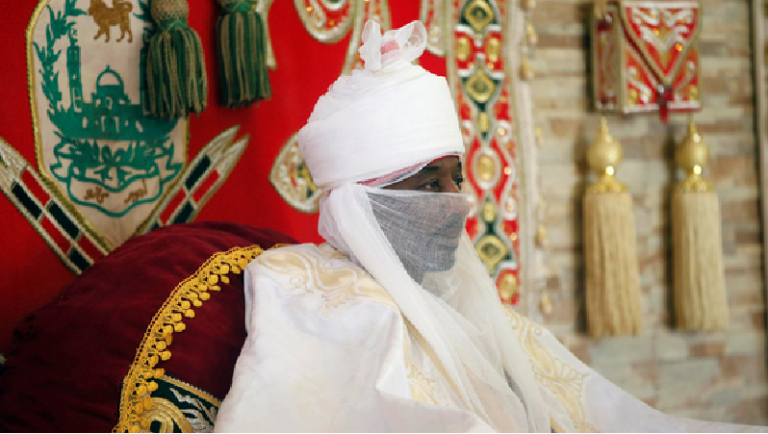
The Emir of Kano, Muhammadu Sanusi II, has intensified scrutiny of Nigeria’s fiscal direction, questioning why the federal government continues to accumulate debt despite removing fuel subsidies, a reform widely expected to ease pressure on public finances.
In a public address posted on social media, the former central bank governor restated his opposition to the subsidy regime, calling it unsustainable.
“I have always said the subsidy regime was unsustainable. We cannot continue supporting foreign refineries when we are an oil-producing country, keeping refineries open abroad while we’re not running our own,” he said.
Register for the next Tekedia Mini-MBA.
Register for Tekedia AI in Business Masterclass.
Join Tekedia Capital Syndicate and co-invest in great global startups.
Yet Sanusi’s central concern lies in what has followed the policy shift. “Secondly, the subsidy has been removed, but what is being done with the savings? We should be seeing fiscal consolidation. You cannot eliminate wastage and still continue borrowing,” he said. “People need to see the benefits. If subsidy payments have stopped and funds are available, why are we still borrowing repeatedly? What exactly are we borrowing for?”
His remarks come against the backdrop of a rapidly expanding debt profile under President Bola Tinubu. Nigeria’s total public debt stood at roughly N159 trillion (about $110 billion) as of December 2025, one of the highest levels in the country’s history. A significant portion of that accumulation has occurred during Tinubu’s tenure, driven by aggressive external borrowing, approval of multi-billion-dollar loan packages, and continued reliance on multilateral financing to plug budget deficits and fund infrastructure.
Within months, the administration has secured approvals for over $6 billion in fresh external borrowing, alongside a broader borrowing plan exceeding $20 billion. Additional World Bank loans, estimated at over $6 billion in the first 16 months of the administration, have further added to the debt stock. The latest request, a $516 million facility for the Sokoto–Badagry Superhighway, underscores the pace at which new obligations are being taken on.

The rising debt burden is increasingly intersecting with Nigeria’s weak revenue position. A substantial share of government income is now absorbed by debt servicing, leaving limited fiscal space for capital investment and social spending.
“It’s not enough to simply say subsidy was removed. When you get to a point where 100% of your revenue goes into debt servicing, you cannot continue. Where will the money come from?” Sanusi said.
That dynamic has become a central concern among economists. While subsidy removal was expected to reduce recurrent expenditure and free up resources, the anticipated fiscal relief has been diluted by continued borrowing and rising debt obligations. In effect, savings from subsidy reforms risk being offset by higher interest payments and debt repayments.

Sanusi also questioned the sequencing of reforms, warning that policy timing has compounded macroeconomic pressures.
“For me, removing subsidy or liberalizing exchange rates are good interventions. But were they done at the right time? That’s a key question,” he said.
He cautioned that implementing such measures in a loose monetary environment could destabilize the currency.
“However, if you remove subsidy and liberalize exchange rates in an environment of very loose monetary conditions, before tightening money supply, the naira can fall sharply,” he said.
Concerns over fiscal management extend to how borrowed funds are deployed. The federal government’s push to finance large-scale infrastructure projects, including the Sokoto–Badagry Superhighway and the Lagos-Calabar Coastal Highway, has drawn criticism over prioritization and transparency.
Economist Ndubisi Nwokoma described the borrowing strategy as “fiscal rascality,” arguing that existing infrastructure should take precedence.
“I recently travelled to the East, and the roads are in terrible condition. Why not focus on maintaining them? Even if we must borrow, Nigerians should see tangible improvements in major expressways. If that happens, people will not complain as much,” he told Daily Trust.
He warned that some projects risk becoming “white elephants,” adding, “Why not fix what we have before embarking on new roads? … There was no transparent tendering process. This points to fiscal recklessness.”
Procurement concerns have further amplified criticism. Both flagship road projects have been linked to Hitech Construction, part of the Chagoury Group, raising questions about competitive bidding and value for money, particularly when financed through debt.
Former Vice President Atiku Abubakar echoed those concerns, warning that borrowing without transparency could deepen fiscal vulnerabilities.
“At a time when Nigeria is already groaning under the weight of unsustainable debt, the resort to yet another foreign loan, without transparent terms, clear cost-benefit analysis, and a credible repayment framework, raises profound questions about prudence and accountability,” he said.
He added, “What Nigerians expect is not just ambitious projects, but responsible financing. Development must not become a euphemism for deepening debt traps that generations yet unborn will be forced to repay.”
Atiku also questioned the procurement process, warning against what he described as a pattern of insider contracting. He called on the National Assembly, led by Godswill Akpabio, to subject the loan request to rigorous scrutiny.
The broader economic picture reveals a structural imbalance. Nigeria’s revenue-to-GDP ratio remains among the lowest globally, limiting the government’s ability to fund expenditure without resorting to debt. At the same time, rising interest costs, both domestic and external, are increasing the burden of servicing existing obligations.
Sanusi pointed to the contradiction at the heart of current policy. “Today, we have a situation where we have a domestic refinery, we’re not importing petroleum products, and we’re even exporting to Europe. This is very good for the economy,” he said.
However, he maintained that such gains must translate into fiscal improvement, not continued borrowing.
The tension between reform and outcomes is becoming more pronounced. Subsidy removal and exchange rate liberalization were intended to stabilize the economy and restore investor confidence. So far, there are little or no visible improvements in fiscal discipline, infrastructure delivery, or cost of living. That has fueled public skepticism.