
DD
MM
YYYY

PAGES

DD
MM
YYYY

spot_img

PAGES

Home Blog

Grayscale Says the CLARITY Act Is Unlikely to Pass This Year

0

Grayscale has reportedly lowered its expectations for the passage of the CLARITY Act this year, highlighting the growing uncertainty surrounding one of the most important pieces of proposed cryptocurrency legislation in the United States.

The bill has been viewed by much of the digital-asset industry as a potential turning point because it seeks to establish clearer rules for determining how cryptocurrencies are regulated and which agencies should oversee different parts of the market.

The CLARITY Act has attracted significant attention because regulatory uncertainty has remained one of the biggest obstacles facing the American crypto industry.

For years, companies, investors and developers have operated under a framework in which the boundaries between securities, commodities and other digital assets have often been contested.

The legislation is designed to provide a more defined regulatory structure, potentially giving market participants greater confidence about how digital assets will be treated.

Grayscale’s assessment therefore represents more than a legislative prediction. It reflects concerns about the political and procedural challenges that remain before the bill can become law.

Even when there is broad support for the principle of clearer crypto regulation, disagreements over the details can significantly slow the legislative process.

One of the central questions involves the division of authority between the Securities and Exchange Commission and the Commodity Futures Trading Commission.

Establishing which regulator should oversee particular digital assets, exchanges and market activities is politically sensitive because regulatory jurisdiction also determines enforcement powers, compliance obligations and the future development of the industry.

The delay could have important consequences for crypto businesses operating in the United States. A comprehensive regulatory framework could encourage companies to expand their American operations, attract institutional capital and reduce the legal uncertainty surrounding new products.

If legislation is pushed into another year, however, businesses may continue to face fragmented rules and uncertainty about how regulators will interpret existing laws. For investors, the delay could also affect expectations surrounding the broader institutional adoption of cryptocurrencies.

Large financial institutions have increasingly explored digital assets, tokenization, stablecoins and blockchain-based financial infrastructure. Clearer legislation could accelerate that trend by providing institutions with greater certainty about compliance and market structure.

The difficulty of passing the CLARITY Act demonstrates how complicated cryptocurrency policy has become in Washington. Digital assets are no longer a niche technological issue. They now intersect with financial regulation, banking, payments, consumer protection, taxation and national economic policy.

As a result, lawmakers must balance the interests of traditional financial institutions, crypto companies, investors and regulators.

The bill’s uncertain timeline could intensify pressure on policymakers. The United States is competing with other jurisdictions that are developing dedicated frameworks for digital assets. If American legislation continues to stall, some crypto businesses could increasingly look overseas for clearer regulatory environments.

Still, the possibility that the CLARITY Act will not pass this year does not necessarily mean that momentum for crypto regulation has disappeared. Legislative negotiations can continue, amendments can address outstanding disagreements and political priorities can change rapidly.

The immediate lesson is that regulatory clarity remains a work in progress. Grayscale’s cautious outlook underscores the gap between political support for clearer rules and the difficult process of turning that support into legislation.

Until Congress resolves the remaining disputes, the American digital-asset market will continue operating in an environment where regulatory uncertainty remains a defining factor.
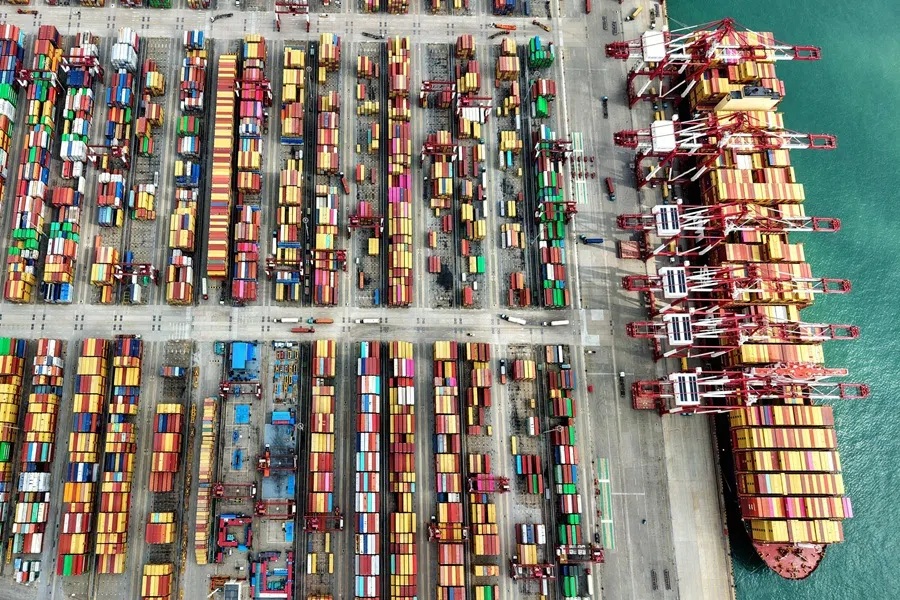

U.S. Container Imports Hit Fourth-Highest July Level as Shippers Race Ahead of Tariff Changes

0

U.S. imports of containerized goods remained unusually strong in July as companies accelerated shipments to get products into the country before another round of uncertain tariff changes, highlighting the continuing impact of trade policy on global supply chains.

U.S. ports handled about 2.5 million 20-foot equivalent units (TEUs) in July, making it the fourth-highest July volume on record, according to supply-chain technology provider Descartes Systems Group. Although volumes fell 4.3% from the near-record level recorded in July 2025, imports during the first seven months of 2026 were down only 0.9% from a year earlier and remained well above pre-pandemic levels.

The figures suggest that companies are continuing to bring forward shipments as they attempt to reduce exposure to potentially higher import costs and avoid disruptions caused by changing U.S. trade policy.

The latest rush came ahead of changes to U.S. tariffs at the end of July. The 10% global tariffs imposed under Section 122 expired and were replaced by tariffs of as much as 12.5% on imports from 60 countries, in connection with U.S. allegations concerning forced labor.

The uncertainty has made the timing of shipments beneficial for importers. Bringing goods into the United States before a tariff takes effect can allow companies to reduce the immediate cost of inventory, although it can also increase warehousing expenses and leave retailers carrying larger inventories than they would under normal demand conditions.

China was a particularly important source of July’s import activity.

Imports from China reached 873,129 TEUs, the highest monthly volume in a year. China remains the largest source of containerized goods entering the United States even as the Trump administration has imposed tariffs on a broad range of Chinese products.

The increase indicates that tariffs have not eliminated the underlying commercial relationship between the world’s two largest economies. Instead, they have encouraged companies to adjust the timing, sourcing and routing of shipments.

Major U.S. retailers remain useful to those flows. Walmart, Amazon and Home Depot together account for roughly half of U.S. container imports, according to Descartes. Their purchasing cycles also help explain why shipping volumes have become less concentrated around the traditional peak season.

Retailers typically increase imports ahead of autumn and winter promotions and the holiday shopping period. That seasonal pattern has increasingly been stretched over a longer period as companies attempt to anticipate disruptions and secure inventory before trade-policy changes take effect.

The shift began during the COVID-19 pandemic, when supply shortages, port congestion and unpredictable consumer demand forced retailers to rethink inventory management. It has continued as companies respond to geopolitical tensions, shipping disruptions and successive changes in U.S. tariff policy.

The latest figures therefore provide an indication not only of import demand but also of how businesses are adapting their supply chains to greater policy uncertainty.

Descartes said the wider trade environment remains unsettled, with risks surrounding the Strait of Hormuz, changing U.S. tariff measures, tighter draft restrictions in the Panama Canal and continuing disruption in the Red Sea affecting freight costs, shipping routes and sourcing decisions.

The combination of those factors is making supply-chain planning more expensive and complex.

The Strait of Hormuz significantly matters because disruptions there can affect energy prices and global transportation costs. The Panama Canal remains a key route for trade between Asia and the U.S. East Coast and Gulf Coast, while instability in the Red Sea has forced many vessels to take longer routes around Africa.

For U.S. importers, the result is a supply chain increasingly shaped by risk management rather than simply by the lowest transportation or production cost. The strong July import figures also complicate the assessment of the underlying health of U.S. consumer demand. High import volumes can indicate robust retail demand, but they can also reflect companies accelerating purchases ahead of tariffs rather than responding to immediate consumer needs.

Analysts see that distinction becoming more important in the coming months. If import volumes weaken sharply after the tariff changes take effect, it could indicate that July’s strength was partly driven by front-loading. If volumes remain elevated, it would suggest that retailers and manufacturers continue to see sufficient demand to absorb higher trade costs.

China’s rebound in July shipments is similarly notable. The increase suggests that U.S. companies continue to rely heavily on Chinese manufacturing despite tariffs and efforts to diversify supply chains. Shifting production to alternative countries can take years, particularly for complex products and established supplier networks.

The data therefore point to an American import market that remains resilient but increasingly shaped by tariff deadlines and geopolitical risks.

While the strategy of moving goods earlier can provide retailers with protection against sudden tariff increases and shipping disruptions, it also carries costs, including higher inventory financing, storage requirements and the risk of being left with unwanted products if consumer demand changes.

Crypto Card Spend Hits a New All-Time High

0

Crypto adoption is increasingly moving beyond trading, investing and speculation, as consumers use digital assets for everyday purchases.

The latest indication of this shift is the rise in spending through crypto-linked payment cards, which has reached a new all-time high. The milestone highlights how cryptocurrency is gradually becoming integrated into conventional financial activity.

Crypto cards allow users to spend digital assets through payment networks that resemble traditional debit or prepaid cards.

Depending on the provider, cryptocurrency can be converted into fiat currency at the point of purchase, allowing merchants to receive familiar currencies while customers retain access to their crypto holdings.

This model has helped remove one of the biggest barriers to everyday cryptocurrency use: the need for merchants to directly accept digital assets. The surge in card spending also reflects the expanding infrastructure around stablecoins.

Unlike volatile cryptocurrencies such as Bitcoin and Ether, stablecoins are designed to maintain relatively stable values against fiat currencies. This makes them particularly suitable for payments, allowing users to hold digital dollars and spend them without worrying about large price fluctuations between the time of purchase and settlement.

Another factor behind the growth is the increasing integration between crypto companies and traditional payment networks. Crypto platforms are developing cards that can be used at millions of merchants worldwide.

While financial institutions and payment companies are becoming more comfortable supporting blockchain-based settlement. As these connections improve, consumers can use crypto balances without necessarily understanding the underlying blockchain infrastructure.

The new spending record is significant because transaction activity can provide a different measure of adoption than cryptocurrency prices or exchange volumes.

A rising Bitcoin price can be driven by investment demand, while higher crypto card spending suggests that digital assets are increasingly being used as a financial utility. In other words, crypto is moving from an asset people hold to an asset people can use.

Rewards and cashback programs are also contributing to this trend. Some crypto cards offer users incentives in digital assets for everyday purchases, creating an additional reason to use them instead of conventional payment cards.

For frequent users, these rewards can turn routine spending on groceries, transportation, subscriptions and other services into opportunities to accumulate crypto. Transaction fees, foreign-exchange costs, regulatory requirements, taxation and the volatility of certain cryptocurrencies can complicate crypto-based payments.

Providers must maintain strong compliance and security systems as their products become more widely adopted. The record in crypto card spending points toward a broader transformation in digital finance. The next phase of cryptocurrency adoption may not be defined solely by new tokens or higher market valuations.

But by how seamlessly blockchain-based money becomes embedded in everyday commerce. If the trend continues, crypto cards could become an important bridge between decentralized assets and the traditional financial system.

The new all-time high therefore represents more than a spending record. It is evidence that cryptocurrency is increasingly being treated not just as an investment, but as a practical payment tool. This evolution could create new opportunities to reach a global customer base while reducing reliance on traditional banking intermediaries.

As blockchain payment infrastructure becomes faster and cheaper, crypto cards may increasingly compete with conventional payment products, particularly in markets where access to reliable financial services remains limited.

Japan Swings to First Current-Account Deficit in 17 Months as Oil Costs, Foreign Payouts Bite

0

June deficit sharply misses forecasts, but record first-half surplus shows AI-driven exports and overseas investment income continue to underpin Japan’s external finances

Japan recorded its first current-account deficit in 17 months in June as larger dividend payments to foreign investors and higher oil import costs eroded the country’s external surplus, although a record first-half surplus underscored the continuing strength of its overseas investment income and technology exports.

The current-account balance was a deficit of 92.3 billion yen ($584.5 million) in June, Finance Ministry data showed on Monday. The result was a sharp reversal from a surplus of 1.28 trillion yen a year earlier and fell far short of economists’ median forecast for a surplus of 1.51 trillion yen in a Reuters poll.

The monthly deficit is notable because Japan has relied on income from its vast overseas investment holdings to offset periods of weak trade performance. June’s figures show how quickly that cushion can narrow when payments to foreign investors rise and energy costs increase.

The primary-income balance, which captures earnings from overseas securities and direct investment, fell 74% to 380 billion yen. It is normally the single largest contributor to Japan’s current-account surplus. The decline was driven largely by larger dividend payments by Japanese companies to foreign investors following increased investment in Japan’s domestic markets. The development illustrates an important shift in Japan’s external accounts: stronger foreign participation in Japanese equities and businesses can support asset prices and corporate financing while simultaneously increasing the income that flows out of the country.

Higher oil import costs added to the pressure. Japan remains heavily dependent on imported energy, making its trade balance particularly sensitive to movements in global crude prices. Rising oil costs pushed the country into a trade deficit in June and helped drag the overall current account below zero.

The June result, however, needs to be viewed against a much stronger performance over the first half of the year. Japan’s current-account surplus increased 22.5% to a record 17.4 trillion yen in the six months through June. The improvement was supported by a trade surplus, with exports of semiconductors destined for artificial-intelligence data centers providing a significant boost.

The contrast between the June deficit and the record first-half surplus highlights the changing structure of Japan’s external finances. The country is no longer dependent solely on merchandise trade to generate foreign currency. Investment income from overseas assets has become a critical source of support, while Japan’s manufacturers are increasingly benefiting from the global expansion of AI infrastructure.

AI Boom Strengthens Japan’s Export Position

The strength of semiconductor-related exports is enormous because it links Japan’s external balance to one of the fastest-growing areas of global capital spending. Japanese companies occupy important positions across the semiconductor supply chain, supplying chipmaking equipment, materials and components required to manufacture advanced processors and build AI data centers. Strong demand for these products has helped support exports even as other parts of global trade have faced uncertainty.

The first-half figures suggest that the AI investment cycle is becoming an important source of external demand for Japan. If spending on data centers and advanced computing infrastructure remains strong, Japanese exporters could continue to benefit through demand for semiconductor manufacturing equipment and related technology.

At the same time, the June figures demonstrate that the export gains can be offset temporarily by movements in investment income and energy costs.

Foreign Investment Creates A Two-Way Income Flow

The sharp contraction in primary income is also a consequence of Japan’s growing integration with global capital markets.

Foreign investors have increased their exposure to Japanese shares and companies, attracted by corporate-governance reforms, improving profitability and a shift away from years of deflation. That capital supports Japanese asset prices and can provide companies with access to international investors.

But the resulting dividends and other investment returns eventually flow back overseas. In June, those payments were large enough to materially reduce the primary-income surplus. This means a stronger foreign investment presence in Japan does not automatically translate into a larger current-account surplus. It can improve the country’s financial position in other ways while increasing the amount of income that leaves Japan.

The trade balance remains another source of volatility. Japan imports most of the energy it consumes, leaving its external accounts exposed to swings in oil and gas prices. A sustained increase in energy costs can quickly widen the import bill and reverse gains from stronger exports.

That vulnerability is relevant as geopolitical tensions continue to create uncertainty in global energy markets. A renewed oil-price surge would raise Japan’s import costs and could place additional pressure on the trade balance, especially if export growth slows.

Conversely, lower energy prices would provide an immediate benefit to the country’s external position by reducing the value of imports.

Record Surplus Offers Broader Reassurance

Despite the June deficit, the record 17.4 trillion yen first-half surplus indicates that Japan’s external position remains substantial.

The data also underline the resilience provided by the country’s huge stock of overseas assets. Japanese investors and companies have accumulated significant foreign investments over decades, generating a recurring stream of dividends and interest income that has increasingly compensated for the country’s historically weaker merchandise trade balance.

For the yen, the latest figures offer a mixed signal. A current-account surplus generally creates underlying demand for the currency, but larger outward investment-income payments and higher import costs can reduce that support. The record first-half surplus, however, suggests Japan continues to generate considerable external income even as individual monthly readings become more volatile.

The key question for markets will be whether the June deterioration proves temporary or marks the beginning of a broader weakening in Japan’s external balance. Currently, the first-half figures are arguing against the latter.

Sunrise Energy Metals Soars as U.S. Backs Australian Scandium Mine in Bid to Break China’s Mineral Grip

0

Shares of Australia’s Sunrise Energy Metals surged as much as 29% on Monday after the Trump administration backed the company with a $400 million conditional loan commitment to develop a major scandium project, giving fresh momentum to Washington’s drive to build critical-mineral supply chains outside China.

The stock later pared some of its gains but still closed more than 16% higher, as investors responded to a U.S. government commitment that could help Sunrise finance development of its Syerston project in New South Wales.

The U.S. Department of War said its Office of Strategic Capital had agreed to provide the conditional long-term debt financing to support Sunrise’s plan to establish an integrated scandium value chain, beginning with primary mining and extending into processing.

The proposed development matters notably because scandium is a relatively obscure but highly specialized metal whose properties make it valuable in aerospace, defense and advanced manufacturing. Adding scandium to aluminum can significantly increase strength while improving resistance to heat and corrosion. Those characteristics make scandium-aluminum alloys attractive for applications where manufacturers need lighter and stronger materials, including aerospace and defense systems.

The metal is also being considered for energy infrastructure supporting power-intensive industries such as artificial intelligence data centers, adding another potential source of demand as global investment in AI computing capacity accelerates.

More importantly for Washington, the project offers a potential alternative to China’s dominance of critical-mineral supply chains.

China produces nearly 70% of the world’s rare earths from domestic mines and controls almost 90% of global rare-earth processing, according to figures cited in the report. Its position has given Beijing considerable leverage over industries dependent on strategic minerals and has heightened concerns in Washington and other Western capitals about supply disruptions and export restrictions.

The Sunrise financing is therefore part of a much broader industrial policy. The United States is increasingly using government-backed loans, equity investments and other forms of financial support to encourage mining, processing and manufacturing capacity at home and in allied countries.

“Under the leadership of President Donald J. Trump, securing our critical minerals supply chain is a top national security priority,” David A. Lorch, director of the Office of Strategic Capital and senior adviser to Deputy Secretary of War Steve Feinberg, said in a statement.

Lorch said the proposed Sunrise transaction would help establish a more resilient scandium supply chain and facilitate the mineral’s use in defense and commercial applications.

The U.S. government said the broader transaction, combining public and private capital, could approach $1 billion.

That distinction is important. The $400 million announced by Washington is a conditional loan commitment rather than a direct government grant, while the wider financing package is expected to include private capital. The government support could nevertheless improve Sunrise’s ability to secure the additional funding required to develop the project.

For Sunrise, access to government-backed capital could be particularly valuable because scandium is an extremely small market compared with commodities such as copper, lithium and rare earths. The limited size of the existing market has historically constrained investment in dedicated scandium production.

Most scandium has traditionally been recovered as a byproduct of other mining operations rather than through large-scale primary mines. Sunrise’s strategy is consequently based on creating a dedicated supply source and expanding the market for the metal through new applications.

Sunrise Chairman Robert Friedland described the U.S. backing as a “landmark moment” for the company and Australia’s mining industry.

“The world has entered an era in which access to critical minerals will shape industrial strength, technology leadership and national security,” Friedland said.

“Scandium is one of the clearest examples, supporting the technologies, industries and defence capabilities that will shape the coming decades,” he added.

The project’s strategic appeal is also linked to its potential scale. Sunrise Chief Executive Sam Riggall said in June that Syerston could become the world’s largest single source of scandium and have the capacity to replace China’s current supply from one operation.

“What we are building in Australia, very close to Sydney, will be the world’s single largest source of scandium supply and it will have the capacity to replace everything that China supplies today from this one mining operation,” Riggall said.

“So, with this particular metal, it is possible to find ready solutions that can address this supply risk very quickly,” he added.

That potential makes Syerston significant beyond Sunrise itself. A large, reliable source outside China could give Western manufacturers greater certainty over a material that is strategically important but currently has a fragmented and relatively opaque supply chain.

The project also fits Australia’s important role in the critical-minerals strategy of the United States and its allies. Australia combines substantial mineral resources with an established mining industry and close security and economic ties with Washington, making it a natural partner as Western governments seek alternatives to Chinese-controlled supply chains.

The move comes as China increasingly uses its position in critical minerals as an instrument of economic leverage.

The U.S. backing for Sunrise follows a broader acceleration in Washington’s efforts to secure strategic minerals needed for defense equipment, electric vehicles, energy infrastructure and advanced technology.

However, the announcement does not eliminate the risks associated with developing Syerston. The loan remains conditional, and Sunrise will still have to navigate financing, permitting, construction, technical and commercial hurdles before the project generates revenue.