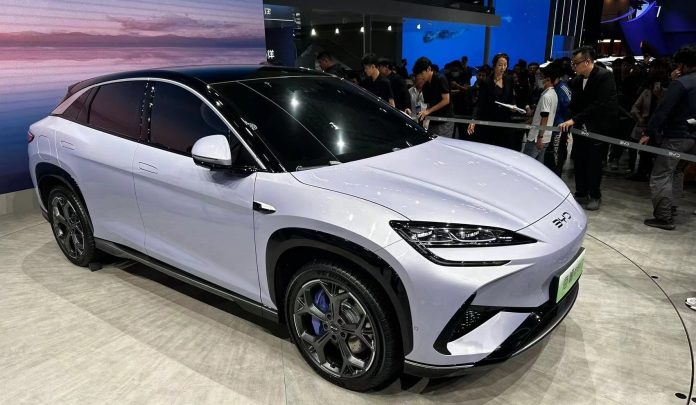
BYD’s January sales dropped by 30.1% from a year earlier, marking the fifth straight month of decline, and exposing the struggle of the Chinese EV giant amid a push to expand its market.
The decline is seen as a revealing snapshot of how China’s electric vehicle champion is being squeezed simultaneously by a cooling domestic market, intensifying competition, and a more uncertain global expansion path.
The company sold 210,051 vehicles worldwide in January, according to a stock exchange filing. Production fell nearly in tandem, down 29.1%, extending a contraction that began in July last year. The parallel slide in both sales and output suggests the slowdown is not simply a demand hiccup but a broader recalibration across BYD’s operations.
At home, the pressure is most visible in BYD’s core plug-in hybrid segment. Plug-in hybrids account for more than half of the company’s total vehicle sales and have long been a key differentiator, appealing to price-sensitive consumers wary of charging infrastructure gaps. Yet sales of these models fell 28.5% in January, deepening a trend after a 7.9% decline in 2025. In response, BYD rolled out upgraded versions of several plug-in hybrid models last month, equipped with longer-range batteries and positioned as better-value options in the affordable segment. The January data shows those upgrades have yet to arrest the slide.
China’s auto market, the largest in the world, is entering a phase of stagnation as the government scales back subsidies for trading in lower-priced vehicles. Those incentives had helped sustain volume growth and price competitiveness, particularly for manufacturers like BYD that built scale around affordability. Their gradual withdrawal is reshaping consumer behavior and forcing automakers into sharper price wars, especially in the mass-market and budget categories.
Competition has also become more unforgiving. Domestic rivals such as Geely and Leapmotor have been aggressive in rolling out new models and cutting prices, narrowing the differentiation that once set BYD apart. The result is margin pressure and slower sales growth across the sector, even as capacity built during the boom years remains high.
Against this backdrop, BYD’s overseas business has become central to its growth narrative. Exports of new energy vehicles reached 100,482 units in January, and international sales growth last year was strong enough to help BYD overtake Tesla as the world’s top EV seller by volume. That overseas surge offset domestic weakness in 2025 and underpinned BYD’s ability to narrowly meet its reduced global sales target of 4.6 million vehicles.
But even the export story is showing signs of caution. BYD has set a target of 1.3 million vehicles in overseas shipments this year, implying a 24% increase from 2025. That figure, however, is below earlier ambitions. Management had told Citi in November that overseas sales could reach as high as 1.6 million units. The absence of an explanation for the downward revision hints at a more sober assessment of global conditions, including rising trade barriers, regulatory scrutiny, and slower-than-expected adoption in some markets.
Geopolitics and trade policy have also come into play. Chinese EV makers face growing resistance in Europe and North America, where governments are increasingly wary of subsidized imports. BYD’s strategy to counter this has been to localize production. Its new EV plant in Hungary is expected to come online this year, adding to existing manufacturing in Brazil and Thailand, with assembly plants planned in Indonesia and Turkey. These facilities are designed to shorten supply chains, reduce tariff exposure, and signal long-term commitment to host markets.
Still, overseas expansion comes with its own risks. Building plants abroad requires heavy upfront investment at a time when cash flows are under pressure, while competition from established automakers and local EV brands remains fierce. Moreover, slowing global growth and tighter consumer spending in many regions could limit the pace at which overseas markets absorb new Chinese entrants.
The January numbers also raise questions about BYD’s near-term outlook. The company has not yet announced a global sales target for 2026, a notable silence for a manufacturer that has historically been confident in projecting aggressive growth goals. Combined with falling production and sustained sales declines, the lack of guidance suggests management is bracing for a more volatile and uncertain year.
More broadly, BYD’s struggles reflect a turning point for China’s EV sector. Years of rapid expansion, generous subsidies, and intense competition created a market defined by scale and speed. That era is giving way to one marked by consolidation, tighter margins, and slower growth. Even market leaders are being forced to adjust expectations, refine product strategies, and rethink how quickly overseas markets can compensate for a maturing domestic base.
The challenge now is execution for BYD. Its global footprint, vertical integration, and battery expertise still give it structural advantages. But sustaining leadership will depend on whether it can stabilize domestic sales, defend margins in a price-sensitive market, and turn its ambitious overseas investments into durable growth engines rather than costly hedges.
January’s data does not signal a collapse, but it does underline a harder truth: the path forward for China’s largest EV maker is becoming more complex, less predictable, and far more contested than during the boom years that propelled it to the top.