On the evening of May 23, 2026, an unusual anxiety swept through parts of Nigeria. Across cities in the Southwest, particularly Ibadan, rumours spread rapidly that everyone must remain indoors by 9 PM to avoid an impending danger. Shops closed early. Roads became congested with people rushing home. Families warned one another to stay inside. WhatsApp voice notes circulated feverishly. Nobody seemed entirely certain what was supposed to happen, yet many acted as if something certainly would.
By 9 PM, nothing happened.
The immediate temptation is to dismiss the episode as another case of gullibility, misinformation, or mass panic. Why did so many people find the rumour believable in the first place? The answer lies not only in misinformation, but in Nigerians’ collective memory.
Collective memory refers to the shared experiences, fears, beliefs, and stories that shape how societies interpret events. People rarely react to information in isolation. They respond through lenses built over time by history, institutions, family, religion, and repeated social experiences. In this sense, the 9 PM rumour was not simply believed because it was circulated. It was believed because it sounded familiar.
Nigeria is a society where uncertainty is deeply embedded in everyday life. Security scares often emerge suddenly. Official information is sometimes delayed or contradictory. Stories of ritual sacrifice, spiritual danger, and political conspiracy circulate frequently. Many Nigerians have learned through experience that ignoring warnings, even uncertain ones, can feel risky.
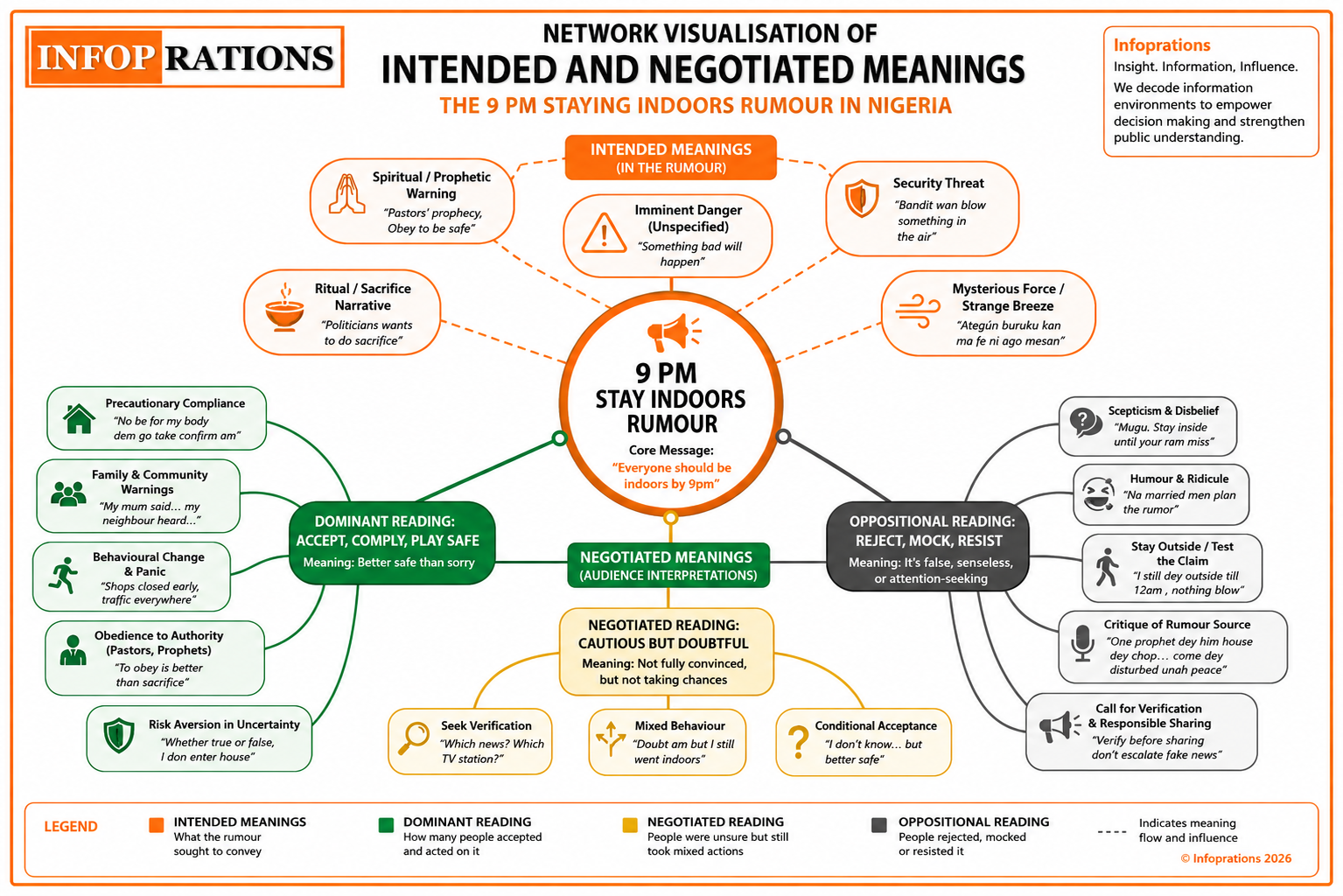
This helps explain comments such as, “Whether true or false, no be me go dey doubt am” or “No be for my body dem go take confirm am.” Such responses were not necessarily irrational. They reflected a form of social risk management rooted in memory. When trust is fragile and danger often feels unpredictable, caution becomes survival logic.
The rumour also revealed how Nigerians build trust. In many countries, people instinctively verify unusual information through formal channels such as news media or official statements. In Nigeria, information often gains legitimacy through relationships. Mothers warned their children. Siblings called one another. Neighbours shared updates over fences. WhatsApp voice notes travelled through family groups.
One striking feature of the reactions was how often people referenced trusted relatives as sources. “My mum said,” “my neighbour heard,” or “people are saying” became enough to justify precaution. Even when some questioned the source, the emotional credibility of family and community networks remained powerful.
This points to an uncomfortable truth: in moments of uncertainty, informal trust networks sometimes carry more authority than institutions.
Religion also played a significant role in shaping reactions. Several comments connected the rumour to prophecy, spiritual warnings, or unseen dangers. References to pastors, sacrifices, and obedience reflected long-standing religious narratives that are deeply woven into Nigerian public life. In such an environment, rumours are rarely assessed only through logic. They are filtered through spiritual imagination and cultural memory.
Interestingly, the rumour also exposed an opposing tendency in Nigerian society: scepticism. Many mocked the panic online. Some deliberately stayed outdoors past 9 PM to test the claim. Others ridiculed what they called another round of “forwarded many times” misinformation. Yet even among sceptics, there was hesitation. Some still went indoors early, just in case.
This contradiction is revealing. Nigerians may distrust information and still obey it. The cost of disbelief can feel too high when the consequence of being wrong is imagined as potentially catastrophic. Fear, after all, rarely waits for verification.
Perhaps the most important lesson from the 9 PM rumour is that misinformation thrives where trust is weak. When citizens believe a voice note faster than official communication, society is confronting more than fake news. It is confronting a credibility problem.
The events of that evening should not simply be remembered as an embarrassing moment of mass panic. They should be understood as a social mirror. The rumour exposed how collective memories of insecurity, spirituality, uncertainty, and institutional fragility continue to shape behaviour in Nigeria.
Nothing happened at 9 PM. Yet something important was revealed. Nigerians were not merely responding to a rumour. They were responding to years of remembered experience.