
DD
MM
YYYY

PAGES

DD
MM
YYYY

spot_img

PAGES

Home Blog

Deepsnitch AI Price Prediction: Bed Bath & Beyond Pivots to RWA and Top Coins Crash, But Smart Investors Are Buying DeepSnitch AI for Maximum Alpha

0

Bed Bath & Beyond has signed an agreement to acquire Tokens.com, indicating a massive push into real estate finance and tokenized real-world assets (RWAs). As more tokens crash in the market, smart investors are accumulating DeepSnitch AI.

Now in Stage 5 with a price of $0.03830, DeepSnitch AI has surged more than 153% from its opening, proving that AI token analysis and superior market intelligence are the only safe harbors in a storm. The current Deepsnitch AI price prediction suggests that this intelligence ecosystem is poised to outperform many other projects.

Bed Bath & Beyond’s crypto bet

Bed Bath & Beyond is transforming from a home goods retailer into a financial technology investor. The company’s acquisition of Tokens.com is part of a strategy to develop a platform focused on real estate finance and tokenized securities.

By integrating blockchain systems with regulated financial services, the retailer aims to aggregate traditional and tokenized assets into a single interface. This platform will allow users to view ownership, estimated values, and liquidity options for RWAs, supported by Bed Bath & Beyond’s existing stakes in blockchain businesses like tZERO and GrainChain.

The best gem to invest in the market decline

Deepsnitch AI Price Prediction: The green candle in a red market

While the rest of the market searches for a bottom, the DSNT growth outlook is overwhelmingly bullish. The project has raised over $1,470,000 and is defying the global crash by consistently hitting higher highs in its presale stages. Currently priced at $0.03830, DeepSnitch AI represents a sanctuary for capital fleeing the volatility of public markets.

The bullish Deepsnitch AI price prediction is driven by its utility, as it has AI agents that provide trading intelligence to investors. In a crashing market, traders need answers. They need to know if a drop is a buying opportunity or a death spiral.

DeepSnitch AI provides these answers through real-time data analysis and risk scoring. Smart investors are buying DeepSnitch AI now, and they can also earn passive income with over 33 million tokens staked.

The high demand for its tools suggests a listing price target potentially exceeding $1.00 in 2026. That’s why the DeepSnitch AI price prediction is very bullish, with many investors buying as much as they can before TGE.

ZKsync ($ZK) price prediction

ZKsync ($ZK) is currently caught in the crossfire of the market sell-off. The token has declined by 6% in the last seven days as of February 2nd. While this is a loss, it is technically outperforming the global crypto market, which is down 10%.
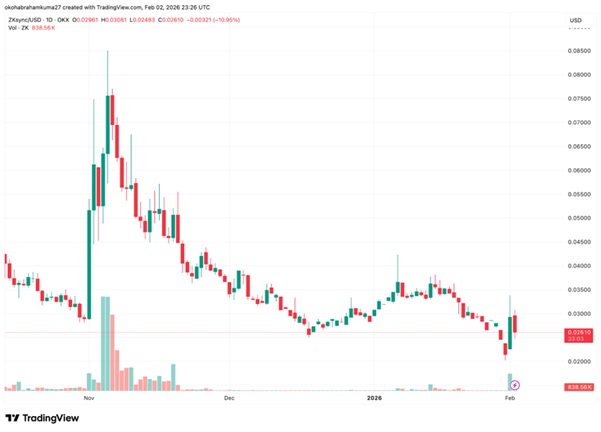
The sentiment for ZKsync is bearish with a Fear & Greed Index of 14. Volatility is very high, making it a risky hold for short-term traders. The long-term forecast sees ZKsync hitting $0.05323 by the end of 2026, a 101% gain. However, waiting for a 2x return while enduring extreme volatility is a difficult proposition. The DeepSnitch AI price prediction offers a superior risk-reward profile. By investing in the presale, you lock in a fixed price and avoid the daily anxiety of watching charts bleed.

Ondo ($ONDO) price prediction

Ondo ($ONDO) should theoretically benefit from the Bed Bath & Beyond news, as it is a leader in the RWA space. However, the market is irrational. Ondo has declined by 15% in the last week as of February 2nd, underperforming both the global market and its peers.

The RSI is at 27.10, indicating the asset is oversold, but in a crash, oversold conditions can persist for weeks. While Ondo is forecasted to recover to $0.5859 by the end of 2026, DeepSnitch AI is ready for immediate post-launch growth.

Final thoughts

The market is crashing, but your portfolio doesn’t have to. DeepSnitch AI is the green lifeboat in a sea of red. Hence, keeping an eye on the Deepsnitch AI price prediction matters most. It is a project that has the potential to deliver massive profits for investors.

Visit the official DeepSnitch AI website, join Telegram, and follow on X for more updates.

FAQs

What is the Deepsnitch AI price prediction for 2026?

The Deepsnitch AI price prediction for 2026 is highly bullish, with targets exceeding $1.00 post-listing.

How does the Bed Bath & Beyond news affect AI token analysis?

The entry of major retailers into tokenized assets increases market complexity. This validates the need for AI token analysis platforms like DeepSnitch AI.

What makes the Deepsnitch AI price forecast better than Ondo’s?

The Deepsnitch AI price forecast is superior because it is an early-stage asset with a huge growth potential of more than 100x.


Rethink Sales

0
Good People, if you truly believe you have the best products and services, then silence is not humility; it is neglect. Not telling people about them is not modesty; it is unfairness. I carry a simple business philosophy: when you have something that improves human welfare, you have a moral obligation to let the world know. Value hidden is value denied.
 
In Igbo wisdom, good things do not sell themselves unless they are shown. If you do not speak for your product, you have already voted against it. When I tell you about our products, do not see it as noise; see it as social good. Why should people be denied access to the best simply because the producer chose to be quiet? Lol.
 
Many people misunderstand marketing and sales. They think selling is begging. It is not. Selling is education. It is helping people make better choices. I often say: if your product is truly superior, then not promoting it is an injustice to the market.
 
That is why I ask leaders to reframe sales in their minds. Invite me to speak with your marketing team. I have studied how to overcome sales inertia, that invisible force that keeps customers stationary even when value is right in front of them. Like in physics, motion does not happen without energy. Sales teams fail not because products are weak, but because motivation is misdirected.
 
Why deny the world the best products if you believe you have them? When we accelerate people’s confidence to market boldly, we unlock growth. Advertising is not deception when the product is excellent; it is public service. Do not be apologetic. Be responsible. Inform customers that better options exist.
 
In Igbo land, I learned this early. As a young boy in Oriendu Market, Ovim, I would shout, “bia z?? ji nnenne m!”; buy my grandmother’s yam. That was not arrogance; it was fairness. It would have been wrong to deny customers the chance to buy the best yam in the market!!!
 
Change your attitude to sales, and you will change your business. See selling as a call to duty, a higher-purpose assignment to improve lives by making people aware of the best products.
 
But this message comes with a condition: I hope you truly have the best products!
 
(At Tekedia Mini-MBA, we have improved thousands of businesses across Africa with a business education that delivers a motion of growth & success. Next edition begins on Feb 9)

Steps Brain Injury Victims Should Take to Protect Their Rights

0

Brain injuries can change a person’s life in ways that are difficult to predict. Even a mild injury can affect memory, concentration, and emotional health. Severe injuries can lead to long-term physical, cognitive, and emotional challenges. Beyond medical recovery, brain injuries often involve complex legal matters, especially when the injury was caused by another person’s negligence or a defective product. Taking the right steps early can protect both your health and your legal rights. Seeking legal help for brain injury victims can ensure proper guidance throughout this challenging process.

Understanding the impact of a brain injury is the first step in protecting your rights. Brain injuries can range from concussions and mild traumatic brain injuries to severe trauma resulting in long-term disability. Each injury can affect a person differently. Physical effects may include headaches, dizziness, or motor skill problems. Cognitive issues can affect memory, focus, and problem-solving, while emotional changes might involve anxiety, depression, or mood swings. These effects can influence your daily life, work, and relationships. Because of the lasting consequences, brain injuries often have legal implications. Compensation may be necessary to cover medical bills, ongoing care, lost income, and reduced quality of life.

Step 1: Seek Immediate Medical Attention

The first and most important step for anyone injured is to seek immediate medical care. Even if symptoms appear mild, a proper evaluation can prevent further complications and ensure that the injury is fully documented. Detailed medical records are crucial for supporting any legal claim. They serve as official evidence of the injury’s severity, the treatment provided, and the ongoing care required. Early medical attention also helps establish a clear timeline, which can be important in legal proceedings.

Step 2: Preserve Evidence

Evidence plays a central role in any brain injury claim. It is important to collect and preserve all documents related to the incident. This includes:

  • Medical records
  • Accident reports
  • Witness statements
  • Photographs of the injury or accident scene
  • Any devices or equipment involved in the injury

Proper documentation can prove liability and support the extent of your damages. Without evidence, it is difficult to hold the responsible party accountable and secure fair compensation.

Step 3: Document Daily Challenges and Symptoms

Keeping a personal journal of daily challenges and symptoms is highly recommended. Record:

  • Physical pain
  • Cognitive difficulties
  • Emotional changes
  • Limitations in daily activities

These notes can demonstrate the injury’s impact on your life and help quantify damages in legal claims. Detailed documentation can also provide your attorney with a clear picture of how the injury affects you over time, which is particularly useful in cases where symptoms evolve or appear gradually.

Step 4: Limit Social Media Exposure

It may be tempting to share your experience online, but posting details about your injury or medical treatment can negatively impact your case. Insurance companies and defense attorneys often monitor social media for statements that may be used against you. To protect your legal rights, it is best to avoid posting information about your injury, treatment, or claim on social media platforms.

Step 5: Understand Your Legal Options

Brain injury claims can arise from various situations, including personal injury, negligence, and product liability cases. Understanding your legal options is essential. Key concepts include:

  • Liability: Who is responsible for the injury
  • Damages: The losses you have suffered
  • Compensation: The amount needed to cover medical bills, lost income, and ongoing care

Consulting a qualified attorney can help you understand which claims apply to your situation. Obtaining legal help for brain injury victims early ensures that evidence is preserved, deadlines are met, and your rights are protected throughout the legal process.

Step 6: Choose Experienced Legal Representation

Not all lawyers have experience with brain injury cases. Selecting an attorney who regularly handles these claims can make a significant difference. Experienced legal representation can help:

  • Navigate complex cases
  • Work with expert witnesses
  • Negotiate effectively with insurance companies or defendants
  • Ensure compensation covers current and future expenses, including medical bills, lost income, rehabilitation costs, and long-term care

Having skilled guidance increases the chances of a successful claim and helps victims recover the support they need.

Step 7: Be Patient and Organized Throughout the Process

Brain injury claims often take time because of the severity and complexity of the injuries. Patience is essential. Maintaining organized records of medical treatments, legal correspondence, and any related documents will help maintain clarity and support your case. Being systematic and thorough allows your legal team to respond quickly to developments and ensures that no important detail is overlooked. Consistency, organization, and ongoing communication with your attorney are key to strengthening your claim.

Conclusion

Brain injuries are serious and can have long-lasting effects on every aspect of a person’s life. Protecting your legal rights is just as important as seeking medical care. By following these steps—seeking immediate treatment, preserving evidence, documenting daily challenges, limiting social media exposure, understanding legal options, choosing experienced representation, and staying organized—brain injury victims can safeguard their rights and improve their chances of securing fair compensation. Professional guidance is essential, and obtaining legal help for brain injury victims ensures that evidence is preserved, liability is established, and your claim is handled properly.

How Evidence Shapes Truck Accident Litigation in Austin, TX

0

Truck accident litigation is rarely decided by sympathy or surface facts. In reality, these cases rise or fall on evidence—what is preserved, what is documented, and what can withstand scrutiny. In Austin, Texas, where commercial trucking traffic moves through crowded highways, construction zones, and fast-growing urban corridors, the aftermath of a serious truck crash becomes a race against time. Digital records, corporate documents, and physical proof begin to disappear almost immediately. This is why injured victims often turn to Austin truck accident attorneys who understand that in complex trucking cases, accountability is not assumed—it is built through evidence.

Why Truck Accident Evidence Is Different From Car Accidents

Unlike standard vehicle collisions, truck accidents involve commercial operations governed by strict regulations and layered responsibilities. A single crash may implicate a driver, a trucking company, a maintenance contractor, a freight broker, or even a vehicle manufacturer. Each entity generates records, data, and reports that can either clarify liability or obscure it.

This complexity makes evidence collection both more challenging and more critical. Without early, strategic preservation of proof, key information can be lost or controlled by parties with strong incentives to limit exposure.

The Critical Role of Time-Sensitive Evidence

In truck accident litigation, time works against injured victims. Commercial vehicles often carry electronic logging devices, onboard computers, and GPS systems that record speed, braking, hours of service, and route data. These records are not preserved indefinitely.

If evidence is not requested and secured quickly, data may be overwritten or destroyed under routine retention policies. Surveillance footage from nearby businesses or traffic cameras can disappear just as fast. In Austin, where traffic density and construction are constant, scenes change quickly, making early documentation essential.

How Corporate Records Shape Liability

Beyond physical evidence, truck accident cases hinge on corporate documentation. Driver qualification files, training records, maintenance logs, and dispatch instructions often reveal whether safety protocols were followed—or ignored.

These records help establish patterns, not just isolated mistakes. A fatigued driver may point to unrealistic delivery schedules. A mechanical failure may trace back to skipped inspections. Litigation strength grows when evidence shows systemic issues rather than one-time errors.

Insurance Strategy and Evidence Control

Trucking companies and their insurers understand the power of evidence. Defense strategies often focus on narrowing the narrative early, framing the accident as unavoidable or shifting blame onto other drivers.

This is where evidence becomes leverage. When data contradicts initial statements or exposes regulatory violations, settlement dynamics change. For truck accident attorneys in Austin, building a case around objective proof—not assumptions—creates pressure that insurers cannot easily dismiss.

Expert Analysis Turns Data Into Proof

Raw data alone does not win cases. Evidence must be interpreted, contextualized, and explained. Accident reconstruction experts analyze vehicle dynamics and impact forces. Industry experts interpret federal and Texas trucking regulations. Medical experts connect crash mechanics to injury severity.

In Austin truck accident litigation, expert testimony often bridges the gap between technical records and legal accountability. Courts and insurers respond to clear, credible explanations grounded in evidence rather than speculation.

How Texas Law Elevates Evidence Standards

Texas law places a premium on proof, particularly in high-value commercial cases. Comparative fault arguments, damage thresholds, and corporate defenses all increase the importance of strong documentation.

In Austin, where trucking routes include both interstate highways and congested urban roads, evidence must address multiple driving environments. Speed data, lane positioning, and reaction times take on different meanings depending on where and how the collision occurred.

The Second Life of Evidence: Trial Preparation

Even when cases resolve before trial, they are shaped by trial readiness. Evidence collected early must be organized, preserved, and presented as if a jury will evaluate it.

This approach affects negotiations. When trucking companies see that evidence supports a clear narrative of fault and damages, they reassess risk. This is why truck accident attorneys in Austin who prepare cases for court—not just settlement—often achieve stronger outcomes.

What Happens When Evidence Is Weak

When evidence is incomplete or delayed, the balance shifts. Insurers gain room to question causation, minimize damages, or stretch litigation timelines. In truck accident cases, weak evidence often leads to prolonged disputes or undervalued claims.

This is not because injuries are less serious, but because proof is less persuasive. The absence of data creates uncertainty, and uncertainty favors the defense.

Conclusion: Evidence Is the Foundation of Accountability

Truck accident litigation in Austin, Texas, is not driven by emotion or assumption. It is driven by evidence—what was recorded, preserved, and proven. From electronic data to corporate records and expert analysis, each piece contributes to a larger picture of responsibility.

When evidence is treated as the foundation rather than an afterthought, accountability becomes harder to avoid. In a city where commercial trucking plays a constant role in daily life, the outcome of serious truck accident cases ultimately depends on one question: not just what happened on the road, but what can be proven afterward.

India’s Factory Growth Ticks Up in January, but Weak Confidence and Hiring Signal a Cautious Manufacturing Outlook

0

India’s manufacturing sector showed modest signs of recovery in January, with factory activity inching higher as domestic demand improved, but the rebound was too mild to restore business confidence or trigger a meaningful pickup in hiring, according to a private survey released on Monday.

The HSBC India Manufacturing Purchasing Managers’ Index (PMI), compiled by S&P Global, rose to 55.4 in January from December’s two-year low of 55.0. While the reading remained firmly above the 50-mark that separates expansion from contraction, it fell short of the preliminary estimate of 56.8, pointing to a slower-than-expected improvement in operating conditions.

India’s PMI has stayed in expansionary territory since July 2021, underscoring the resilience of the manufacturing sector through successive global shocks. Still, the January data suggest that momentum remains uneven and fragile.

Factory output strengthened from December, when growth had eased to a 38-month low, reflecting a modest revival in production schedules. New orders also regained some of the ground lost in the previous month, indicating that demand conditions have stabilized after a soft patch at the end of last year.

However, the composition of demand highlights an important imbalance. Export orders improved only marginally from December and remained weak overall, signaling that the recovery was largely driven by domestic consumption rather than overseas markets. Manufacturers reported receiving orders from clients across Asia, Australia, Canada, Europe, and the Middle East, but the pace of export growth remained subdued, mirroring a challenging global trade environment marked by slowing growth, tighter financial conditions, and lingering geopolitical uncertainty.

The weak export performance contrasts with India’s broader ambitions to expand its manufacturing footprint globally and deepen its integration into supply chains, shifting away from China. It also comes as exporters face rising uncertainty from U.S. trade policies under President Donald Trump, which have weighed on sentiment and planning across several sectors.

Despite the improvement in output and new orders, the survey showed little evidence that manufacturers are confident enough to expand their workforce aggressively. Employment growth rose to a three-month high, but the pace of hiring remained modest. Firms reported adjusting staffing levels only cautiously to meet higher workloads, suggesting they remain wary about the durability of the demand recovery.

That caution was reflected more starkly in business sentiment. Overall confidence about future output slipped to its lowest level in three-and-a-half years. Only 15% of surveyed manufacturers said they expected production to increase over the next 12 months, while the majority anticipated no change. Such subdued optimism points to lingering concerns over global demand, input costs, and policy uncertainty, both at home and abroad.

Inflation dynamics within the sector were mixed. Input cost inflation accelerated to a four-month high, with companies citing higher prices for chemicals, copper, iron, steel, and transportation. These increases reflect both commodity market pressures and elevated logistics costs, which continue to squeeze margins.

Yet manufacturers appear reluctant or unable to pass those higher costs on to customers. Output price inflation fell to its lowest level in nearly two years, indicating weak pricing power despite firmer demand. This suggests intense competition and price sensitivity in the market, particularly as consumers remain cautious and export markets stay soft.

However, the January PMI paints a picture of a manufacturing sector that is still expanding but struggling to build convincing momentum. Domestic demand is providing a cushion, but weak exports, muted hiring, and falling confidence underline the challenges facing manufacturers as they navigate an uncertain global environment and rising cost pressures.

Analysts expect the data to reinforce the importance of sustaining domestic demand while addressing structural bottlenecks that continue to limit India’s manufacturing competitiveness and export growth.