

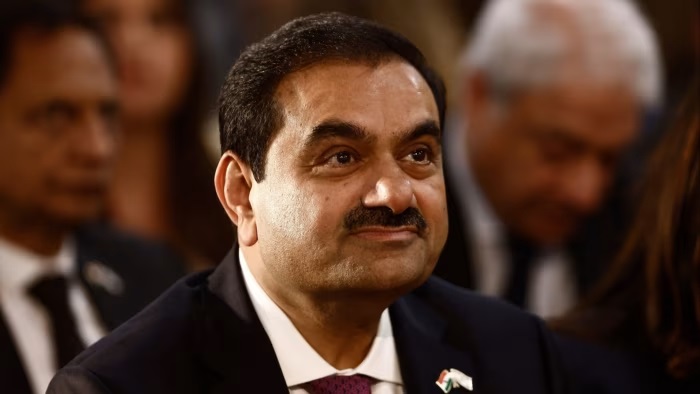
Adani Group announced on Tuesday that it plans to invest $100 billion over the next decade to develop renewable energy-powered, AI-ready data centers, aiming to create the world’s largest integrated data center platform and establish India as a major global player in artificial intelligence infrastructure.
Chairman Gautam Adani described the initiative as a cornerstone of India’s participation in what he called “the Intelligence Revolution — more profound than any previous Industrial Revolution.” The company stated that the $100 billion investment would generate a $250 billion AI infrastructure ecosystem in India by 2035, while catalyzing an additional $150 billion in spending across server manufacturing, sovereign cloud platforms, and supporting industries.
The announcement aligns with India’s broader push to become a significant AI hub in the Global South. It coincides with the ongoing AI Impact Summit in New Delhi (February 16–20, 2026), India’s first major international AI conference, featuring global leaders such as OpenAI CEO Sam Altman and Alphabet CEO Sundar Pichai.
Register for Tekedia Mini-MBA edition 20 (June 8 – Sept 5, 2026).
Register for Tekedia AI in Business Masterclass.
Join Tekedia Capital Syndicate and co-invest in great global startups.
Register for Tekedia AI Lab.
Key Elements of the Adani Plan. Adani’s vision builds on AdaniConnex — its joint venture with U.S.-based data center operator EdgeConnex — which currently operates 2 gigawatts (GW) of national data center capacity. The company aims to scale this to 5 GW as part of the broader $100 billion program. All facilities will be powered by renewable energy, leveraging Adani Green Energy’s massive solar and wind portfolio to meet the enormous power demands of AI data centers.
The plan includes large-scale campuses across India, with strategic partnerships already in place. Google (Alphabet) announced in October 2025 a $15 billion investment over five years to build an AI data center hub in southern India, and Adani said it is in talks with other major global players to establish additional facilities. While specific names were not disclosed, the scale suggests potential involvement from hyperscalers seeking low-cost, renewable-powered capacity in Asia.
Market Reaction and Stock Performance
Adani Enterprises, the flagship listed entity of the Adani Group, rose 2.3% on the news, making it one of the top gainers on the benchmark Nifty 50 index. Adani Green Energy shares gained 1.8%. The positive response underlines investor enthusiasm for Adani’s pivot toward high-growth AI infrastructure, which complements its existing strengths in ports, airports, energy, and renewables.

However, Adani stocks remain volatile. Late last month, U.S. Securities and Exchange Commission (SEC) court filings revealed efforts to serve summons on Gautam Adani and nephew Sagar Adani in connection with a November 2024 New York federal indictment alleging bribery and fraud in a massive scheme involving solar energy contracts. India’s Ministry of Law and Justice twice refused to deliver the summons under the Hague Convention in 2025, complicating the case.
India’s Rising AI Role
India’s AI ambitions are accelerating rapidly. The government has set targets to become a global AI powerhouse, with initiatives like the IndiaAI Mission (?10,300 crore allocation) and plans for sovereign cloud infrastructure. But data centers are a critical bottleneck: India’s current capacity is around 1 GW, but demand from hyperscalers, domestic tech firms, and AI startups is expected to grow exponentially as the country aims for 10% of global AI compute share by 2030.
Adani’s $100 billion commitment, if fully realized, would dwarf current capacity and position India as a major alternative to traditional hubs like the U.S., Singapore, and Europe. The renewable energy focus addresses both sustainability concerns and the massive power requirements of AI workloads (a single large data center can consume as much electricity as a small city). The plan also aligns with India’s “Make in India” and “Atmanirbhar Bharat” (self-reliant India) initiatives, aiming to build domestic server manufacturing, cooling systems, and ancillary industries.

The projected $150 billion in ecosystem spending would create thousands of jobs and stimulate manufacturing in semiconductors, power electronics, and data center hardware.
The Challenges Ahead
Building 5 GW of AI-ready, renewable-powered data center capacity requires massive capital, land, power infrastructure, and regulatory approvals. India’s power grid faces constraints, and renewable integration at this scale will demand significant investment in transmission and storage.
Also, the ongoing U.S. SEC case and bribery allegations create reputational risk, even if they remain unresolved. Competition is fierce: global hyperscalers (Google, Microsoft, AWS, Meta) are expanding in India, while domestic players like Reliance Jio and Tata Communications are building large-scale data centers.
In addition, Adani Group’s aggressive expansion across ports, airports, energy, and now AI infrastructure has drawn scrutiny over debt levels and governance. The group’s ability to deliver on the $100 billion pledge while maintaining financial discipline will be closely watched.
However, the announcement reinforces India’s growing role in global AI infrastructure. With the U.S. facing power constraints in traditional data center hubs and Europe grappling with energy costs, India’s low-cost renewable energy, large talent pool, and government support make it an attractive destination.
The AI Impact Summit provides a high-profile platform for Adani to showcase the plan to global leaders. Participation from Altman, Pichai, and other executives underscores India’s rising relevance in the AI ecosystem. For investors, the news strengthens the case for Adani Group stocks as a proxy for India’s infrastructure and AI growth story. Adani Enterprises and Adani Green Energy have been volatile but resilient, reflecting confidence in Gautam Adani’s execution ability despite legal and geopolitical challenges.
Analysts expect India’s positioning as a creator and exporter of intelligence, not just a consumer, to buoy Adani’s $100 billion bet to become one of the defining infrastructure plays of the decade. Success would accelerate India’s AI ambitions, create a massive domestic ecosystem, and challenge established data center hubs worldwide.