

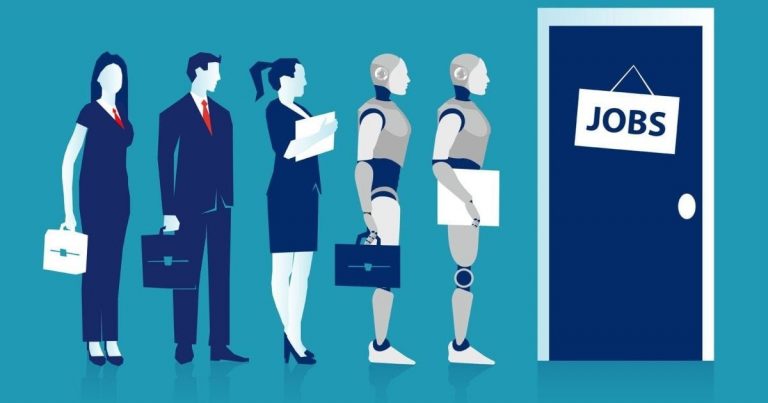
The U.S. job market just recorded its worst October layoff numbers in more than two decades as the rapid rise of artificial intelligence is reshaping industries and accelerating cost-cutting measures.
According to a new report from Challenger, Gray & Christmas, companies announced over 153,000 job cuts last month, nearly three times the number seen a year earlier.
While some sectors are still correcting after pandemic-era over-hiring, analysts say a growing share of layoffs is now tied to AI-driven restructuring, as businesses rush to automate tasks, streamline operations, and reduce labor costs in a tightening economic climate.
Register for Tekedia Mini-MBA edition 20 (June 8 – Sept 5, 2026).
Register for Tekedia AI in Business Masterclass.
Join Tekedia Capital Syndicate and co-invest in great global startups.
Register for Tekedia AI Lab.
The report noted that weakened consumer and business spending has contributed to significant workforce cuts, particularly in warehousing and logistics. Many industries are now correcting previous hiring surges from the pandemic era, shifting toward leaner operational models.
John Challenger, CEO of Challenger, Gray & Christmas, highlighted the scale of the trend, stating that layoffs of this magnitude, such as 48,000 job cuts from UPS and potentially 30,000 from Amazon, are reminiscent of major workforce reductions seen during the 2020 pandemic and the 2009 recession. “When companies make cuts of this size, it signals a real shift in direction,” he said.
Research shows the U.S. has now lost over one million jobs in 2025, the highest total since the pandemic era. Analysts attribute this not only to economic downturns but also to AI-driven restructuring. Andy Challenger, chief revenue officer at the firm, noted that AI is proving to be as disruptive as it was in the early 2000s, fundamentally reshaping how organizations operate.

Tech companies remain at the forefront of AI-driven cuts;
Enrico Moretti, an economics professor at the University of California, Berkeley, said that the largest tech companies like Amazon are at the forefront of AI-related job cuts, “in part because they’re both producers and consumers of AI”.
Recall that the e-commerce giant, which confirmed plans to cut roughly 14,000 corporate roles, said it needs to be “organized more leanly” to seize the opportunity provided by AI. Also, UPS disclosed that it has cut 48,000 jobs since last year. The delivery company’s chief executive previously linked redundancies, in part, to machine learning. Tech giant Microsoft announced plans to cut around 4% of its workforce, which translates to thousands of jobs, as it looks to rein in costs while making heavy investments in AI infrastructure.
Microsoft’s President & Vice-Chair acknowledged that while AI efficiency gains weren’t the main driver of the layoffs, the costs of scaling AI infrastructure and the need to reallocate resources toward growth influenced the decision.

Some companies have outright said they’re replacing workers with AI. Klarna CEO Sebastian Siemiatkowski said in May that the company was able to shrink its headcount by about 40%, in part because of AI. Duolingo said in April that it would stop using contractors for work that AI can handle. Salesforce laid off 4,000 customer support roles in September, saying that AI can do 50% of the work at the company.
In some cases, entire HR, support, and operations departments are being restructured as AI systems assume tasks such as scheduling, customer support, fraud monitoring, and data processing.
Outside of tech, financial services, retail, and logistics are also accelerating automation. Companies in these sectors are increasingly using AI to; Analyze customer behavior, detect risk, manage supply chains, forecast demand, Automate back-office accounting and compliance workflows.
This shift enables faster decision-making, but often at the expense of traditional administrative and clerical roles. This trend is reinforced by a Wharton study showing that 74% of enterprises are already experiencing positive returns from their AI investments.
Notably, while the financial benefits of AI are clear, the transition raises critical questions. As companies prove they can accomplish more with fewer employees, experts are asking what becomes of the workers behind those efficiencies.