

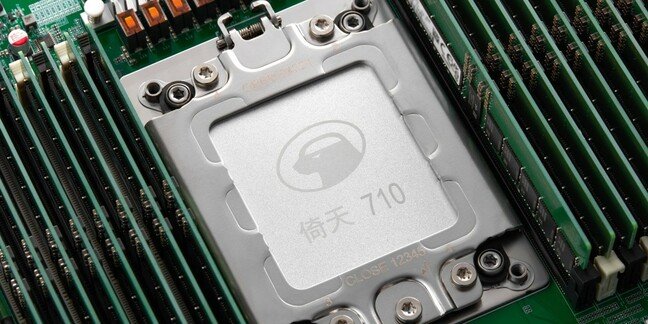
Alibaba Group on Wednesday unveiled a new artificial intelligence processor, the Zhenwu M890, marking one of China’s most ambitious attempts yet to build a domestic alternative to chips made by Nvidia as U.S. export restrictions tighten around advanced semiconductors.
The new chip, developed by Alibaba’s semiconductor arm T-Head, is designed specifically for the next generation of AI “agents,” autonomous software systems capable of executing complex tasks with limited human supervision. Alibaba said the Zhenwu M890 delivers roughly three times the performance of its earlier-generation Zhenwu 810E processor.
The launch highlights how China’s biggest technology companies are accelerating efforts to reduce reliance on U.S. semiconductor technology as Washington expands controls on exports of high-end AI chips to Chinese firms. The restrictions have forced companies across China’s cloud computing and AI sectors to intensify investment in homegrown processors, networking systems, and AI infrastructure.
Register for the next Tekedia Mini-MBA.
Register for Tekedia AI in Business Masterclass.
Join Tekedia Capital Syndicate and co-invest in great global startups.
Alibaba said the M890 is optimized for workloads that require large memory capacity, long-context processing, and rapid communication between models, capabilities increasingly viewed as critical as AI systems evolve from chatbots into more autonomous digital agents capable of carrying out multi-step enterprise tasks.
The company also outlined a longer-term semiconductor roadmap that signals sustained investment in proprietary AI silicon. Alibaba said a next-generation processor, the V900, is scheduled for release in the third quarter of 2027 and is expected to deliver another roughly threefold performance increase over the M890. A further chip, the J900, is planned for the third quarter of 2028.
The roadmap mirrors strategies pursued by leading U.S. hyperscalers such as Amazon, Google, and Microsoft, all of which have increasingly shifted toward designing custom AI chips to reduce dependence on Nvidia’s dominant graphics processors and lower infrastructure costs.

For China, however, the issue extends beyond economics into technology sovereignty and national security. U.S. export controls introduced over the past several years have barred Chinese firms from accessing Nvidia’s most advanced AI accelerators, including top-tier chips used to train frontier AI models. Washington argues the restrictions are necessary to prevent advanced computing technologies from strengthening China’s military and surveillance capabilities.
The tightening controls have triggered a broad domestic push across China’s semiconductor industry. Huawei Technologies has already introduced its own AI accelerators, while firms including Alibaba and Baidu are increasing investment in indigenous cloud and AI infrastructure.
Alibaba’s announcement came during its annual Alibaba Cloud Summit, where the company also introduced a new server system called the Panjiu AL128. The platform integrates 128 M890 accelerators into a single rack architecture aimed at enterprise-scale AI deployments.

The system is being made immediately available to Chinese enterprise customers through Alibaba Cloud’s domestic AI platform, Bailian, reflecting the company’s strategy of tightly integrating chips, cloud infrastructure, and AI software into a vertically connected ecosystem.
The company disclosed that T-Head has already shipped more than 560,000 Zhenwu processors, with more than 400 external customers across 20 industries deploying the chips. Alibaba said users include automotive manufacturers and financial services companies, sectors where demand for AI inference and autonomous systems is accelerating rapidly.
The chip unveiling accompanies Alibaba’s broader push into AI infrastructure. Last year, the company pledged to invest more than 380 billion yuan, or roughly $53 billion, into cloud and AI infrastructure over three years, its largest-ever technology spending commitment.
That spending surge points to a growing consensus across China’s technology sector that AI demand will continue expanding sharply as businesses deploy autonomous agents, industrial AI systems, and enterprise automation tools.
Alibaba also used the summit to unveil Qwen 3.7-Max, the latest version of its flagship large language model. The company said the model is optimized for advanced coding tasks and extended agent operations, claiming it can run continuously for up to 35 hours without significant performance degradation.
The focus on long-duration AI operations underscores a broader industry shift toward “agentic AI,” where models are expected not only to answer prompts but also independently execute workflows, coordinate software tools, and manage extended chains of reasoning.
That trend is rapidly increasing demand for computing infrastructure capable of handling persistent memory workloads and real-time coordination between AI systems, areas where Nvidia currently dominates globally through its GPUs and networking stack.