

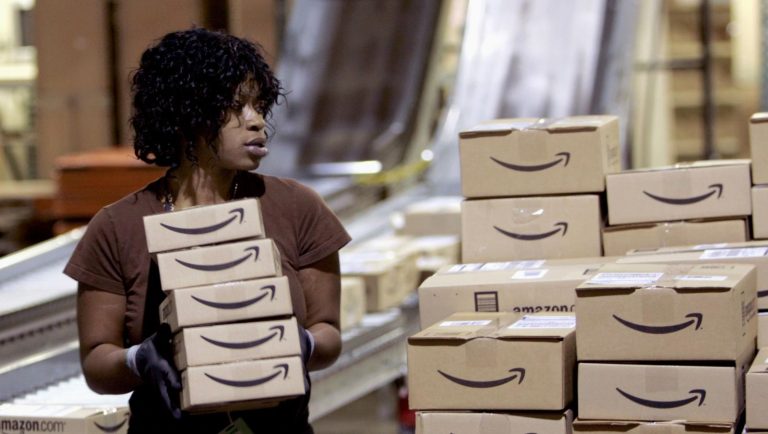
Amazon CEO Andy Jassy has confirmed that President Donald Trump’s sweeping tariffs are beginning to affect consumer prices, marking a turning point in the trade policy’s impact on one of the world’s largest online marketplaces.
His comments, made Tuesday at the World Economic Forum in Davos during an interview with CNBC’s Becky Quick, highlight the complex balancing act retailers face as global trade tensions translate into domestic cost pressures.
According to Jassy, Amazon and its vast network of third-party merchants initially attempted to shield consumers by pre-purchasing inventory ahead of the tariff hikes, a strategy aimed at delaying the effect of rising import costs.
Register for Tekedia Mini-MBA edition 20 (June 8 – Sept 5, 2026).
Register for Tekedia AI in Business Masterclass.
Join Tekedia Capital Syndicate and co-invest in great global startups.
Register for Tekedia AI Lab.
“Most of that supply ran out last fall,” he said, explaining why price increases are now becoming more noticeable across certain categories.
In July 2025, Apollo Global Management’s chief economist Torsten Sløk warned that the most damaging effects of Trump’s sweeping tariff policies would begin to grip the U.S. economy toward the end of the year, potentially setting off a dreaded stagflation shock that could drag into 2026.
However, the impact is uneven as some sellers are passing increased costs directly to consumers, while others absorb some of the extra expense to maintain demand. A third segment is adopting a hybrid approach, splitting the cost between the business and shoppers.

Jassy described this as the point where “you start to see some of the tariffs creep into some of the prices.”
This development represents a shift from Amazon’s earlier position. Following the initial imposition of tariffs, Jassy had maintained that prices had not “appreciably gone up.” However, he had also cautioned that businesses with limited margins would eventually face pressure to adjust prices.
“Some businesses don’t have 50% extra margin that you can play with,” he said in April, foreshadowing the current pricing reality.

Retail Margins Under Pressure
Retail operates on thin mid-single-digit margins, leaving little room to absorb a sudden 10% increase in input costs without affecting the bottom line. Jassy emphasized that “you don’t have endless options” to absorb tariffs, suggesting that further price increases across a broad range of products may be inevitable.
Trade associations have also been warning of broader consequences. Last August, a major retail trade group predicted that tariffs could complicate inventory planning, potentially reduce product availability, and even trigger job losses. Amazon’s experience offers an early case study of these predictions: companies pre-purchased inventory to mitigate price shocks, but as that stock depletes, the full effect of tariffs on pricing is emerging.
Despite the price pressures, Jassy noted that consumers remain resilient. While some shoppers are trading down to cheaper alternatives or postponing discretionary purchases, overall spending continues.
“Consumers are still spending amid the tariffs,” he said, highlighting that the immediate demand shock has been muted, though behavioral adjustments are evident.
Bargain hunting, switching to lower-cost brands, and postponing luxury purchases are emerging trends, signaling that households are adapting to higher costs without entirely curtailing consumption.
Broader Implications for Global Supply Chains
Amazon’s experience reflects the broader ripple effects of U.S. trade policy on global supply chains. Companies that rely on imported goods are now confronting higher costs for everything from electronics and apparel to household items. For multinational retailers, the challenge lies in balancing inventory strategy, pricing, and customer loyalty while maintaining competitiveness.
The issue also intersects with inflation dynamics. As tariffs contribute to higher retail prices, there is potential for broader impacts on consumer price indices and monetary policy decisions. Economists have long noted that tariffs, while aimed at protecting domestic industries, can act as a hidden sales tax on consumers and disrupt finely tuned global supply networks.
Some companies are exploring alternative sourcing strategies or shifting production to countries not affected by U.S. tariffs to mitigate cost pressures. Amazon itself has invested in logistics, warehousing, and technology infrastructure to better manage its supply chain and maintain competitive pricing.
However, the CEO’s remarks suggest that even large, tech-enabled platforms face limits in fully offsetting the economic impact of broad trade measures.
Looking ahead, Amazon and other retailers will likely continue to grapple with the dual pressures of tariffs and thin profit margins. While consumers are adjusting their buying behavior, sustained cost increases could slowly feed into higher prices across categories, affecting household budgets and consumption patterns.
Analysts say retailers will need to balance margin management, inventory planning, and customer experience to navigate what Jassy called an “unavoidable” shift in the market landscape.
While pre-purchased inventory and margin absorption temporarily shielded customers, the limits of these measures are now visible, signaling that Trump’s tariffs are beginning to filter through the U.S. retail ecosystem with real-world consequences for both businesses and consumers.