

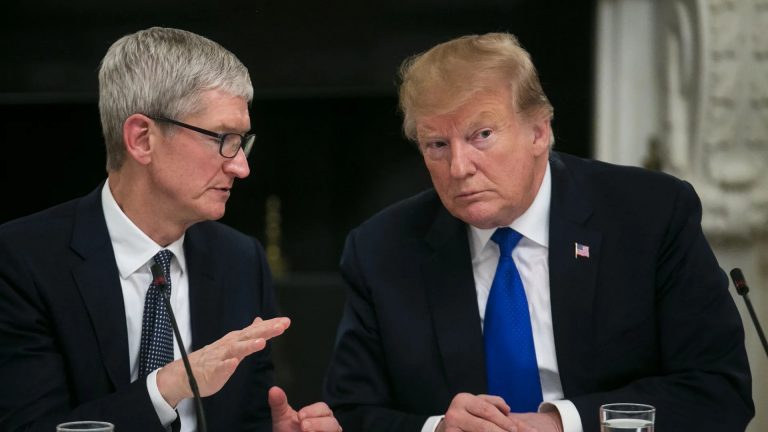
President Donald Trump and Apple CEO Tim Cook on Wednesday announced a sweeping plan that will see the tech giant invest an additional $100 billion into the U.S. economy over the next four years—a move Trump hailed as the largest commitment Apple has ever made domestically or abroad.
The announcement bolsters Apple’s total pledged U.S. investment under Trump’s presidency to $600 billion, solidifying the company’s position as a central player in the administration’s push to rebuild America’s industrial base.
Speaking alongside Cook at the White House, Trump praised the iPhone maker for “coming home” after years of being seen as more invested in foreign manufacturing.
Register for Tekedia Mini-MBA edition 20 (June 8 – Sept 5, 2026).
Register for Tekedia AI in Business Masterclass.
Join Tekedia Capital Syndicate and co-invest in great global startups.
Register for Tekedia AI Lab.
“This is the largest investment Apple has ever made in America and anywhere else,” Trump said. “Apple has been an investor in other countries a little bit, I won’t say which ones, but a couple, and they’re coming home.”
The new $100 billion commitment builds on a $500 billion pledge Apple made in February, following what Cook described as a direct challenge from Trump to do more.
“President Trump shared some kind words about that work, but he also asked us to think about what more we could commit to doing,” Cook said. “Mr. President, we took that challenge very seriously.”

Apple’s expanded investment includes a wide array of U.S.-based suppliers and facilities, with a stated goal of creating a fully domestic chip and component supply chain. At the center of this is Apple’s so-called American Manufacturing Program, which now counts more than a dozen strategic partners, including Corning, Coherent, GlobalWafers, Applied Materials, Texas Instruments, Samsung, GlobalFoundries, Amkor, and Broadcom.
Glass, Lasers, and Chips: Building Apple’s Supply Chain in America
Apple said it would spend $2.5 billion to expand its partnership with Corning, which manufactures glass for iPhones and Apple Watches at its Kentucky facility. On Wednesday, Cook presented Trump with a souvenir made of Corning’s glass, symbolizing what both leaders described as a long-term commitment to reshoring advanced manufacturing.
The company also announced a multi-year deal with Coherent to produce lasers used in the iPhone’s facial recognition system. Apple said the partnership would bolster its U.S. sensor supply chain, which is becoming increasingly vital to its smartphone and wearables business.

Meanwhile, Apple revealed that it expects its U.S.-based supply chain to manufacture more than 19 billion chips this year alone, a scale of production that spans multiple states and suppliers. That includes chips produced by TSMC at its Arizona plant, as well as U.S.-made wafers from GlobalWafers, and semiconductor components from Texas Instruments, which will be installing new tools at facilities in both Utah and Texas.
Apple also named GlobalFoundries as the manufacturer for its wireless charging modules. The chips will be produced in New York, leveraging GlobalFoundries’ capabilities as a U.S.-based foundry that already supplies legacy chips for federal government contracts.
The initiative aims to create an “end-to-end” supply chain—a concept that means every phase of Apple’s chipmaking process, from raw materials to final assembly, can happen within the U.S.
Data Centers and Rare Earths
Beyond semiconductors, Apple is also expanding its data center footprint across North Carolina, Iowa, Nevada, and Oregon. The company originally announced $10 billion in planned data center investments in those states, a number that has since been exceeded.
The company also reiterated its earlier pledge to invest $500 million in a rare earths mining venture, part of a strategy to ensure that vital raw materials used in batteries and device motors can be sourced locally, reducing reliance on China and other foreign suppliers.
Trade Policy and Tariff Implications
The announcement comes amid escalating trade tensions, including new U.S. tariffs on India—a move by Trump in response to India’s increasing imports of Russian oil. While Apple has shifted much of its iPhone assembly to India in recent years to avoid tariffs on Chinese goods, the new India-focused import taxes, which raise rates to 25%, pose another layer of cost pressures.
However, White House officials told CNBC that Apple is expected to be “largely unaffected” by the India tariffs, thanks to existing exemptions and sourcing strategies.
Still, the company acknowledged that existing tariffs—particularly those on Chinese imports—will cost Apple an estimated $1.1 billion this quarter. Apple is also closely watching the outcome of a Section 232 investigation that could impose even higher import taxes on semiconductors, further impacting its bottom line.
This isn’t the first time Apple has made splashy U.S. investment announcements. In 2018, under pressure during Trump’s first term, the company committed to $350 billion in U.S. spending over five years. In 2021, it upped that figure to $430 billion.
But the latest commitments far outpace those earlier pledges. The combined $600 billion now represents an average of $125 billion in annual U.S. spending—nearly double the $70 billion per year Apple pledged in 2018.
Much of that investment has already materialized. The company has built out data centers, funded suppliers, and launched a $10 billion manufacturing fund, which supports U.S.-based firms like Corning. Suppliers do not publicly disclose how much of their revenue comes from Apple, but analysts say the tech company is among the largest private-sector drivers of advanced manufacturing growth in the country.
The Bigger Picture
Wednesday’s announcement reinforces Trump’s agenda to use executive and economic pressure to push multinational companies toward domestic reinvestment.
“There are a lot of factories and a lot of plants that are either under construction or soon we’ll be starting construction,” Trump said. “So can’t tell you exactly when, but I want to be around a year from now.”
The Apple deal is likely to serve as a flagship example of that policy in action. With tech manufacturing now entangled in geopolitics, tariffs, and supply chain reengineering, Apple’s massive U.S. commitment provides both political cover and strategic reassurance.