

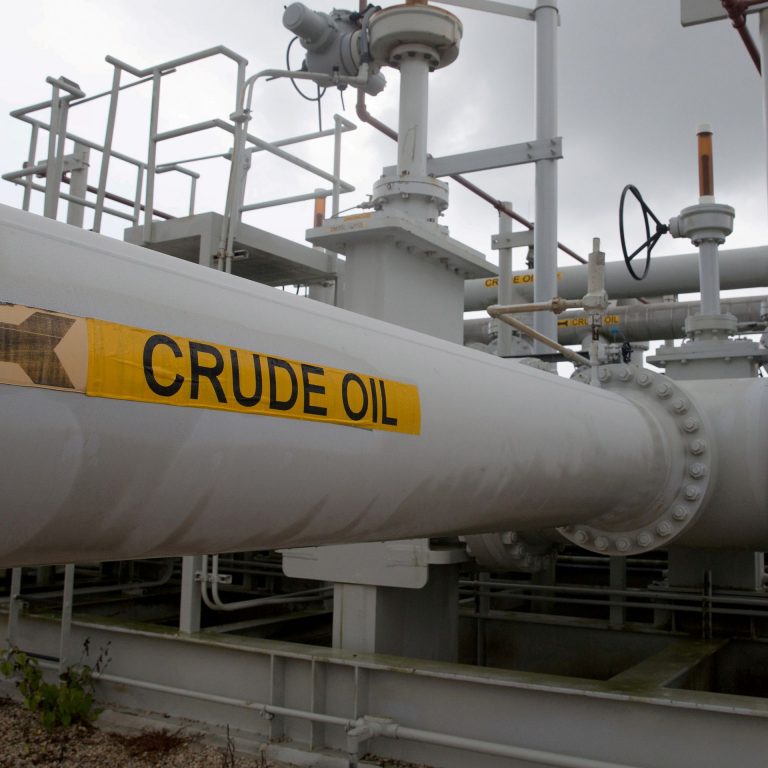
Saudi Aramco has told at least two European refining customers that they will receive no Saudi crude oil next month, Bloomberg News reported on Friday, as an attack on the kingdom’s critical East-West pipeline disrupts established supply flows and forces refiners to search for replacement barrels.
The development represents a further escalation of the disruption created by the attack. European refiners typically rely on term contracts with Saudi Aramco for predictable monthly crude deliveries, but at least two customers have now been told that their October supplies will not proceed, according to people familiar with the matter cited by Bloomberg.
The immediate consequence is a scramble for alternative crude. Poland’s Orlen, one of the affected buyers, has already been seeking replacement supplies, with traders saying the refiner bought North Sea crude to compensate for disrupted Saudi deliveries.
Register for the next Tekedia Mini-MBA.
Register for Tekedia AI in Business Masterclass.
Join Tekedia Capital Syndicate and co-invest in great global startups.
The significance for the wider oil market extends beyond the individual cargoes that have been cancelled. Saudi Arabia is one of the world’s most important crude suppliers, and any interruption to its established export infrastructure forces refiners to compete for alternative grades from other producers. That can increase crude procurement costs, freight rates and, depending on the duration of the disruption, refined-product prices.
The attack damaged three pumping stations along Saudi Arabia’s East-West pipeline, which transports crude from the kingdom’s oil-producing region in the east toward the Red Sea port of Yanbu. The pipeline provides Saudi Arabia with an alternative export route that reduces its reliance on the Strait of Hormuz.
Aramco is working to partially restart the pipeline within days and restore full capacity within six weeks, Bloomberg reported. In the meantime, the company has been increasing crude movements from its Gulf operations through ship-to-ship transfers near Oman’s Sohar port.

Trade sources said Aramco plans to move about 60 million barrels from its Gulf port of Ras Tanura through ship-to-ship transfers at Sohar during September and October, equivalent to roughly 1 million to 1.5 million barrels per day.
Those measures could reduce the immediate impact of the pipeline shutdown, but they do not eliminate the disruption. The cancellation of contracted European supplies shows that logistical workarounds are not yet sufficient to maintain all established customer flows.
A Potential Opening for Dangote
For Nigeria’s Dangote Refinery, the timing creates an unusually favorable commercial environment.

The refinery is currently at the center of an initial public offering through which Dangote is seeking to raise about 2.15 trillion naira, or roughly $1.6 billion, from the sale of 4.1 billion shares at 525 naira each. The offering values the refinery at roughly $47 billion and is scheduled to close on October 13.
The Saudi disruption provides investors with a real-world example of why large refining capacity outside traditional Middle Eastern supply corridors can become valuable when geopolitical shocks disrupt global energy flows.
Dangote is already operating at about 700,000 barrels per day, its current processing capacity, and has increasingly established itself as an important supplier of refined products beyond Nigeria.
The refinery generated $1.82 billion in after-tax profit in the first half of 2026, compared with a $476 million loss for all of 2025. Its growing exports of jet fuel, diesel and gasoil have also given the plant a larger role in international petroleum markets.
The Saudi disruption could strengthen that position if European buyers continue looking for alternative sources of refined products as Middle Eastern crude and refining operations remain vulnerable to attacks and transport disruptions.
For Dangote, the opportunity is not necessarily about replacing the Saudi crude that European refiners have lost. Rather, it is about benefiting from the broader market consequences of that shortage.
When refiners lose access to contracted crude, they have to compete for replacement barrels. When regional refining capacity or crude transportation is disrupted, buyers also become more dependent on refiners elsewhere that have available production. If those conditions push up product prices and refining margins, a large refinery with access to international markets can benefit.
But there is a hard limit to how much Dangote can capture.
The refinery can currently process about 700,000 barrels of crude per day. It cannot immediately increase that figure simply because international fuel markets have become tighter.
That constraint bears a heavy impact as Dangote prepares its IPO because the company’s longer-term investment proposition is built around substantially greater capacity.
Dangote plans to double the refinery’s capacity to 1.4 million barrels per day by 2029. The additional capacity would give the company significantly greater ability to serve Nigeria, supply other African markets and maintain exports to Europe and other international destinations at the same time.
At 700,000 bpd, Dangote is already a major single-site refinery. At 1.4 million bpd, it would become one of the world’s largest refining complexes, giving the company considerably more flexibility to allocate production toward markets offering the strongest margins.
That flexibility becomes particularly valuable during supply disruptions.
The IPO Is Betting On Future Scale
The current geopolitical crisis thus arrives at an important moment for Dangote. The refinery is demonstrating strong earnings at the same time that disruptions in Middle Eastern energy infrastructure are creating tighter global petroleum markets. Analysts say that combination can strengthen the near-term economics of the business and provide investors with a tangible illustration of the value of additional refining capacity.
But investors need to separate the temporary benefit of a supply shock from the refinery’s underlying long-term economics.
Geopolitical disruptions can produce unusually high refining margins because crude supplies become constrained while demand for fuels remains relatively firm. Refiners that have available capacity and access to alternative crude can capture those spreads.
While those conditions can generate exceptional profits, they cannot automatically be assumed to persist.
If Saudi Arabia restores the East-West pipeline within the expected six-week timeframe, crude exports normalize, and Middle Eastern refining capacity recovers, some of the scarcity premium supporting current fuel prices could disappear.
That makes the timing of Dangote’s IPO significant. The company is asking investors to value not only the refinery’s current earnings but also its future expansion and its ability to remain profitable when market conditions become less favorable.
Reuters Breakingviews has calculated that the offering implies a valuation of roughly $50 billion and noted that Dangote’s implied 2026 EBITDA multiple is substantially above those of major U.S. refiners including Valero, Marathon Petroleum and Phillips 66.
That premium effectively places considerable value on the refinery’s future growth. The Saudi disruption strengthens the argument that additional refining capacity can be valuable in a fragmented global energy market. It does not, by itself, establish that the IPO valuation is justified.