

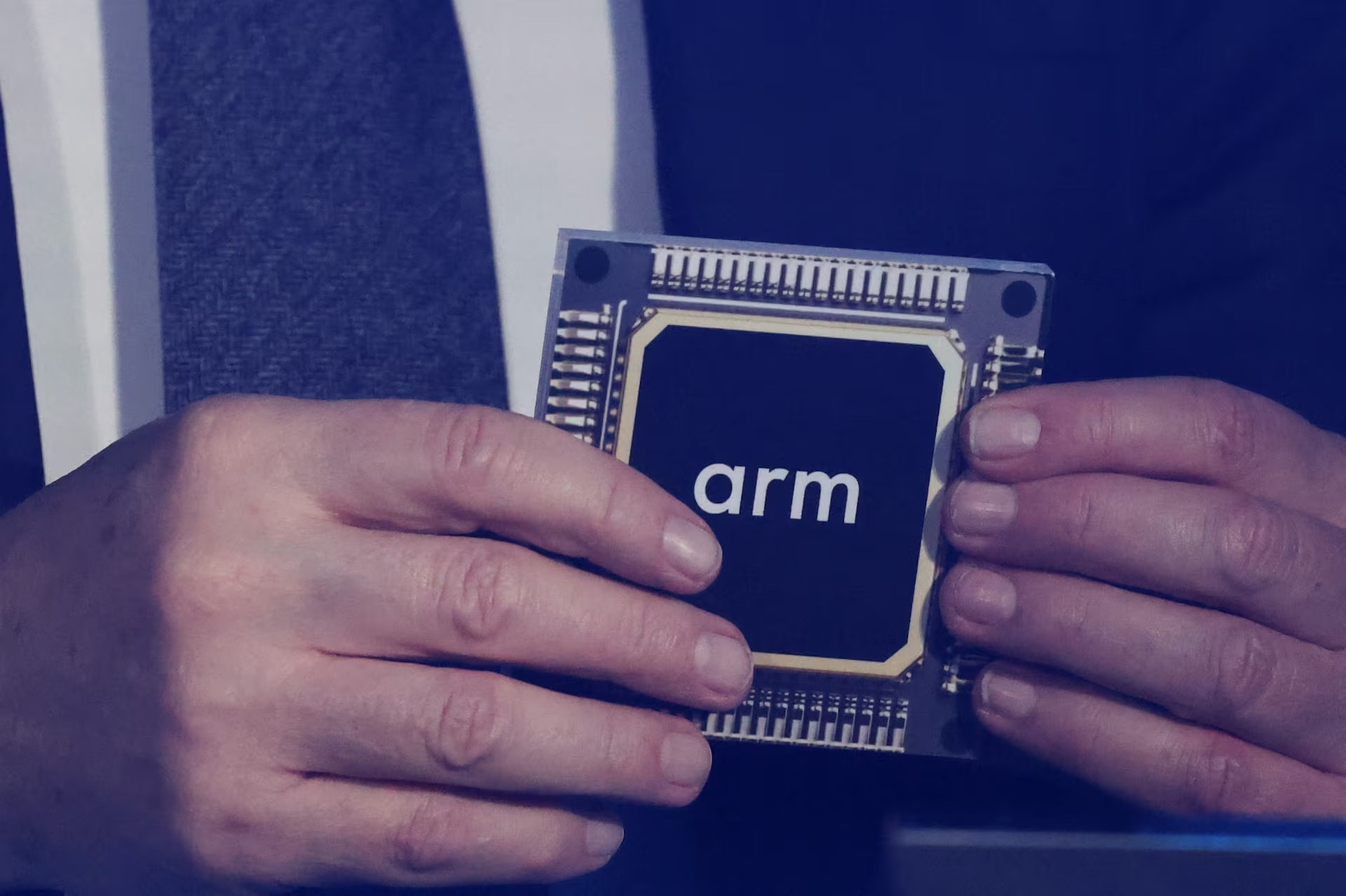
Arm Holdings CEO Rene Haas has extended his contract to lead the British chip designer through 2033, reinforcing his commitment to the company after speculation that Nvidia could approach him to replace Jensen Huang following the latter’s unexpected resignation.
The contract extension strengthens Arm’s leadership continuity at a time when the semiconductor industry is undergoing rapid changes driven by artificial intelligence demand, intensifying competition for computing infrastructure and growing investment in custom-designed processors. It also removes one of the most prominent names discussed in connection with Nvidia’s search for a permanent chief executive.
Haas had emerged as a potential successor to Huang after Nvidia’s board reportedly approached him during its search for a replacement, before Huang was reinstated.
Register for the next Tekedia Mini-MBA.
Register for Tekedia AI in Business Masterclass.
Join Tekedia Capital Syndicate and co-invest in great global startups.
Haas was considered a credible candidate partly because of his previous experience at Nvidia, where he rose to vice president and general manager of its computing products business before joining Arm in 2013. His familiarity with Nvidia’s operations, semiconductor technology and commercial relationships made him a potentially attractive choice for a company facing the challenge of sustaining its leadership in the AI chip market.
His decision to extend his Arm contract through 2033, however, provides a stronger indication of his long-term commitment to the company. It also preserves leadership stability at a business whose processor architecture has become central to the global semiconductor industry.
“I’ve never been more confident about Arm’s future … I’m wholly committed to realizing Arm’s full potential for many years to come,” Haas said in a statement on Monday.

Haas became Arm’s chief executive in 2022, taking charge ahead of the company’s return to public markets through its $65 billion Nasdaq listing in 2023. Under his leadership, Arm has strengthened its position in the semiconductor industry as demand for energy-efficient computing architectures expands beyond smartphones into data centers, personal computers, automotive systems and connected devices.
Arm’s business model gives it a distinctive position in the chip industry. Rather than manufacturing most of the processors built around its technology, the company licenses its instruction-set architecture and processor designs to semiconductor manufacturers and technology companies. It earns revenue from licensing agreements and royalties when customers incorporate its technology into commercial products.
This model has allowed Arm to maintain relationships across the semiconductor industry, including with companies that compete against one another. Nvidia, for instance, relies on Arm’s architecture for several of its processor products, while developing its own specialized graphics processing units and AI accelerators.

The relationship illustrates why Haas’s potential move to Nvidia attracted attention. He would have brought knowledge of both companies, potentially helping Nvidia navigate its dependence on Arm’s technology while expanding its broader computing portfolio. His departure from Arm, however, would also have introduced uncertainty at a company seeking to capture a larger share of the growing market for AI infrastructure.
Arm’s strategic importance is rising as technology companies seek alternatives to traditional x86 processors and pursue more energy-efficient computing systems. Its architecture is increasingly relevant to data-center operators looking to manage the power consumption and operating costs associated with AI workloads. As demand for inference grows, processor efficiency is becoming an important consideration alongside raw computing performance.
Nvidia’s position in this market also makes its leadership transition consequential. Huang built the company into the dominant supplier of AI accelerators, supported by its hardware, networking systems, and CUDA software ecosystem. Finding a successor capable of maintaining that technological and commercial advantage would be a significant undertaking, particularly as competitors invest heavily in alternative AI chips.
Haas’s contract extension also strengthens his position within SoftBank Group, which holds a controlling stake in Arm. Effective December 1, he will assume the additional role of vice chairman of the Japanese conglomerate.
He already serves on SoftBank’s board and took over leadership of its international business in April, expanding his responsibilities beyond Arm’s semiconductor operations. The additional appointment places him closer to SoftBank founder Masayoshi Son’s broader technology investment strategy, which includes substantial commitments to artificial intelligence and computing infrastructure.
For SoftBank, retaining Haas provides continuity at one of its most important technology holdings while giving the group an experienced semiconductor executive in a senior leadership position. Arm’s performance is key to the value of SoftBank’s investment, particularly as the company seeks to capitalize on rising demand for AI-related computing technology.
Arm’s US-listed shares rose nearly 9% in premarket trading, although the advance came amid a broader recovery in AI stocks following last week’s sharp selloff. The movement therefore cannot be attributed solely to Haas’s contract extension.
The longer contract gives Arm greater certainty over its leadership as it pursues opportunities in AI computing, while underpinning how executive leadership has become closely tied to the competition for control of the technologies underpinning the next generation of computing.