

The race to dominate artificial intelligence has a new—and often overlooked—frontline: electricity. At the World Economic Forum in Davos, Switzerland, industry and political leaders converged on one point with striking clarity: AI development at scale cannot exist without abundant, affordable power, and China has a decisive advantage.
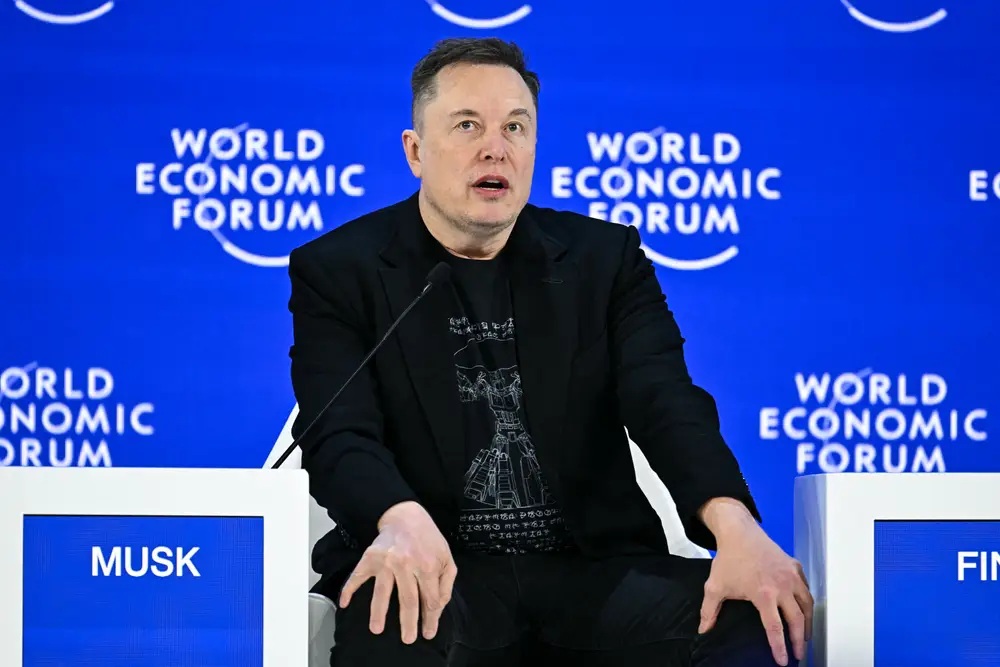
Tesla CEO Elon Musk, in his Davos debut, framed the issue bluntly during a conversation with BlackRock CEO Larry Fink.
“It’s clear that maybe later this year, we will be producing more chips than we can turn on,” Musk said. “Except for China: China’s growth in electricity is tremendous.”
Register for Tekedia Mini-MBA edition 20 (June 8 – Sept 5, 2026).
Register for Tekedia AI in Business Masterclass.
Join Tekedia Capital Syndicate and co-invest in great global startups.
Register for Tekedia AI Lab.
The comments highlighted what U.S. and European AI executives have long feared: that the global race for AI supremacy will be as much about power grids and kilowatt-hours as it is about algorithms and talent.
China’s expansion in energy capacity is staggering. Beijing added roughly 445 gigawatts of generation in the first 11 months of 2025, compared with an anticipated 64 gigawatts for the United States across the entire year, according to the National Energy Administration and the U.S. Energy Information Administration. This gap illustrates how energy-intensive operations such as AI data centers and chip fabrication plants could be limited outside China, potentially slowing AI training cycles, infrastructure deployment, and large-scale experimentation.
Europe’s Energy Bottleneck and Policy Hurdles
European policymakers are acutely aware of the challenge. At a panel on clean power, Romanian Energy Minister Bogdan Ivan framed the issue as a matter of urgency.

“We need speed. We are in a world competing with China, which has one of the most affordable prices in energy,” Ivan said.
He emphasized that without streamlined permitting, diversified energy portfolios, and strategic investment, Europe risks falling behind.
Energy costs in Europe remain structurally higher than in China, with stark variations across member states. For example, EU data shows that in the first half of 2025, Hungary’s non-household electricity price was 17.7% above the EU average, while other nations, including Germany and Italy, faced similarly steep costs. Such disparities have direct implications for energy-intensive industries, particularly AI infrastructure, which consumes megawatts at an unprecedented rate.

Bureaucratic delays compound the problem. Ivan noted that constructing a nuclear or hydroelectric plant can take up to 11 years due to permitting hurdles.
“This timeline is incompatible with the global pace of technological competition,” he said, arguing that Brussels must allow member states to pursue energy solutions suited to local conditions.
Southern European countries may favor solar power, while nations with nuclear expertise, like Romania, should be encouraged to expand along that path.
U.S. Strategy: Nuclear, Permits, and AI Readiness
U.S. President Donald Trump echoed the theme of energy as a critical foundation for AI in his Davos address. He framed energy expansion as national infrastructure, asserting that an adequate supply is essential to maintain America’s AI competitiveness. Trump highlighted efforts to expand nuclear capacity and to expedite permits for new power plants, including private facilities built by tech companies. He framed this approach as a strategic imperative for AI development, positioning the U.S. to keep pace with China’s rapid buildout.
However, Trump’s remarks contained factual inaccuracies. He claimed that China exports wind turbines to Europe but does not operate wind farms domestically. In reality, China leads the world in installed wind capacity, with hundreds of gigawatts deployed nationally. Analysts noted that misstatements like these may undermine confidence in U.S. policy coherence even as the administration accelerates domestic energy production.
The Stakes for AI Infrastructure
The energy-AI link is no longer theoretical. Training a single large language model can require tens of millions of kilowatt-hours, and global AI infrastructure is poised for unprecedented expansion. Nvidia CEO Jensen Huang called the AI buildout “the largest infrastructure buildout in human history,” estimating trillions of dollars will be invested in compute and data centers over the next decade.
Without affordable and reliable energy, such investments could stall or shift to regions with lower costs, amplifying the competitive imbalance.
European leaders are particularly concerned that high electricity prices and regulatory delays will not only hinder AI adoption but also risk ceding industrial leadership to China. Microsoft CEO Satya Nadella, speaking at the same forum, warned that GDP growth in the AI era will be closely linked to energy costs.
“If you have a cheaper commodity, it’s better,” Nadella said, stressing that regions failing to secure low-cost electricity will struggle to translate AI capabilities into economic growth.
China’s head start in energy infrastructure has implications beyond AI competitiveness. Affordable electricity gives Chinese data centers a lower total cost of ownership, while companies can rapidly expand high-performance computing clusters without incurring the capital and operational penalties seen in the U.S. and Europe. The advantage may extend to other strategic sectors, from semiconductor fabrication to electrified manufacturing, reinforcing a broader technology and industrial lead.
For Europe and the U.S., the Davos conversations underscored a pressing reality: AI supremacy will require more than innovation in algorithms or investment in startups. It will demand bold infrastructure policies, accelerated permitting processes, and significant capital commitment to energy generation. Without these steps, experts warn, the gap between energy-rich regions and constrained ones could translate into a durable technological and economic imbalance.
Against this backdrop, the question for policymakers in Washington and Brussels is whether they can move fast enough to ensure that constraint does not define the next decade of AI leadership.