

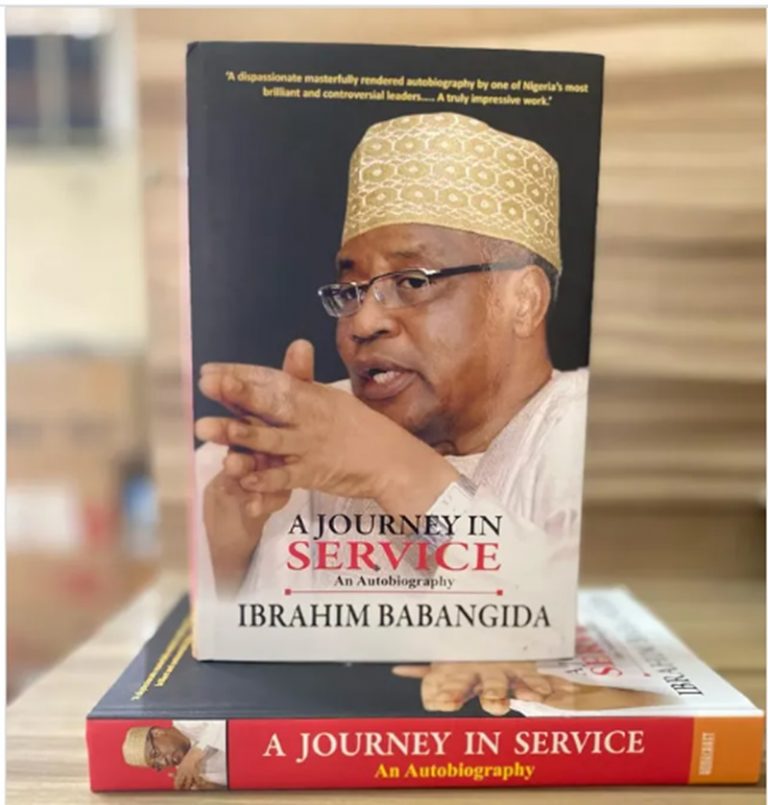
Former Nigerian military president, General Ibrahim Babangida (retd.), has once again found himself at the center of national discourse following the launch of his autobiography titled, ‘A Journey in Service.’
While the event raked in nearly N17 billion in donations from Nigeria’s business elite, it also reignited deep-seated resentment over his controversial past—particularly his role in annulling the historic June 12, 1993, presidential election.
The book launch, which took place in Abuja on Thursday, was attended by Nigeria’s wealthiest business figures, former military officers, and political leaders, all eager to contribute to the establishment of a presidential library in Babangida’s name. The staggering amounts donated underscored the strong ties between Nigeria’s business community and the country’s former leaders, even those with contentious legacies.
Register for Tekedia Mini-MBA edition 20 (June 8 – Sept 5, 2026).
Register for Tekedia AI in Business Masterclass.
Join Tekedia Capital Syndicate and co-invest in great global startups.
Register for Tekedia AI Lab.
Nigeria’s Business Titans Open Their Wallets
Among the biggest contributors was Africa’s richest man, Aliko Dangote, who pledged N8 billion towards the presidential library, promising N2 billion annually for the next four years. Dangote, whose business empire spans cement, sugar, and oil refining, justified the donation by crediting Babangida with creating Nigeria’s private sector in its current form.
“He was the one who really created the private sector in Nigeria. I remember how he issued about 30 banking licenses on the same day,” Dangote remarked at the event.
Another industrial magnate, Abdulsamad Rabiu, Chairman of BUA Group, donated N5 billion, praising Babangida’s impact on Nigeria’s economic structure.

“We are gathered to celebrate more than a person, a building, or an archive. We are gathered to celebrate a sanctuary of memory, a testament to the vision, complexity, and enduring legacies of one of Nigeria’s transformative leaders, General Ibrahim Babangida,” Rabiu stated.
Other high-profile donations included:
- Theophilus Danjuma (retd.) – N3 billion
- Arthur Eze – N500 million
- Senate President Godswill Akpabio – N50 million
- Mustafa Chike-Obi – N100 million
- Folorunsho Alakija and others – Unspecified amounts
The massive fundraising effort is among the largest seen for a private initiative in Nigeria, reinforcing how deeply embedded Babangida remains within the country’s business and political class.

June 12, 93: The Past That Keeps Coming Back
However, while Babangida was being celebrated in elite circles, a different conversation was raging across Nigeria. His book, which for the first time acknowledged that Chief Moshood Abiola clearly won the June 12 election, was met with outrage rather than absolution.
For decades, Babangida refused to explicitly admit Abiola’s victory. Now, in A Journey in Service, he concedes: “Upon closer examination of the original collated figures from the 110,000 polling booths nationwide, it was clear that Abiola satisfied the constitutional requirements, having obtained 8,128,720 votes against Tofa’s 5,848,247 votes and securing the mandatory one-third of votes cast in 28 states, including Abuja,” he said.
Babangida also detailed how General Sani Abacha and other military figures orchestrated the annulment behind his back and that he feared Abiola would be assassinated if allowed to take office.
“I was convinced that if he became President, he would be quickly eliminated by the same forces who pretended to be his friends. Having experienced a civil war, I was not prepared to see another,” he said.
IBB admitted that the June 23, 1993, annulment statement was issued without his authorization while he was away in Katsina and that Abacha had outmaneuvered him to take control of the country.
“It was painful to later discover that, apart from Abacha, some of my closest colleagues, including a Lieutenant General, were deeply involved in the plot to eliminate me,” he said.
Despite his attempts to frame himself as a reluctant participant, many Nigerians were unmoved.
Public Backlash: “IBB Does Not Deserve Celebration”
Following his revelations, Babangida has faced a fierce backlash, particularly from those who lived through the June 12 crisis. Many viewed his admission as too little, too late, with some arguing that he was attempting to rewrite history.
Wale Lawal, a social commentator, condemned the celebration of Babangida while justice remained elusive for victims of his regime.
“IBB—a well-known despot—is launching a book and getting billions in donations, meanwhile the Ogoni 9 (peaceful environmental activists executed 30 years ago by the regime of IBB’s defense minister, Abacha) have still not been exonerated. Nigeria is crazy,” he said.
Activist and human rights lawyer, Abdul Mahmud, recalled the deaths and political repression that followed Babangida’s decision.
He said: “People don’t understand the gravity of the crime that IBB treated lightly yesterday. Protesters were killed by the police at the bridgehead in Apongbon, Lagos, on 18 July 1993. Student leaders were rusticated—many lost their future careers. Activists were tortured and jailed.
“I was 24 when we – at CD- led the first protests against the annulment of 12 June, 1993 election that we all knew MKO won. IBB plunged our country into a needless crisis that lasted for 6 years. People died in defence of June 12. May their blood continue to haunt him!”
Others were even more scathing. Dele Farotimi, another prominent rights activist, accused Babangida of exploiting Nigeria’s lack of historical accountability.
“In a place inhabited by the conscious, IBB would not dare to show his face in public. But in the crime scene that doubles as our country, having been succeeded by even more villainous rulers, Badamasi is installed in the seat of the statesman. Tueh.”
A Celebration for Some, A Betrayal for Others
Babangida’s book launch and the billions raised paint a stark picture of Nigeria’s enduring power dynamics. To the business elite, he is a patron and benefactor who laid the foundation for their success. But to activists, he is the architect of one of Nigeria’s greatest betrayals—the man who annulled the freest and fairest election in the nation’s history.