

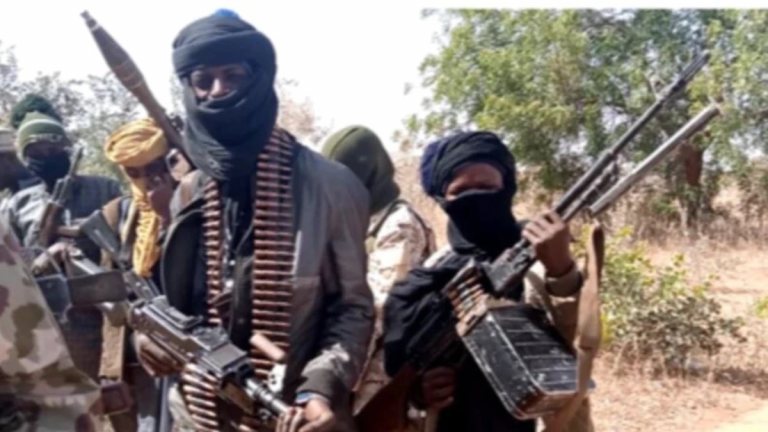
The persistent wave of banditry across Nigeria, particularly in the northern and north-central regions, has evolved from a security challenge into a complex socio-political and humanitarian crisis. Using data extracted from newspaper reports between April and July 2025, in this report, our analyst examines how media discourses construct the problem of banditry, the nature of responses from both state and non-state actors, and the broader implications for governance, security management, and social resilience. The findings draw on coded themes such as attacks, community responses, military operations, and policy interventions, revealing deep-seated patterns of insecurity and state fragility.
Nature and Framing of Banditry in the Media
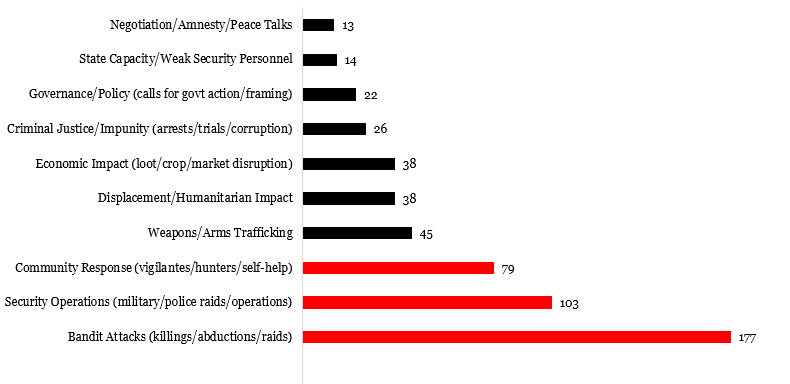
Our dataset, comprising 261 reports from diverse media outlets such as Channels TV, Daily Nigerian, Blue Print, and Business Day, reveals that bandit attacks dominate the coverage. Most headlines and extracts revolve around killings, abductions, and raids on villages, farms, and highways. Through this framing, the media present banditry primarily as a problem of escalating violence and insecurity, rather than a manifestation of socio-economic deprivation or political neglect. This heavy focus on attacks shapes public perception by emphasizing fear and urgency while obscuring the structural conditions, such as poverty, unemployment, and rural marginalization, that sustain violent networks.
Exhibit 1: Top 10 themes reported between April and July, 2025
Register for Tekedia Mini-MBA edition 20 (June 8 – Sept 5, 2026).
Register for Tekedia AI in Business Masterclass.
Join Tekedia Capital Syndicate and co-invest in great global startups.
Register for Tekedia AI Lab.
Also, the media’s crisis-oriented reporting often privileges sensational narratives over analytical ones. While such coverage raises awareness and mobilizes attention, it can also contribute to desensitization, fatigue, and policy responses driven by emotion rather than evidence. Thus, the way the media define and circulate stories about banditry significantly influences how society and the government understand the crisis and prioritize solutions.
Community Responses and Informal Security Systems
One of the most striking insights from the dataset is the increasing visibility of community-based responses to banditry. Across multiple reports, local vigilante groups, hunters, and youth organizations emerge as frontline defenders of their communities. The media depict them as courageous and morally justified actors stepping in where the state has failed. This discourse underscores widespread disillusionment with official security agencies and reflects a shift from dependence on the state to self-organized protection networks.
However, the rise of informal security groups raises complex governance questions. While they provide immediate protection, they also risk escalating cycles of violence, reprisal attacks, and human rights violations. Reports of vigilantes demanding government recognition or access to arms demonstrate how non-state actors increasingly operate within the grey zone between legality and necessity. In the absence of coherent state coordination, these groups have become essential yet destabilizing elements of Nigeria’s fragmented security order.

State Responses and the Question of Capacity
Media coverage of state responses shows that Nigeria’s approach to banditry remains largely reactive and militarized. The reports highlight frequent airstrikes, raids, and troop deployments, often followed by renewed attacks and civilian casualties. This pattern suggests that state action, while visible, has limited deterrent impact. The government’s dependence on force rather than intelligence, negotiation, or socio-economic intervention reflects institutional weakness and policy fragmentation.
Moreover, the themes of weak security capacity and poor coordination recur across the dataset. Journalists frequently report inadequate training, low morale, and corruption among personnel. Public officials, governors, and legislators are often quoted appealing for federal intervention or resource allocation, an indication of vertical disconnection between national and subnational security structures. These portrayals reinforce the perception that Nigeria’s state institutions are overstretched and reactive, operating without a coherent long-term counter-banditry framework.
Socioeconomic and Governance Dimensions
Beyond security operations, the reports contain scattered but critical references to the humanitarian and economic fallout of banditry. Communities across Zamfara, Katsina, Niger, and Kaduna face large-scale displacement, destruction of farmlands, and declining agricultural productivity. Although underreported, these consequences deepen poverty and food insecurity, locking rural populations in a vicious cycle of vulnerability. The economic dimension is thus central to the persistence of banditry, yet it receives less sustained media attention compared to the violence itself.

Governance issues also permeate the narratives. Political leaders’ repeated calls for federal action, without visible results, expose performative governance practices that emphasize rhetoric over implementation. The occasional inclusion of surrender initiatives or amnesty programs reflects a contradictory policy landscape, oscillating between coercion and negotiation. Consequently, the state’s legitimacy remains contested, with both bandits and communities perceiving it as distant or ineffective.
Going Forward
The evidence from media reporting reveals that managing banditry in Nigeria requires a multidimensional approach that moves beyond the military paradigm dominating current discourse. The crisis is as much about governance and legitimacy as it is about violence. Sustainable management depends on rebuilding trust between state and citizens, integrating community-based security structures into regulated frameworks, and addressing the socio-economic roots of rural unrest.