

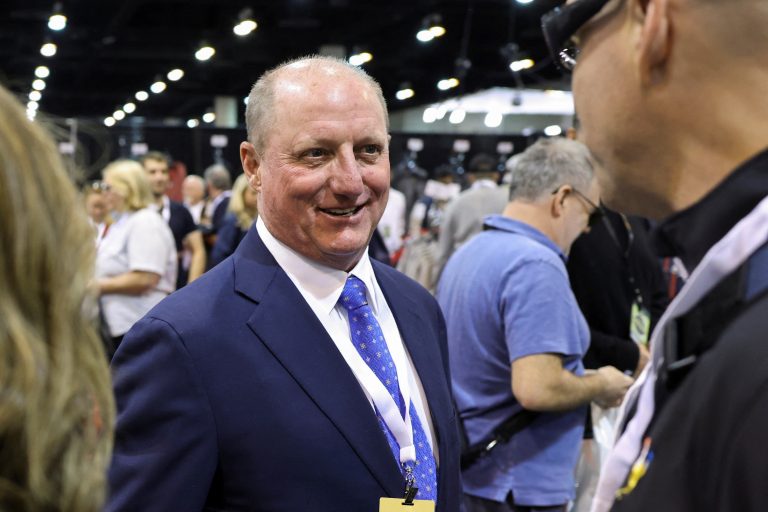
In his first annual letter to shareholders as chief executive of Berkshire Hathaway, Greg Abel delivered a message of assurance to investors: the conglomerate’s long-standing culture of financial conservatism, capital discipline, and decentralized management will remain intact following the leadership transition from Warren Buffett.
“I am honored by our Board’s decision to appoint me CEO of Berkshire and humbled to succeed Warren as I write my first annual letter to you,” Abel wrote in the annual report released Saturday alongside quarterly earnings. “Warren is obviously a very hard act to follow.”
Abel, 63, formally assumed the CEO role at the start of 2026 after Buffett, 95, stepped down and remained chairman. The tone of the letter, first published by CNBC, emphasized institutional continuity rather than strategic redirection. Abel framed Berkshire’s core principles as enduring: maintaining financial strength, allocating capital with discipline, and preserving the conglomerate’s reputation for integrity.
Register for Tekedia Mini-MBA edition 20 (June 8 – Sept 5, 2026).
Register for Tekedia AI in Business Masterclass.
Join Tekedia Capital Syndicate and co-invest in great global startups.
Register for Tekedia AI Lab.
“We maintain a fortress-like balance sheet, ensuring Berkshire’s foundation is never compromised,” he wrote. “We preserve this financial strength by using debt sparingly and prudently. Our substantial liquidity enables us to meet our obligations even under the most adverse conditions and to respond swiftly when opportunities arise.”
Cash, capital allocation, and portfolio oversight
Berkshire ended 2025 with $373.3 billion in cash and equivalents — a record level that has drawn attention from investors seeking clues about deployment strategy. Abel described the cash pile as strategic flexibility rather than defensive retrenchment, characterizing it as “dry powder” that allows the company to move decisively without jeopardizing resilience.
He pushed back against any interpretation that the size of the cash balance reflects a retreat from investing. Instead, he reiterated that Berkshire’s hurdle remains value creation: retained earnings must generate more than one dollar of market value for each dollar kept inside the company.

“Our approach to cash dividends continues to be that Berkshire will not pay dividends so long as more than one dollar of market value for shareholders is reasonably likely to be created by each dollar of retained earnings,” Abel wrote, noting the board reviews the policy annually.
The new CEO also resolved a key governance question by confirming he will directly oversee Berkshire’s equity portfolio.
“At Berkshire, equity investments are fundamental to our capital allocation activities; responsibility ultimately resides with me as CEO,” he wrote.

Berkshire’s publicly traded holdings remain concentrated in a small group of U.S. companies that Abel said are expected to compound value over decades, including Apple, American Express, Coca-Cola, and Moody’s. Notably absent from that list was Bank of America, which ranked as Berkshire’s third-largest holding at the end of 2025.
Abel reiterated that the portfolio will remain concentrated and turnover limited, though Berkshire would “significantly adjust” a position if long-term economic prospects change. Ted Weschler will continue managing roughly 6% of the equity portfolio, including investments previously overseen by Todd Combs, who recently departed for JPMorgan.
Abel emphasized that the same analytical discipline applies across the capital stack: acquisitions of entire businesses, minority equity stakes, and share repurchases are evaluated under a unified value framework.
“We will assess value carefully, act patiently, and hold for the long term — preferably forever,” he wrote.
Leadership transition and long-term orientation
Internally, Abel has long been viewed as an operationally hands-on executive with deep familiarity across Berkshire’s sprawling subsidiaries. A native of Edmonton, Alberta, he joined Berkshire in 2000 after its acquisition of MidAmerican Energy and later became chief executive of that unit in 2008. His tenure within the conglomerate spans 25 years.
In the letter, Abel underscored his intention to serve as a long-term steward. “Our owners’ time horizon extends beyond the tenure of any individual CEO,” he wrote. “I will not be your CEO for the next 60 years as simple arithmetic makes that – shall we say – an ambitious plan. However, 20 years from now … my intention is that you – or your descendants – will be proud that your company is even stronger.”
He also sought to reassure shareholders that Buffett remains engaged. According to Abel, Buffett continues to come into the office five days a week and provides ongoing input as chairman, reinforcing the sense of continuity during the transition.
In keeping with Berkshire’s long-standing communications philosophy, Abel made clear the company will not adopt Wall Street’s quarterly earnings call model.
“We concentrate on quality, not frequency,” he wrote. “If a significant issue arises, you will hear from me, but it will not be through quarterly commentary, given our long-term horizon.”
Together, the letter positions Berkshire not as an institution entering a new era of experimentation, but as one committed to preserving the structural principles that defined it under Buffett: a fortress balance sheet, concentrated long-duration investments, and a corporate culture built around autonomy, trust, and patient capital.