

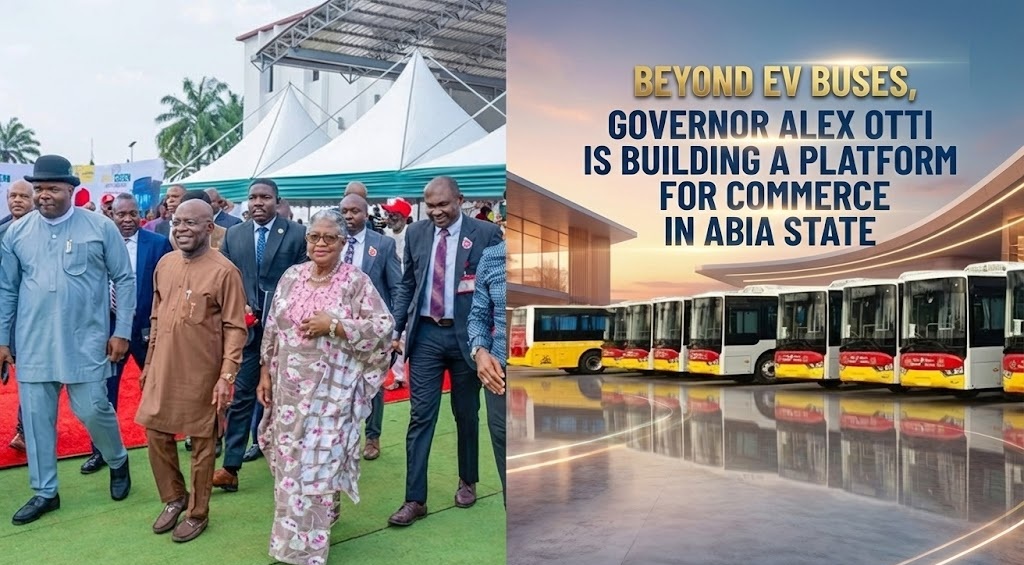
Question: “Sir, I read a post where someone in the diaspora criticized Abia State for buying 20 EV buses and still funding Abia Line Network, even though the state transporter is losing money. What is your view?”
My Response: Let me speak in my personal capacity and offer a perspective that may help.
I am from Ovim which used to have a railway station. And one of the biggest strategic mistakes Nigeria ever made was allowing the railway system to collapse. As a village boy, I saw with my own eyes what connectivity meant. When trains ran, villages along the corridors grew. We did not feel cut off from cities. I never visited any city until I went to represent Abia State at FGC Okigwe in JETS (junior engineers, technicians and scientists) regional competition, and I enjoyed village because everything was there. Our Oriendu Market Ovim, and many markets along the Port Harcourt–Maiduguri rail line, thrived because goods and people could move.
Register for Tekedia Mini-MBA edition 20 (June 8 – Sept 5, 2026).
Register for Tekedia AI in Business Masterclass.
Join Tekedia Capital Syndicate and co-invest in great global startups.
Register for Tekedia AI Lab.
But when Nigeria shut down the railways, and even the postal services, because they were judged “unprofitable,” those markets faded, and villages lost oxygen. In dismantling rail and post, we dismantled the backbone of our supply chain. And let me be clear: no nation has any chance of becoming an economic promise without a working supply chain because supply chain is commerce.
Today, in Abia State, Governor Alex Otti is deliberately building what I call a platform for commerce, a foundation upon which private enterprise can plan, invest, and grow. But you cannot build commerce without logistics. You cannot grow markets without movement. Transportation must therefore be strengthened, even if, in the short term, it records accounting “losses.” Any loss by Abia Line Network must be seen holistically, not narrowly.
Look around the world. In the United States, Amtrak has not made a profit since it was established in the early 1970s. The U.S. Postal Service has recorded losses for more than two decades. Yet America has not shut them down. From China to the U.K., public transport and postal systems are not designed primarily as profit centers. They are strategic infrastructure in what I have described in Harvard Business Review as a One Oasis: a foundational capability upon which many other activities compound.

China, for instance, loses billions of dollars every year subsidizing transport, not because it enjoys losses, but because it understands that strong logistics is the spine of national competitiveness. In 2022, Abia’s internally generated revenue was about N20 billion. This year, it is projected to exceed N100 billion. If the state spends, or even “loses” N1.2 billion on transport to activate rural and urban commerce that is later taxed, that N1.2 billion can be recovered many times over. What looks like a loss on paper is, in reality, an investment in growth. Eliminating it would be short-sighted.
Yes, 20 buses may look significant today. But I wish Abia had the resources to buy 2,000. When Abians can travel easily, markets grow, services expand, and jobs are created. Over time, that activation will attract private operators. The state is stepping in now precisely because the private sector has not yet shown up at scale. If capable private transporters were ready, government would not need to do this. But you do not wait for perfection before fixing your supply chain. Yes, just as roads are being rebuilt, movement must also be restored.
This is not to defend any government. It is to explain why I believe what Governor Alex Otti is doing is good for Abia State. I am 100% apolitical and non-partisan. The previous administration honored me as Abian of the Year in Diaspora and Abia Ambassador because of my small contributions (google the awards). Under Dr. Otti, I have had opportunities to serve more deeply, as co-chair of the Economic Transformation Council, a member of the Transition Council, and a member of the State Global Economic Advisory Council alongside Dr. Ngozi Okonjo-Iweala and others. What the Governor is executing today reflects the kind of thinking many of these advisers have shared: build foundations first across many verticals including transportation. That is why a huge chunk of next year’s budget will go into infrastructure.

At a personal level, my governing philosophy is simple: government must spend, intentionally and strategically, to stimulate growth. I have seen this in the United States. The so-called blue cities invest heavily in public infrastructure like schools, transport, research, and more than 80% of America’s largest cities and top-ranked universities are in those cities. They understand one thing: invest in foundations, and prosperity compounds.
So, if Abia Line transport needs N1.2 billion support, provided that is not due to waste but is a strategic action to activate markets, then under a comprehensive and integrated revenue framework, Abia will recover it, many times over. Imagine a rail line connecting all LGAs in Abia. Yes, it may lose billions yearly. But those losses would cushion and power the state’s economy. Even the U.S. Postal Service could flip to profit by simply raising stamp prices, yet it refuses, because its mission is bigger than profit. Likewise, I will not advise Abia Line to raise fares just to look profitable.
Our Governor is an economist and a banker, he understands the connections within these policies, and when you speak with him, you hear a visionary who has absolute love for his people. And for those challenging the government, provided it is done with facts, that is good for our state because that is what you need in a democracy. Finally, in economics, not every good investment shows up as profit on the same line of the balance sheet. Some show up in busier markets. Some in new businesses. Some in higher tax receipts. I hope this perspective helps.
Ndubuisi Ekekwe
Member, Abia State Global Economic Advisory Council
Comment on Feed
Please read ABC Transport Plc financials to understand the bus system in Nigeria. No one makes money in that business because of bad roads, insecurity, etc. ABC Transport is a publicly traded company and that means we can see the undiluted data. ABC made losses in 2020, 2021 and could have also continued if not for the support. I do not expect state operated ones to be different.
That sector is terrible in economics. If you check, they have received at least N100 billion bailouts in the last two years via ticket support, CNG conversion, etc. Put that in context, you will agree that states like Abia and others have no chance.
Every state is running losses on this except Lagos. But they hide them under transportation miscellaneous. Abia budget is item-line based and that makes it possible to see everything. That is why you read people write: they bought laptop this, etc because it is detailed to the pencil and pen. You can build institutional capability, but I can tell you that running one is a terrible idea because it does not compound with leverage.
If you close US Postal service, more than 90% of ecommerce companies in US will go bankrupt. The US subsidizes their businesses by making sure logistics works but later recovers by taxing those activities. If Abia moved from N20b IGR to N100B while losing N1.2B, is that not a good strategy? Every part of Abia must be connected to grow IGR to N300b.
---
Connect via my
LinkedIn |
Facebook |
X |
TikTok |
Instagram |
YouTube