

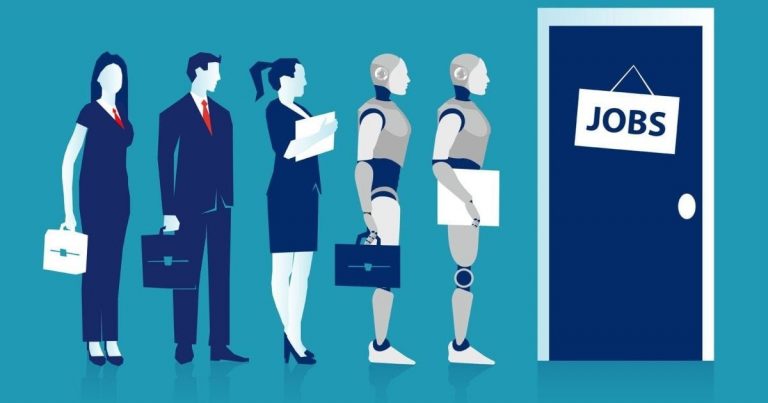
British telecoms giant BT may shed even more jobs than originally planned by 2030 due to the accelerating adoption of artificial intelligence, according to CEO Allison Kirkby.
In a recent interview with the Financial Times, Kirkby said that the company’s widely publicized plan to slash up to 55,000 jobs by the end of the decade may underestimate the full impact of emerging AI capabilities on the workforce.
“Depending on what we learn from AI… there may be an opportunity for BT to be even smaller by the end of the decade,” she said.
Register for Tekedia Mini-MBA edition 20 (June 8 – Sept 5, 2026).
Register for Tekedia AI in Business Masterclass.
Join Tekedia Capital Syndicate and co-invest in great global startups.
Register for Tekedia AI Lab.
BT, which has more than 130,000 employees including contractors, first announced the 55,000 job-cut target in 2023 under former CEO Philip Jansen as part of a sweeping cost-reduction drive. But Kirkby, who took over in early 2024, said the plan “did not reflect” AI’s full potential to reshape operations and reduce the need for human involvement in key service areas.
The telecoms firm has increasingly turned to AI to automate functions across its core and mobile units. Last year, BT confirmed it was deploying generative AI tools to support customer service and sales functions across its consumer-facing businesses, including EE. One such tool, a virtual assistant named “Aimee,” was reportedly handling around 60,000 customer queries per week. The company says it has been able to resolve nearly half of those issues without needing human intervention.
The use of generative AI has allowed BT to “reinvent” its customer-facing operations, especially in call handling and diagnostics, two areas previously earmarked for automation. The firm had already anticipated that as many as 10,000 roles could be eliminated through AI alone. Kirkby’s latest remarks suggest that the figure could be significantly higher.

Wider Trend Across Industries
BT is not alone in this shift. Swedish payments company Klarna announced last year that its OpenAI-powered chatbot had taken over tasks equivalent to 700 full-time customer service staff. Klarna CEO Sebastian Siemiatkowski said the company’s workforce dropped from 5,500 to about 3,000 over the past two years, largely due to efficiency gains driven by AI.
He has since admitted that the cuts may have gone too far and said the firm is now rehiring, but he continues to warn of wider implications for white-collar workers.
“My suspicion again is that there will be an implication for white-collar jobs, and when that happens, that usually leads to at least a recession in the short term,” Siemiatkowski said in a podcast interview earlier this month.

Dario Amodei, CEO of leading AI startup Anthropic, also issued a stark warning recently, saying AI could wipe out up to half of all entry-level white-collar jobs within five years.
“We, as the producers of this technology, have a duty and an obligation to be honest about what is coming,” Amodei told Axios.
Kirkby’s Broader Vision for BT
Since assuming the role in February 2024, Kirkby has pushed to restructure BT into a leaner, more focused business. Under her leadership, the company has exited several international operations and is now exploring the future of Openreach—BT’s broadband infrastructure arm—which could be spun off after reaching its target of connecting 25 million UK homes with fiber by the end of 2026.
Openreach alone is estimated to be worth over £30 billion, exceeding BT Group’s entire market capitalization of about £18.5 billion. Analysts say the unit’s eventual separation could unlock significant value, although Kirkby has not confirmed if a spin-off is imminent.
BT has also achieved a £3 billion cost-saving milestone and aims to double that by 2029. Since Kirkby took charge, BT shares have surged by 65 percent, reflecting investor confidence in the new leadership’s direction.
However, the company’s challenges have refused to go away. Kirkby recently warned that a proposed hike in employer national insurance contributions could cost the company more than £100 million, urging the UK government to avoid imposing additional tax burdens on large employers as they invest in digital transformation.
Balancing Innovation and Jobs
While BT sees AI as a lever to boost efficiency and cut costs, the company maintains that it is also investing in reskilling initiatives. Kirkby, who recently spoke at a Google event, said BT is collaborating with tech partners to offer digital upskilling to UK small businesses and individuals navigating the shift toward an AI-enabled economy.
But the signals remain clear: the company’s future will rely heavily on automation, and the scale of its human workforce is likely to continue shrinking.
Kirkby, echoing her long-term goal of preparing the 180-year-old telecoms giant for the challenges and opportunities of the digital age, indicated that there is an opportunity to make BT a simpler, leaner, and more resilient business.
With the AI tide rising rapidly, what once seemed like a theoretical threat is now reshaping hiring, job descriptions, and long-term employment strategies across industries. For telecoms like BT and fintechs like Klarna, the pressure to stay competitive is pushing them to experiment with AI more aggressively. But for millions of workers, the question remains: who’s preparing them for what comes next?