

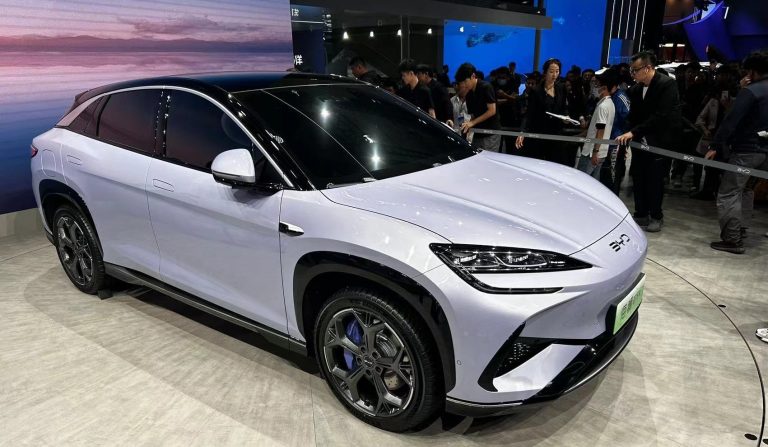
Chinese automaker BYD continues to extend its dominance in the electric vehicle (EV) market, delivering a record-breaking 1,000,804 New Energy Vehicles (NEVs) in the first quarter of 2025. This figure represents a 59.8% increase compared to the same period last year, highlighting BYD’s rapid ascent as the global leader in EV and plug-in hybrid (PHEV) sales.
Meanwhile, Tesla reported a 13% decline in global deliveries, shipping just 336,681 vehicles in Q1—its worst quarterly performance in nearly three years. As BYD accelerates its expansion both in China and internationally, Tesla is facing mounting challenges, including slowing demand, rising competition, and CEO Elon Musk’s increasingly controversial political ties.
BYD’s growth in Q1 was nothing short of staggering. Of the 1,000,804 NEVs it sold, 986,098 were passenger vehicles, while 14,706 were commercial vehicles. The automaker has not produced traditional internal combustion engine (ICE) vehicles since 2022, making these figures representative of its total sales.
Register for Tekedia Mini-MBA edition 20 (June 8 – Sept 5, 2026).
Register for Tekedia AI in Business Masterclass.
Join Tekedia Capital Syndicate and co-invest in great global startups.
Register for Tekedia AI Lab.
A closer look at BYD’s passenger vehicle segment reveals that battery-electric vehicle (BEV) sales reached 416,388 units, a 38.7% increase from Q1 2024. PHEV sales hit 569,710 units, growing at an even more impressive 75.7% year-over-year. This means 42.2% of BYD’s passenger NEVs were fully electric, while 57.8% were PHEVs. The sharp rise in plug-in hybrid sales reflects strong demand from customers who still prefer the flexibility of a gas-powered backup, particularly in markets where charging infrastructure remains a concern.
BYD’s commercial vehicle segment experienced an explosion in growth, with sales surging 688.5% to 14,706 units. While the company did not disclose the exact breakdown between BEVs and PHEVs, it revealed that it sold 1,127 buses, representing a 41.8% increase, and 13,579 other commercial vehicles, including vans and trucks, which soared by an astonishing 1,169% compared to last year.
In March 2025 alone, BYD produced 395,091 NEVs, with 72, 723 exported. This aligns with its ambitious target of doubling exports from 417,204 units in 2024 to 800,000 units in 2025. Last year, BYD sold 4.25 million BEVs and PHEVs combined, placing it on par with traditional automakers like Ford. With a strong 59.8% growth rate in Q1, BYD is well on its way to surpassing this figure in 2025, as China’s NEV market typically picks up steam in the latter half of the year.

In addition to its strong sales figures, BYD recently reported record financial results for 2024. The company achieved an operating profit of 777 billion yuan ($107 billion), a 29% increase year-over-year. Total profits rose by 34% to 40.3 billion yuan ($5.5 billion), setting a new record for the company. Revenue from vehicles and related products totaled 617 billion yuan ($85 billion), reinforcing its status as the world’s most dominant EV manufacturer.
In stark contrast to BYD’s growth, Tesla’s global deliveries plunged in Q1 2025, with the company shipping only 336,681 units, a steep 13% decline from the previous year. Tesla blamed the drop on production challenges, claiming that factory upgrades for the Model Y resulted in “the loss of several weeks of production.” However, analysts believe the problems run much deeper.
Musk’s increasing involvement in Donald Trump’s administration—where he holds an unofficial role as head of the Department of Government Efficiency (DOGE)—has sparked widespread backlash. His close ties to Trump’s controversial policies, including aggressive federal spending cuts and high-profile government layoffs, have alienated many Tesla customers, particularly in liberal-leaning markets like California and Europe.

Musk’s outspoken presence on X has further politicized Tesla’s brand, leading to consumer boycotts and a deteriorating reputation. According to analysts, Tesla is now struggling with a crisis of brand perception that could negatively impact long-term demand.
One of the few bright spots for Tesla in Q1 was its performance in China, where the revamped Model Y became the best-selling battery-electric vehicle by volume. In March 2025, Tesla China sold 43,370 new Model Y units, reinforcing the continued strength of its Chinese operations. However, even this success could not offset Tesla’s overall sales slump. With BYD aggressively expanding into international markets and offering more affordable models, Tesla faces increasing competition not just in China but globally.
Tesla’s weak Q1 results immediately triggered concern among investors. Wedbush Securities analyst Dan Ives, a longtime Tesla supporter, called the quarter “a disaster on every metric.” He warned that “the more political Musk gets, the more Tesla’s brand suffers. There is no debate. BYD is eating Tesla’s lunch in China, and now they’re expanding globally. This quarter was an example of how much damage Musk is doing to his own company.”
Tesla investor Ross Gerber echoed similar frustrations, posting on X that “these numbers suck. The Cybertruck is basically not selling. The brand is broken and may not be fixable. The board of directors is 100% responsible.”
Although Tesla’s stock rebounded 5.3% after a report suggested Musk might step back from his White House role, the company still faces a major uphill battle. With BYD surging ahead, EV demand slowing in key markets, and Musk’s political distractions intensifying, Tesla’s future appears more uncertain than ever.
Against this backdrop, Tesla’s dominance in the EV market is no longer guaranteed. While Musk’s company still leads in North America, its foothold in China is under siege, and BYD is rapidly expanding into Europe, Latin America, and Southeast Asia—regions that are becoming increasingly vital for global EV adoption.
There is concern that if Musk fails to regain investor confidence and refocus on Tesla’s core business, the EV pioneer could see its position as the industry leader permanently eroded.