

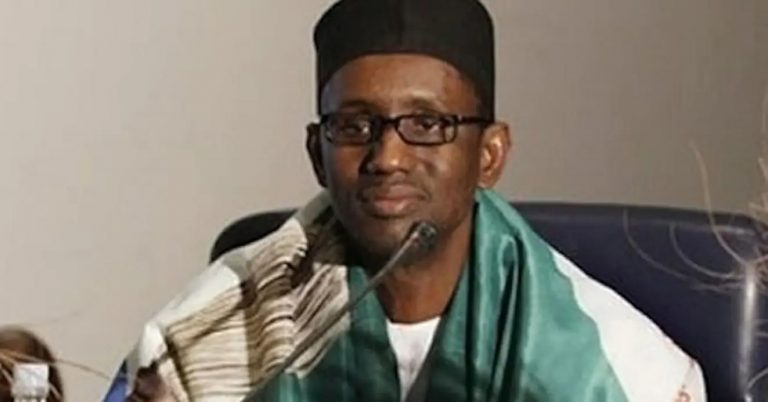
Nigeria’s National Security Adviser (NSA), Nuhu Ribadu, has launched a scathing attack on the Canadian government after it denied visas to the country’s Chief of Defense Staff (CDS), General Christopher Musa, and other top military officers.
Ribadu, visibly angered by the decision, publicly condemned Canada, stating outright that the country “can go to hell” for refusing entry to the Nigerian military delegation.
The visa denials, which prevented General Musa and his team from attending an official event in Canada meant to honor war veterans, have sparked fresh concerns over Nigeria’s global standing and the treatment of its officials by Western governments.
Register for Tekedia Mini-MBA edition 20 (June 8 – Sept 5, 2026).
Register for Tekedia AI in Business Masterclass.
Join Tekedia Capital Syndicate and co-invest in great global startups.
Register for Tekedia AI Lab.
“Every disappointment is a blessing. Yesterday, I was meant to be in Canada. There’s an event to honour our veterans, those that were injured during battles, and we were meant to be there,” General Musa revealed while speaking at the National Association of the Institute for Security Studies (AANISS) annual lecture in Abuja.
In response, Ribadu expressed his outrage, accusing Canada of disrespecting Nigeria’s military leadership and calling for a stronger Nigeria—one that would no longer be taken for granted on the international stage.
“Thank you for the courage to say Canada denied you visas. They can go to hell,” Ribadu said defiantly.

“Even though it’s painful, it’s disrespectful, but we are peaceful and strong, and I agree with you that it is time to fix our country. Yet, this is another reason we work hard to make Nigeria work,” the NSA added.
Human Rights Abuses Tied to Visa Denial
However, many believe that Canada’s decision was not arbitrary, but rather part of a broader international stance against alleged human rights abuses committed by the Nigerian military. In recent years, Western nations have increasingly imposed travel restrictions on individuals accused of serious rights violations, and Nigeria’s security forces have faced persistent allegations of extrajudicial killings, torture, and crackdowns on civilians.
The most notorious recent case was during the EndSARS protests in October 2020, when the Nigerian Army was implicated in the mass killing of unarmed protesters at the Lekki Toll Gate in Lagos. Witnesses, journalists, and human rights groups reported that security forces opened fire on peaceful demonstrators, who had been protesting against police brutality and calling for an end to the notorious Special Anti-Robbery Squad (SARS). The violent crackdown triggered global outrage, with calls for the prosecution of those responsible and sanctions against implicated officials.

Early last year, the Nigerian military invaded Okuama, a town in Delta State, killing and razing houses over the death of 16 personnel who were reportedly killed by militia men. Some of the community leaders arrested in connection to the incident died in the custody of the military, while others remain in detention without trial till now.
Human rights organizations, including Amnesty International and Human Rights Watch, have repeatedly accused the Nigerian military of war crimes in counterinsurgency operations, extrajudicial executions, and the unlawful detention of civilians in conflict zones. A panel set up by the Federal Government found the Nigerian Army and other security agents guilty of mass murder of the protesters.
Adding to the controversy, General Musa has repeatedly defended the aggressive nature of the Nigerian military, even as global scrutiny over human rights violations intensifies.
Late last year, Musa openly justified the Army’s use of force against civilians, arguing that military training deliberately cultivates aggression in soldiers.
In an interview with News Central, Musa stated: “It has also to do with the training. I don’t think anybody wants a docile military—I mean, then there shouldn’t be a military anymore. So somehow, the training brings out that animal aspect of the military. And then for the junior ones, these are things that we have to curtail; because of the nature of the training, they are made to be aggressive. That’s their nature.”
Musa further claimed that Post-Traumatic Stress Disorder (PTSD) and mental health challenges contribute to cases of soldiers assaulting civilians, though he insisted that efforts were being made to “contain the aggressiveness”.
However, many Nigerians and international observers have dismissed Musa’s remarks as a weak attempt to justify human rights abuses. They argue that highly ranked global militaries, such as those of the U.S., U.K., and France, also train their soldiers for combat without resorting to systematic human rights abuses.
Nigeria’s military ranking has also declined in recent years, further discrediting claims that excessive aggression is necessary for effectiveness. According to the Global Firepower (GFP) ranking, Nigeria’s military fell from 36th place in 2023 to 39th place in 2024—a drop that some argue reflects the military’s internal dysfunction and failure to adapt to modern warfare standards.
Human rights activists insist that Musa’s justification denotes that the Nigerian military has no real plans to curb abuses, which may explain why Western governments, including Canada, are taking a tougher stance on Nigerian military officials.
The visa denial for General Musa and his team is the latest indication that Nigeria’s military faces growing isolation on the global stage due to human rights concerns. While Canada has not formally explained its decision, many believe it aligns with its broader policy of restricting access to individuals accused of rights violations.
Although NSA Ribadu’s comments reflect Nigeria’s frustration, they do not address the underlying issue of military misconduct, which continues to damage Nigeria’s reputation. With global scrutiny on the country’s security forces mounting, it remains to be seen whether the Nigerian government will take meaningful action to improve accountability—or if it will continue to dismiss international concerns as mere diplomatic snubs.
Ribadu did however acknowledged the need for Nigeria to fix up. “I know the disrespect is too much and this is why we must quickly fix our country,” he said.