

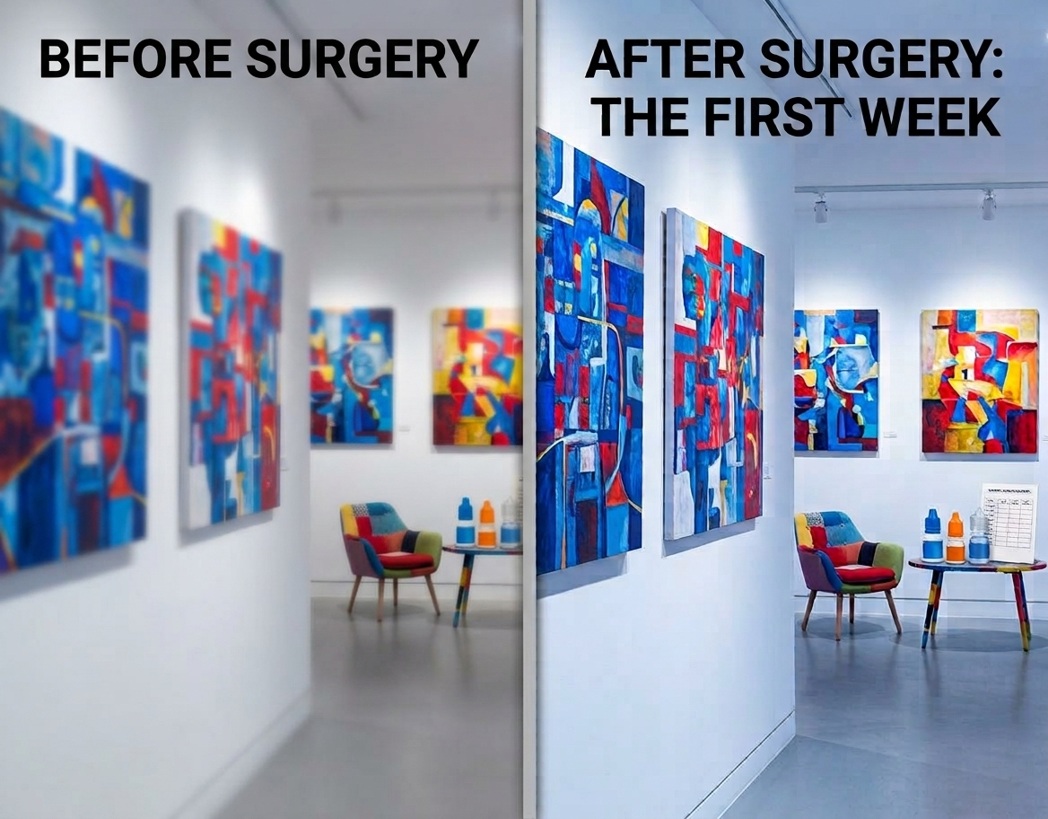
Most people see well enough for everyday tasks within a few days of cataract surgery. The eye usually finishes settling at around four to six weeks, and a minority take two to three months. Where someone lands in that range depends mostly on the health of the cornea and the surface of the eye.
The First Week After Cataract Surgery
The blur in the first days has a physical cause. The cornea, the clear window at the front of the eye, swells slightly during surgery, and the inside of the eye is inflamed. Both settle over several days, and vision clears as they do. Until then, hazy sight, watering, a gritty feeling, and sensitivity to light are normal. A dull ache is also common. Pain that is sharp or getting worse is not, and that is covered below.
Colors look different too. A cataract acts like a yellow-brown filter, and after years of that, a clear lens makes whites look whiter and colors look cooler. The brain takes a few weeks to adjust.
Drops do most of the work. A typical plan includes an antibiotic for about a week and an anti-inflammatory drop that is reduced gradually over three to four weeks, although clinics differ. Stopping the anti-inflammatory early can let the swelling return, so the course is finished even when the eye feels normal. Dr. David Robinson says a written chart of drop times is the simplest way to avoid missed doses, since the first week often involves several bottles at different times.
Weeks Two to Six
By the second week most people read comfortably and many are driving. The eye is still healing, though, and three things commonly linger.
Dry eyes are the most frequent. The incision cuts some of the corneal nerves that signal the eye to make tears, and the preservatives in post-operative drops irritate the surface. This causes burning, grittiness, and vision that fluctuates through the day. It usually improves over several weeks to a few months with lubricating drops. People who had dry eyes before surgery should expect it to be worse for a while.
Glare and halos come from the edge of the new lens and the way it handles light. They are more noticeable at night and tend to be stronger with multifocal lenses. The brain adapts over weeks to months.
As shown in the illustration below, these symptoms can include fluctuating vision and halos around lights.

Floaters are shadowy specks or threads. As people age, the gel inside the eye can pull away from the retina, which is called posterior vitreous detachment. Surgery can bring this forward. Most floaters fade or become less noticeable.
A new glasses prescription is only reliable once the eye has stabilized. That is usually a few weeks after surgery, and the surgeon decides when. If both eyes need surgery, the second is usually done one to a few weeks after the first. In between, the two eyes can be badly mismatched, which makes glasses uncomfortable. The lens over the operated eye is often removed from the frame, or temporary glasses are made. Dr. David Robinson advises asking about this before the first operation, because it affects how people manage in the gap.
Returning to Daily Activities
Reading, television, and phone use are fine from the first day. Screens do not harm the healing eye, although the eyes tire more easily at first. Restrictions on other activities are set by the surgeon, and these are the usual ones.
| Activity | Usual guidance |
| Driving | Once vision meets the legal standard and the surgeon agrees. This is usually cleared at the first check, often within a few days. |
| Desk work | Often within two to three days. |
| Physical work, heavy lifting, straining | Avoid for one to two weeks. Lifting and straining raise pressure in the eye. |
| Swimming, hot tubs, saunas | Avoid for one to four weeks, depending on the surgeon. Water can carry bacteria into the healing eye. |
| Eye makeup | Usually one to two weeks. |
| Dusty or dirty environments | Avoid or wear protective glasses for the first couple of weeks. |
Rubbing the eye should be avoided for the whole of the healing period. Sunglasses help with light sensitivity outdoors.
Follow-Up Visits
The first check is usually the day after surgery or within a few days. The surgeon measures eye pressure, looks for inflammation, checks the incision and the position of the lens, and tests vision. Further visits follow at about a week and at about four weeks, when vision is tested and glasses can be considered.
Pressure can rise after surgery, and inflammation can build, without any symptoms at first. Dr. David Robinson advises keeping every appointment even when vision is excellent, because these are things the patient cannot feel.
Problems That Should Not Wait
Some changes need a call to the clinic the same day. Dr. David Robinson advises not waiting for the next appointment for any of these:
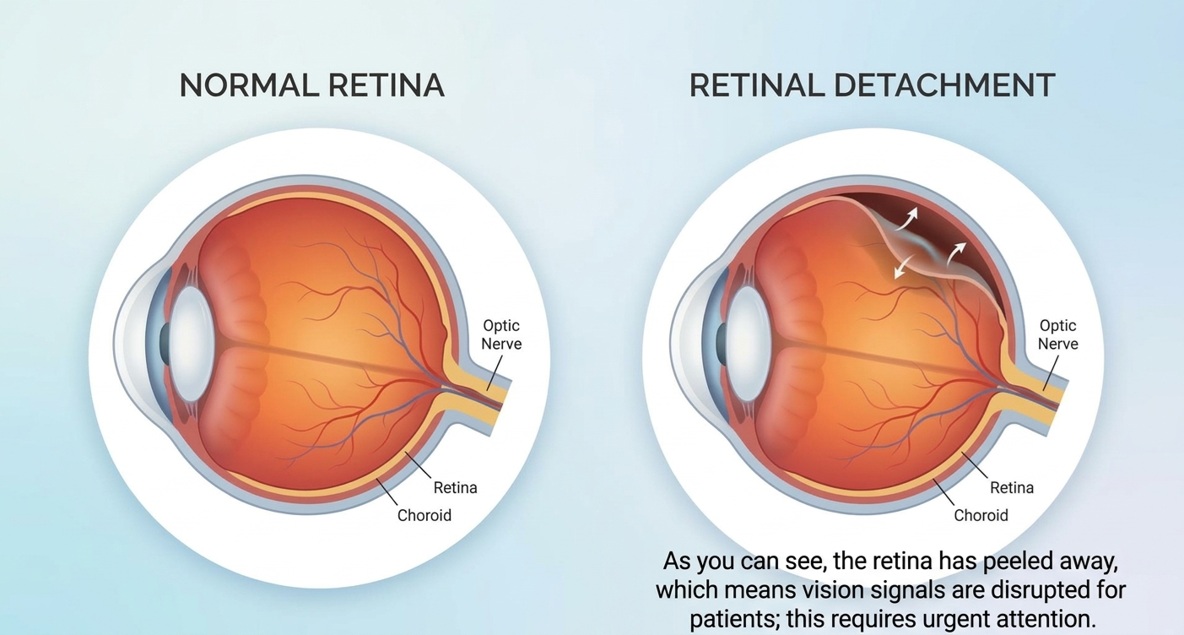
The diagram below highlights the macula, where central vision is focused, and shows how a retinal detachment affects the retina.
- Pain that is getting worse, with increasing redness, discharge, or a sudden drop in vision. These can be signs of infection inside the eye. It is rare, but it is urgent and most often appears in the first week or so.
- New flashes of light, a sudden shower of floaters, or a shadow or curtain across the vision. These can mean a retinal tear or detachment, in which the retina separates from the back of the eye.
- Blurred or distorted central vision that appears after the eye has been seeing well. Between about four and twelve weeks after surgery, fluid can collect in the macula, the central part of the retina. This is called cystoid macular edema. It is uncommon, and it is usually treated with drops.
Some patients notice vision slowly clouding again, sometimes years after surgery. The cause is usually that the thin membrane behind the lens implant has become cloudy, which is called posterior capsule opacification. The artificial lens is not affected. A short laser treatment clears the membrane, usually in a single visit.
Key Takeaway
Expect the eye to feel better within days, settle over several weeks, and keep making small changes for a while after that. Healing at a different pace from someone else is not a problem. What matters is a steady direction of improvement. If vision gets worse, pain increases, or something new appears suddenly, call the clinic rather than waiting.