

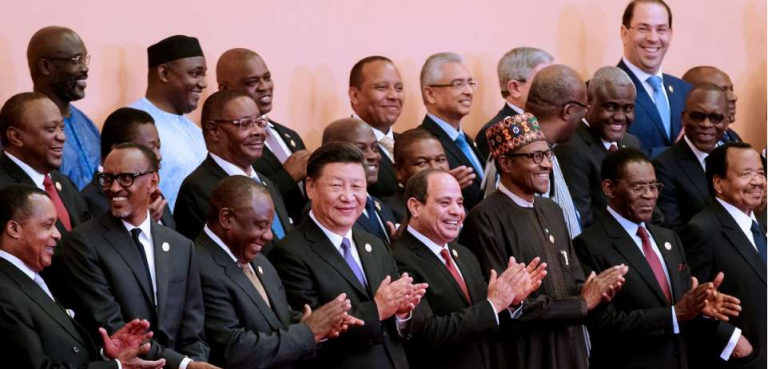
China will implement zero-tariff treatment for imports from 53 African countries with which it maintains diplomatic relations beginning May 1, 2026, significantly broadening its preferential trade regime across the continent.
Business Insider, citing state media, reports that the measure extends duty-free access to nearly all African states, excluding only Eswatini, which maintains diplomatic ties with Taiwan.
The policy shift comes at a time of uncertainty around the future of the African Growth and Opportunity Act (AGOA) in the United States and ongoing tensions between African governments and the European Union over Economic Partnership Agreements (EPAs).
Register for Tekedia Mini-MBA edition 20 (June 8 – Sept 5, 2026).
Register for Tekedia AI in Business Masterclass.
Join Tekedia Capital Syndicate and co-invest in great global startups.
Register for Tekedia AI Lab.
Until recently, Beijing granted zero-tariff treatment on 97%–98% of tariff lines to 33 African least developed countries (LDCs), later expanding that coverage in 2024 to include all products originating from those LDCs. The new framework now covers both least developed and middle-income African economies, marking one of the most comprehensive trade concessions China has offered to the continent.
Trade Imbalance: The Central Challenge
China–Africa trade has grown rapidly but remains structurally uneven. Bilateral trade reached $222.05 billion between January and August 2025, up 15.4% year-on-year, according to China’s customs authorities. Chinese exports to Africa rose 24.7% to $140.79 billion, while imports from Africa increased only 2.3% to $81.25 billion.
Africa’s trade deficit with China widened to $59.55 billion in the first eight months of 2025, nearly matching the full-year 2024 deficit of $61.93 billion.

The imbalance reflects entrenched commodity patterns. Africa exports crude oil, copper, cobalt, iron ore, and other raw materials. In contrast, China exports higher-value manufactured goods, including machinery, telecommunications equipment, vehicles, consumer electronics, and renewable energy systems. Mineral resources alone accounted for roughly 40% of China’s imports from African LDCs in 2023.
The renewable energy trade illustrates the asymmetry. Africa imported 15,032 megawatts of Chinese solar panels between July 2024 and June 2025, a 60% increase year-on-year, underscoring China’s role in powering Africa’s energy transition while retaining higher value-added manufacturing at home.
Zero tariffs could lower entry costs for African exporters, but tariff elimination does not automatically translate into export diversification. The core constraint remains production capacity and value addition.

Diplomatic Calculus and Strategic Positioning
The expansion follows sustained diplomatic lobbying by African leaders seeking improved market access. Cyril Ramaphosa recently visited Beijing to deepen trade cooperation. A non-binding framework agreement was signed by South Africa’s Minister of Trade, Industry, and Competition Parks Tau and China’s Commerce Minister Wang Wentao, paving the way for an Early Harvest Agreement expected by March 2026.
Yoweri Museveni has also repeatedly called for structural correction of the trade imbalance, arguing that African economies must move beyond raw commodity exports.
The decision represents more than tariff policy for China. Economists estimate Beijing will forgo roughly $1.4 billion in tariff revenue under the expanded scheme. The revenue trade-off strengthens China’s economic diplomacy at a time of heightened geopolitical competition.
By offering continent-wide duty-free access, Beijing differentiates itself from Western frameworks. The European Union’s “Everything But Arms” initiative applies only to LDCs, while non-LDC countries must negotiate EPAs that often involve reciprocal market access commitments. AGOA in the United States provides selective access but is subject to periodic renewal and eligibility conditions, creating uncertainty for exporters.
China’s approach offers broader coverage and fewer political conditionalities, reinforcing its image as a long-term commercial partner.
Structural Barriers and Industrial Capacity
Despite tariff removal, analysts caution that non-tariff barriers remain significant. These include sanitary and phytosanitary standards, customs procedures, certification requirements, and logistics bottlenecks. Export financing gaps and limited access to trade insurance also constrain African producers.
Infrastructure deficits compound the challenge. Many African economies lack sufficient port capacity, cold-chain systems, and processing facilities to scale exports of agricultural or perishable goods. Without domestic industrialization, duty-free access may primarily benefit commodity exporters rather than emerging manufacturers.
The policy could, however, incentivize investment in value-added sectors such as agro-processing, textiles, light manufacturing, and mineral beneficiation. If African firms can leverage zero tariffs to enter Chinese supply chains, the measure may accelerate diversification efforts aligned with the African Continental Free Trade Area (AfCFTA).
China has pledged additional trade facilitation measures, including financial instruments and funds to support enterprises operating in Africa. The effectiveness of these mechanisms will determine whether zero tariffs translate into meaningful export growth.
Implications for Global Trade Dynamics
Global trade patterns are fragmenting amid geopolitical tensions, supply chain realignment, and strategic competition for critical minerals used in electric vehicles and renewable technologies. Africa holds substantial reserves of cobalt, lithium, manganese, and rare earth elements, making the continent central to global energy transition supply chains.
By widening tariff-free access, China strengthens its position in securing long-term access to these resources while deepening its economic footprint.
For African governments, the move offers an opportunity to renegotiate trade relationships from a position of improved market access. However, reducing the deficit will depend less on tariff rates and more on industrial policy, export competitiveness, and infrastructure development.
Some analysts believe the zero-tariff expansion represents a decisive deepening of China–Africa economic integration. It addresses long-standing calls for broader access but does not resolve structural imbalances on its own.
If accompanied by domestic reforms, industrial upgrading, and effective trade facilitation, African economies could leverage the scheme to expand processed exports and narrow trade deficits. If structural constraints persist, trade volumes may grow while the imbalance remains.
The policy signals Beijing’s long-term strategic commitment to Africa at a time of shifting global alliances. The Trump administration’s trade policies have stirred a shift in business ties, with nearly every country seeking an alternative to the existing global trade order. However, business leaders believe the ultimate impact will hinge on whether African exporters can translate open access into diversified, value-added trade flows.