

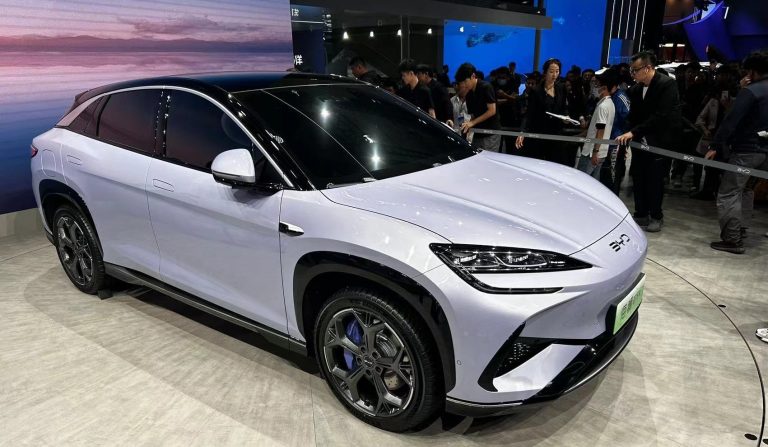
China’s domestic car market extended its downturn for a seventh consecutive month in April, underscoring deepening stress in the world’s largest auto industry as weak consumer confidence, high fuel prices, and slowing economic growth continue to weigh on demand at home.
Data released Monday by the China Passenger Car Association showed domestic vehicle sales fell 21.6% year-on-year to 1.4 million units last month, another sign that China’s once-booming consumer economy is struggling to regain momentum.
The figures highlight an increasingly stark divide inside China’s automotive sector. While domestic sales continue deteriorating, exports are surging as Chinese manufacturers aggressively target overseas markets where rising fuel prices and demand for cheaper electric vehicles are creating new opportunities.
Register for the next Tekedia Mini-MBA.
Register for Tekedia AI in Business Masterclass.
Join Tekedia Capital Syndicate and co-invest in great global startups.
That divergence is rapidly reshaping the global auto industry and accelerating China’s transformation into the world’s dominant vehicle exporter.
The latest weakness at home reflects broader strains across the Chinese economy. Consumer spending remains subdued after years of property-sector turmoil, falling household confidence, and uneven post-pandemic recovery.
Automobiles, traditionally one of the strongest indicators of middle-class consumption in China, are now becoming a symbol of that slowdown.

“Combustion engine car sales missed expectations due to high oil prices and demand for plug-in hybrids was also sluggish,” said Cui Dongshu, secretary-general of the CPCA.
The weakness is particularly striking because even China’s electric-vehicle sector, once the industry’s main growth engine, is beginning to show signs of strain domestically. Sales of electric vehicles and plug-in hybrids, which accounted for 60.6% of total vehicle sales in April, fell 6.8% from a year earlier, extending a losing streak to four months.
That slowdown suggests the market may be reaching saturation in some urban segments after years of explosive growth driven by subsidies, price cuts, and aggressive competition. It also signals that broader economic anxieties are beginning to outweigh enthusiasm for new-energy vehicles among many Chinese consumers.

The downturn comes at a difficult time for automakers already engaged in one of the most brutal price wars the industry has seen in years. Manufacturers across China have repeatedly slashed prices to defend market share, compressing margins and increasing pressure on weaker players.
Many companies are now relying heavily on exports to offset deteriorating domestic conditions, and that strategy is working, at least for now.
Exports of EVs and plug-in hybrids surged 111.8% in April from a year earlier, far outpacing the 80.2% increase in overall vehicle exports. The export boom has been fueled partly by the energy shock created by the U.S.-Israeli conflict with Iran, which sent global fuel prices sharply higher and improved the relative appeal of electric vehicles in many overseas markets.
Chinese automakers have moved quickly to capitalize on that shift. Their EVs are often significantly cheaper than Western rivals while offering increasingly competitive technology and features. As a result, Chinese brands are rapidly gaining ground across parts of Europe, Southeast Asia, Latin America, and the Middle East.
The widening gap between domestic weakness and export strength is clearly visible at BYD, the world’s largest EV maker. The company’s broader sales slowdown extended into an eighth month in April, even as international shipments remained robust.
That trend indicates that Chinese manufacturers are becoming increasingly dependent on foreign markets to sustain growth. Analysts say this export-driven model may become even more pronounced in the coming years.
Morgan Stanley maintained its forecast that China’s overall domestic and export vehicle sales would decline 2% this year, but sharply raised its export growth projection to 33% from 15%. At the same time, the bank expects the contraction in domestic sales to worsen to 11%, nearly double its previous estimate.
The deeper issue confronting China’s auto market is structural. The sector is undergoing a major shift away from low-cost, mass-market vehicles toward larger and more technologically advanced models.
Automakers are increasingly focusing on premium SUVs and feature-rich EVs with higher profit margins rather than budget vehicles that once dominated China’s roads. That trend was visible at last month’s Beijing auto show, where companies unveiled a wave of high-end electric SUVs and luxury-oriented models aimed at wealthier consumers.
The shift has benefited premium domestic brands such as Nio and Zeekr, a unit of Geely. But analysts warn that the industry’s move upmarket is leaving behind a large portion of Chinese consumers who are increasingly unable or unwilling to purchase new vehicles.
Weak demand for affordable cars remains one of the biggest drags on the sector. Entry-level vehicles still account for a substantial share of China’s total car market, especially in smaller cities and rural areas where incomes are lower and economic pressures more acute.
“Sluggish sales in the entry-level segment become a ‘key bottleneck’ holding back the sector’s recovery,” Cui said.
His proposed solution highlights the scale of the challenge facing policymakers. Cui suggested China introduce a category similar to Japan’s “kei car” system, which regulates compact, low-cost vehicles designed for urban and rural use.
Such a move could create a cheaper and more accessible segment tailored to elderly drivers and rural consumers, potentially unlocking suppressed demand. The proposal also reveals growing concern that China’s EV transition may be moving too quickly for parts of the population.
Many consumers continue facing affordability pressures even as manufacturers race toward increasingly sophisticated vehicles packed with advanced software, autonomous-driving features, and luxury interiors.
The slowdown carries broader economic implications for Beijing. The auto sector is one of China’s largest industrial employers and a major driver of manufacturing activity, supply chains, and consumer spending.
Weakening car demand, therefore, threatens growth across multiple sectors of the economy. Also, China’s growing dominance in vehicle exports is intensifying trade tensions abroad.
Western governments have become increasingly concerned that heavily subsidized Chinese automakers could overwhelm domestic industries with lower-cost EVs. The United States and Europe have already imposed or considered tariffs and restrictions targeting Chinese electric vehicles.
That means China’s export strategy, while cushioning domestic weakness for now, could face mounting geopolitical resistance.
The result is a paradox increasingly defining China’s economy. The country is becoming more dominant globally in advanced manufacturing and electric vehicles, even as its own consumers remain cautious, indebted, and reluctant to spend.