

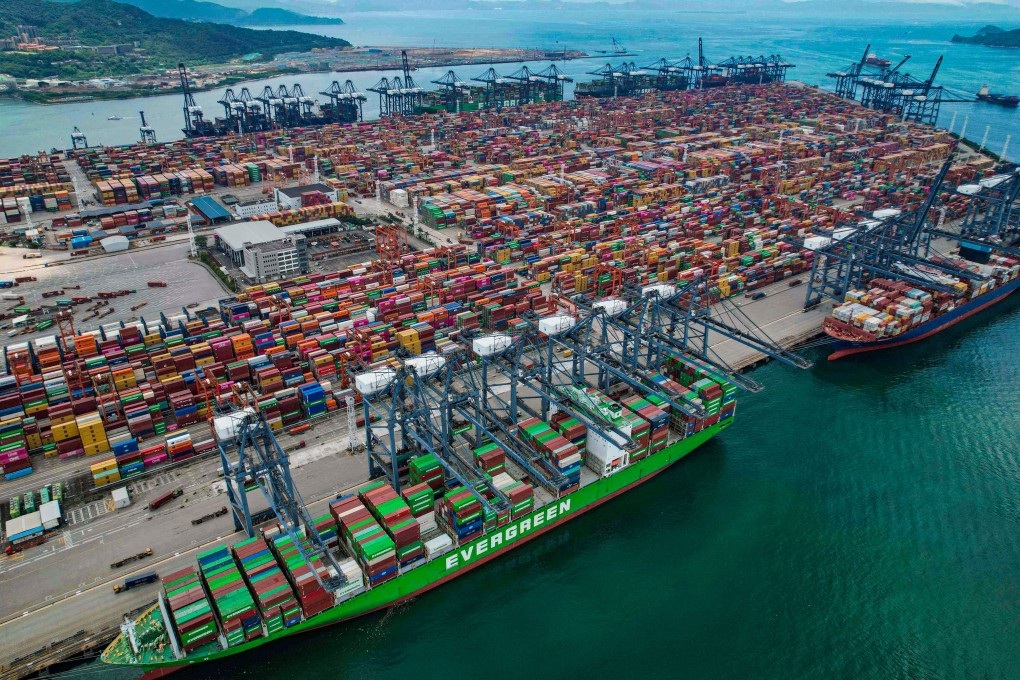
Strong demand for semiconductors, AI-related equipment and electric vehicles is keeping China’s trade engine running, even as consumption, investment and property remain under pressure.
China’s exports accelerated in August, driven by strong overseas demand for high-tech and artificial intelligence-related products, providing a crucial source of growth for an economy still struggling to revive domestic consumption and investment.
Exports from the world’s second-largest economy rose 25% year on year in U.S. dollar terms, matching economists’ forecasts and accelerating from a 23.9% increase in July, customs data showed Tuesday.
Register for the next Tekedia Mini-MBA.
Register for Tekedia AI in Business Masterclass.
Join Tekedia Capital Syndicate and co-invest in great global startups.
Imports also strengthened, climbing 28.2% from a year earlier after rising 27.5% in July, although the increase fell short of the 30% growth economists had expected.
The figures underpin an important divide in China’s economy: external demand remains resilient while activity at home is losing momentum. Beijing is targeting economic growth of between 4.5% and 5% this year, but weaker consumption, investment and the prolonged property downturn are making exports an important support.
“External demand has significantly outpaced domestic consumption,” said Lynn Song, chief economist for Greater China at ING. “Tariff risks and the durability of the tech investment cycle are the key factors to watch to see how long this strength will persist.”

China’s high-tech exports have emerged as a major driver of the expansion. In the first eight months of the year, exports of high-tech products increased 42.9% in U.S. dollar terms.
Semiconductor exports more than doubled in value over the period even though volumes increased only 4.1%, indicating that higher prices and stronger demand for advanced memory and computing components are playing an important role in the export surge.
Automobile exports also rose by more than 50% in both value and volume, reinforcing China’s growing position as a major exporter of electric vehicles and other technology-intensive products.

Strong demand for AI-related equipment, electric vehicles, solar cells and lithium-ion batteries helped offset disruptions caused by weather events, said Zhaopeng Xing, senior China strategist at ANZ.
Xing also noted that companies continued rushing shipments to the United States amid uncertainty over tariffs, potentially bringing some future demand forward.
AI Investment Drives Trade
China’s push to develop strategic technologies is increasingly feeding through into its trade figures. The country is investing heavily in semiconductors, artificial intelligence and advanced manufacturing as Beijing seeks to reduce its reliance on foreign technology and strengthen domestic supply chains.
“The main areas of import growth still look tied to tech products, showing China continues to spend in the ongoing tech race,” Song said.
That investment is benefiting manufacturers across the technology supply chain. Chinese memory-chip producer CXMT, for example, swung to a first-half profit in its first earnings report since listing, helped by higher memory-chip prices and rising demand for AI computing.
The strength of technology exports, however, masks considerable weakness in sectors dependent on Chinese consumers. Companies serving the domestic market continue to face soft demand and producer-price deflation, limiting their ability to pass higher costs on to customers and putting pressure on profitability.
China’s growing reliance on overseas markets also creates a significant policy risk. Using foreign demand to absorb excess industrial capacity can support growth in the short term, but it risks provoking additional trade restrictions from major trading partners already concerned about China’s expanding trade surpluses.
China’s trade surplus reached $119.09 billion in August, up from $112.5 billion in July. For the first eight months of the year, the surplus totaled $805.51 billion, putting the country on course to exceed $1 trillion for the second consecutive year.
The surplus with the United States rose to $29.18 billion from $28 billion in July. Chinese exports to the U.S. jumped 34.4% year on year, substantially outpacing the 17.8% increase in imports.
A trade truce between Beijing and Washington has so far prevented tensions from escalating into a broader confrontation. The two governments are exploring reciprocal tariff reductions covering $30 billion of goods on each side ahead of another summit between the countries’ presidents later this month.
But the sheer scale of China’s trade surplus could make the relationship increasingly difficult to manage, particularly if exports continue to outpace imports.
China’s rare-earth exports increased month on month in August but remained well below the average monthly level for the year. Crude-oil imports fell 23.4% year on year in volume terms, suggesting that the broader import picture is being shaped heavily by technology investment rather than a broad-based acceleration in domestic demand.
The trade figures had little immediate impact on financial markets, with the yuan broadly flat and Chinese stocks slightly higher as investors awaited U.S. inflation data for clues about the Federal Reserve’s interest-rate path.
Domestic Economy Remains The Weak Link
The export strength comes as several major indicators point to slower momentum at home.
China’s economy grew 4.3% in the second quarter, while data released last month showed industrial production and retail sales slowing at the start of the third quarter. Fixed-asset investment also declined more sharply in the first seven months.
The property sector, previously one of the country’s most important sources of economic growth, remains trapped in a prolonged downturn, weighing on household wealth, construction activity and consumer confidence.
Premier Li Qiang called in August for measures to stabilize external demand while acknowledging insufficient domestic demand, difficulties facing industries and rising uncertainty in the international environment.
Beijing has increased fiscal support, including an 800 billion yuan ($119.21 billion) financing facility intended to strengthen infrastructure investment.
But strong exports reduce the immediate pressure on policymakers to introduce more aggressive measures aimed at households, employment and the property market. As long as factories can continue selling abroad, China can partially offset weak domestic demand without relying solely on large-scale stimulus.
That dynamic could also influence monetary policy.
“The latest trade data do not materially strengthen the case for an imminent interest rate cut,” said Hao Zhou, a Hong Kong-based analyst at Guotai Haitong Securities.
“While further policy support cannot be ruled out, the combination of resilient external demand, steady industrial momentum, and increasingly targeted fiscal measures implies that the timing and necessity of additional monetary easing will require further observation,” he said.
However, it is currently not clear if the export boom can remain strong enough to compensate for weakness at home without generating a new wave of trade tensions. AI investment, semiconductors, electric vehicles and other high-tech products are giving China’s exporters a powerful source of momentum.
But the longer domestic consumption remains subdued, the more dependent the economy becomes on foreign buyers, leaving its growth outlook exposed to tariffs, protectionism and the durability of the global technology investment cycle.