

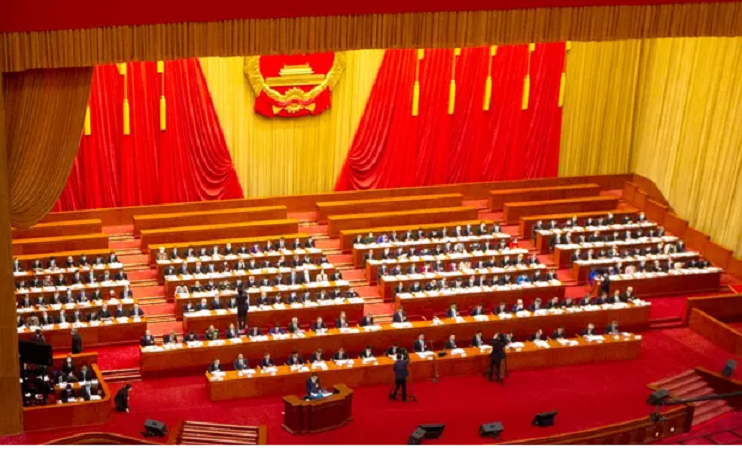
China has unveiled an expansive five-year development blueprint that places artificial intelligence at the center of its economic transformation, outlining a sweeping strategy to accelerate the adoption of emerging technologies and secure leadership in frontier science.
The 141-page policy plan, released alongside the opening session of the National People’s Congress, underscores Beijing’s determination to embed AI throughout the economy while achieving breakthroughs in areas such as quantum computing, humanoid robotics, and next-generation communications.
Officials said the country would “seize the commanding heights of science and technological development” and pursue “decisive breakthroughs in key core technologies,” language that signals intensifying technological competition with the United States.
Register for Tekedia Mini-MBA edition 20 (June 8 – Sept 5, 2026).
Register for Tekedia AI in Business Masterclass.
Join Tekedia Capital Syndicate and co-invest in great global startups.
Register for Tekedia AI Lab.
The blueprint also coincided with a major policy speech delivered by Chinese Premier Li Qiang, who elevated technology development to the top of the government’s economic agenda. The work report presented to lawmakers emphasized what Beijing calls “new quality productive forces,” a phrase that has become shorthand for the country’s push to drive economic growth through advanced innovation rather than traditional infrastructure and property investment.
Artificial intelligence sits at the core of the strategy. The term appears more than 50 times in the document, which outlines a sweeping “AI+ action plan” designed to integrate the technology into virtually every major sector of the economy.
Authorities want AI systems to be deployed widely across manufacturing, logistics, education, finance, and healthcare, while encouraging the use of autonomous software agents capable of performing complex tasks with limited human supervision. In the industry, the government also plans to expand the use of robotics to address labor shortages and boost productivity.

Analysts say the plan reflects mounting pressure on China’s economy from demographic changes. The country’s working-age population has begun shrinking while its elderly population is expanding rapidly, a trend that threatens to weigh on economic growth for decades.
“Beijing’s goal is to use AI and robotics to boost productivity and performance in a wide range of sectors,” said Kyle Chan, a fellow in Chinese technology at the Brookings Institution.
The strategy also highlights China’s ambition to close technological gaps with the United States and reduce reliance on foreign innovation. For years, Chinese officials have expressed frustration over dependence on Western technologies such as advanced semiconductors and aerospace equipment.

Those concerns intensified after Washington imposed export restrictions on advanced chips and semiconductor manufacturing tools destined for China. Beijing responded by tightening export controls on critical minerals and rare earth elements that are essential for electronics and clean-energy technologies.
Against that backdrop, China’s state planning agency said the country was already making rapid progress in several strategic fields, arguing that it now leads globally in research and development and practical applications in areas including artificial intelligence, robotics, quantum technologies, and biomedicine.
The report also pointed to new advances in domestic chip research and manufacturing capabilities, suggesting that Beijing’s long-running push for semiconductor self-sufficiency is beginning to show results.
Beyond AI, the blueprint lays out an array of scientific ambitions that stretch from space exploration to nuclear fusion energy. Authorities plan to expand investment in quantum computing, accelerate research into 6G communications networks, and advance “embodied AI,” the technology underpinning humanoid robots capable of interacting with the physical world.
The document also outlines plans to develop brain-machine interfaces, build scalable quantum computers, and construct an integrated quantum communication network linking satellites and ground infrastructure. Such systems could eventually enable ultra-secure communications resistant to cyber-attacks.
China’s space ambitions are also prominent in the plan. Officials outlined goals that include developing reusable heavy-lift rockets and demonstrating the feasibility of establishing an international lunar research station.
Underpinning many of these initiatives is an enormous expansion of computing infrastructure. The government intends to build “hyper-scale” data clusters capable of training and running large AI models, supported by China’s vast electricity generation capacity.
Access to abundant power is emerging as a key competitive advantage in the global AI race. Training large-scale artificial intelligence systems requires enormous computing power and energy consumption, creating strong incentives for governments to build massive data centers.
China’s blueprint also places unusual emphasis on open-source development, a strategy that analysts say could differentiate the country’s approach to AI from that of many U.S. technology firms.
The plan calls for the creation of large open-source AI ecosystems and developer communities where models, software tools, and research findings can be shared more freely.
“Open source wasn’t mentioned in previous reports, and this is a key difference between the Chinese and American AI approaches,” said Tilly Zhang, a technology and industrial policy analyst at Gavekal Dragonomics.
“I believe China has studied this very carefully and decided to make open-source AI a flagship strategy and a competitive advantage against the United States.”
Such an approach could help accelerate the global spread of Chinese AI technologies, particularly in emerging markets where companies and governments may prefer open platforms over proprietary systems.
China’s ambitions are also being fueled by rapid advances among domestic AI developers. Companies such as DeepSeek have drawn international attention after releasing powerful AI models capable of competing with Western systems.
Their rise has strengthened Beijing’s belief that China can build an independent and globally competitive AI ecosystem even as geopolitical tensions reshape technology supply chains.
For policymakers, the stakes extend far beyond technological prestige. Artificial intelligence and advanced automation are increasingly seen as essential tools for sustaining long-term economic growth in the face of demographic decline, slowing productivity, and a maturing industrial base.
The blueprint, therefore, represents more than a research agenda. It is believed to be a strategic attempt to reposition China’s economy around innovation-driven growth while competing for leadership in the technologies likely to define the global economy over the coming decades.