

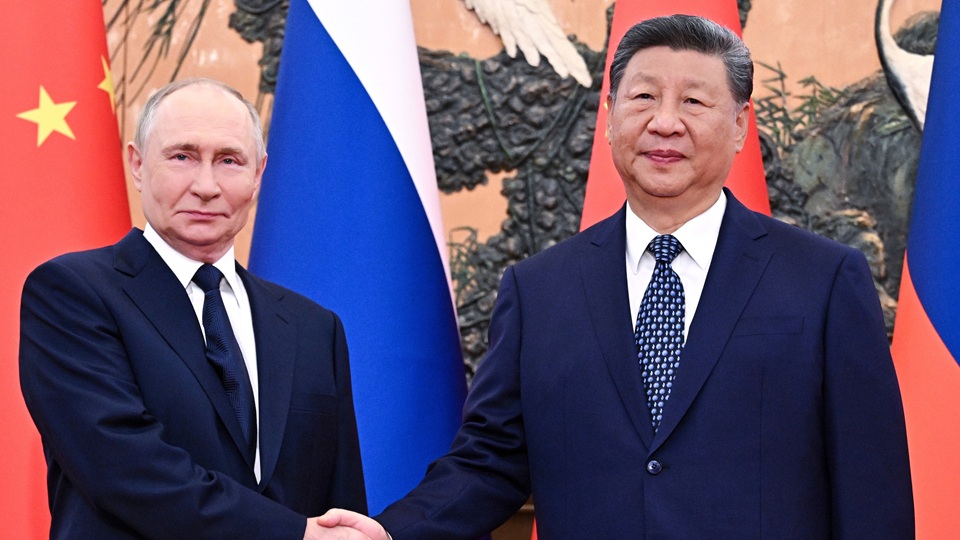
Chinese President Xi Jinping on Monday urged members of the Shanghai Cooperation Organization (SCO) to deepen cooperation on artificial intelligence, while warning against what he described as a “Cold War mentality.”
Xi made the remarks in Tianjin at the largest-ever summit of the SCO, attended by more than 20 foreign leaders, including Russian President Vladimir Putin and Indian Prime Minister Narendra Modi. The gathering comes as Beijing positions itself as a global peacemaker amid ongoing trade frictions with the United States, Russia’s protracted war in Ukraine, and instability in the Middle East following the Israel-Hamas conflict.
According to CNBC, Xi highlighted that China has already invested $84 billion across SCO countries and pledged support for 10,000 students through Beijing’s “Luban” vocational education program. He framed the summit as an opportunity to open a “new phase of high-quality development and cooperation” for the bloc.
Register for Tekedia Mini-MBA edition 20 (June 8 – Sept 5, 2026).
Register for Tekedia AI in Business Masterclass.
Join Tekedia Capital Syndicate and co-invest in great global startups.
Register for Tekedia AI Lab.
Over the weekend, Xi held at least 10 bilateral meetings on the sidelines of the summit, including with Turkish President Recep Tayyip Erdogan and Cambodian Prime Minister Hun Manet. His Saturday meeting with Modi ended with both sides affirming that China and India should prioritize partnership over rivalry.
“A stable relationship and cooperation between India and China and their 2.8 billion peoples on the basis of mutual respect, mutual interest and mutual sensitivity are necessary for the growth and development of the two countries,” India’s Ministry of Foreign Affairs said in a statement.
Xi’s remarks come at a time of heightened tensions with Washington, which has openly declared its intention to lead the AI evolution. The U.S. under President Donald Trump has imposed strict export controls on advanced semiconductor chips and other critical technologies to China, moves seen as an effort to curb Beijing’s ability to develop next-generation AI systems.

These restrictions have severely limited the ability of Chinese firms to access cutting-edge processors needed to power large-scale AI models, forcing Beijing to accelerate domestic chip production.
Xi’s call is also widely viewed as part of Beijing’s pushback against what it considers U.S. “containment measures” in technology. The chip export curbs, introduced under the guise of national security, have already sparked friction between the world’s two largest economies, with ripple effects across global supply chains and AI research collaborations.
Historical Roots of the SCO
The SCO, founded in 2001, traces its origins to the “Shanghai Five” mechanism of the mid-1990s, originally created to resolve border issues among China, Russia, and Central Asian states after the Soviet collapse. Over time, it evolved into a broader political and security grouping aimed at stabilizing Eurasia and countering the influence of Western military alliances.

With NATO expanding eastward and the U.S. building security partnerships across Asia, the SCO emerged as a Eurasian counterweight—emphasizing non-alignment, sovereignty, and multipolarity. Today, the organization encompasses not only China, Russia, and Central Asian republics, but also India, Pakistan, and Iran, representing nearly half the world’s population and a growing share of global economic activity.
For Beijing, the SCO is both a geopolitical shield and an economic platform. Unlike NATO, it does not operate as a formal military alliance, but it coordinates on counterterrorism, economic integration, energy, and increasingly, technology. Xi’s emphasis on artificial intelligence cooperation reflects a desire to anchor the SCO’s next chapter in emerging industries while reinforcing its founding mission to balance against Western dominance in global governance.
While it is unclear if this SCO summit will produce concrete breakthroughs, analysts suggest that Beijing’s détente with India could bolster its influence within the bloc.
“The improvement of relations with India is a big deal. It allows India to access highly critical intellectual property that it needs if it is to industrialize and boost manufacturing,” said Marko Papic, chief strategist at GeoMacro Strategy BCA Access, in an email to CNBC.
“But, over the long term, the U.S. is losing the propaganda battle to paint China as the trouble-maker-in-chief. And that only further ossifies multipolarity,” Papic added.
Henry Huiyao Wang, founder and president of the Center for China and Globalization, noted that China’s initiatives extend beyond economics. “China could take advantage of its good relations with Russia to help broker the deal for the Russian war in Ukraine,” Wang said, adding that SCO members like China and India could act as guarantors of security.
Wang suggested the SCO could evolve into a diplomatic force comparable to Western blocs.
“President Trump is trying to make a lot of peace, but I think with the help of China, we could do the same too,” he said Monday on CNBC’s The China Connection.
Tianjin Declaration and New Initiatives
At the summit, SCO leaders signed the “Tianjin Declaration” and approved a long-term development plan through 2035. While the full text was not immediately released, Chinese state media reported the adoption of 24 documents covering cooperation on security, economic growth, and cultural exchange.
Xi announced the creation of new platforms for collaboration in the green industry, new energy, digital economy, technology innovation, and vocational training. He also unveiled plans for an SCO Development Bank, framed as another multilateral financial institution alongside the Beijing-based Asian Infrastructure Investment Bank.
“Global governance must be achieved by coordination and cooperation, not by unilateral bullying,” China’s top diplomat Wang Yi said, fielding a question about Xi’s proposed Global Governance Initiative.
Xi’s new “Global Governance Initiative” follows earlier banners like the Global Development Initiative and the Global Security Initiative. In his speech, he argued that hegemonism and protectionism persist “despite 80 years of peace” since the end of World War II, warning that “global governance has come to a new crossroads.”
Calling for equal application of international law, Xi cautioned against “the house rules of a few countries” being imposed on others.
It is believed that his appeal for cooperation highlights China’s strategy of presenting itself as a proponent of shared technological growth, in contrast to Washington’s more restrictive stance.