

Switching exchanges starts with the trades you intend to make. This crypto exchange review finds BYDFi worth considering for traders who want spot markets, perpetual futures and automation together. Its appeal is the range of ways to trade within one service. Someone seeking only an occasional cryptocurrency purchase may have less use for that breadth.
A useful cryptocurrency exchange review should connect those choices to everyday decisions. The crypto trading platform combines direct trading with scheduled purchases, grid strategies and copy trading. Whether that combination justifies switching depends on the products you need, how orders execute and what the complete transaction costs.
Match the market to the trade
A spot purchase acquires cryptocurrency, which can then be held or sold. A perpetual futures contract provides exposure to price movements without ownership of the underlying asset and has no fixed expiry. Having both available gives traders flexibility, but each requires a different plan.
Perpetuals introduce margin requirements, liquidation exposure and funding payments. Funding passes between long and short position holders, with the direction of payment determined by the funding rate. It can add to or subtract from the result of holding a position, separately from entry and exit fees.
The platform supports isolated and cross margin. Isolated margin allocates collateral to a particular position; cross margin shares eligible collateral across positions. A trader assessing futures should understand that allocation before choosing position size. Extra margin added manually or automatically also changes the funds exposed to a position.
For someone building cryptocurrency holdings through purchases, spot trading or scheduled buying may be sufficient. Access to futures is useful when it serves a defined strategy, rather than as an automatic next step after learning spot trading.
Evaluate order execution before interface claims
An informative crypto trading platform review should explain what happens after an order is submitted. A market order seeks execution at available prices. A limit order sets an acceptable price, but may remain unfilled. Choosing between them involves a tradeoff between seeking immediate execution and controlling price.
The futures order tools include Post Only. It places an order in the book as a maker and cancels it if it would immediately match an existing order. This matters to traders planning around maker fees: selecting a standard limit order alone does not guarantee maker treatment.
Trigger orders allow preset conditions for submitting a futures order. Reaching a trigger level is distinct from completing the trade, since execution still depends on the order settings, available margin and market conditions. These controls offer ways to implement a plan, while leaving the trader responsible for its price levels and size.
Compare crypto exchange fees on the same basis
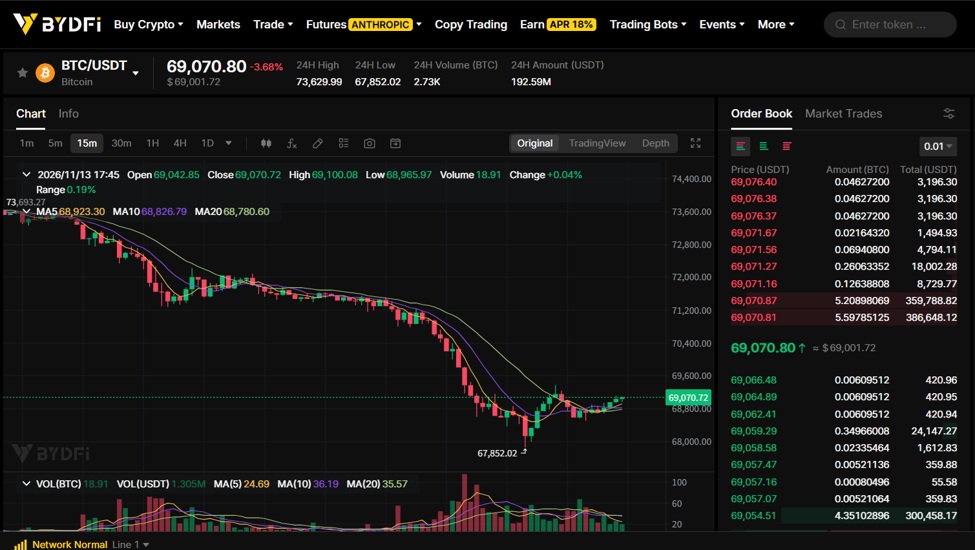
BYDFi’s published base rates, checked on 13 November 2026, distinguish spot trading from USDT-M and COIN-M perpetuals.
| Product | Maker fee | Taker fee |
| Spot trading | 0.1% | 0.1% |
| USDT-M perpetuals | 0.02% | 0.06% |
| COIN-M perpetuals | 0.02% | 0.06% |
VIP reductions may apply, and rates can change. Perpetual trading fees apply when opening and closing positions. For USDT-M contracts, the calculation uses the value traded at entry or exit, rather than just the margin deposited.
For a hypothetical 1,000 USDT spot purchase at the 0.1% base rate, the trading fee is 1 USDT. Buying and later selling creates two transactions, each subject to the applicable fee. Spread and slippage can also affect the overall result.
Convert uses a different presentation. It charges no additional fee because costs are included in the quote. Compare the amount received for the same input with the expected proceeds from an order-book trade after fees. A quote without a separate fee line can still contain a conversion cost.
For a switcher, the comparison should also include any charges for moving assets and the funding payments associated with an intended perpetual position. A lower headline trading rate does not settle the total cost of a strategy.
Choose automation for a specific task
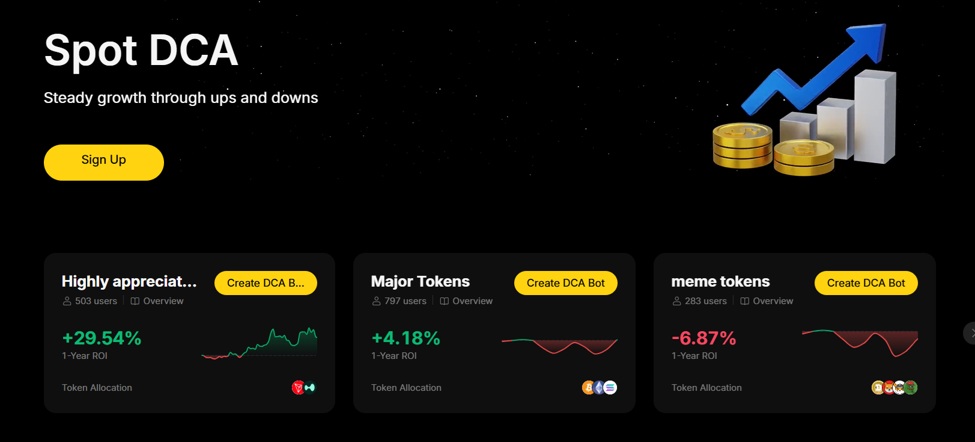
Among BYDFi’s crypto exchange features, Spot DCA, Spot Grid and Futures Grid address different routines.
Spot DCA schedules recurring purchases using a chosen amount and interval, with an optional buy-price range. It suits a plan built around repeated accumulation. The trader still chooses the assets, budget and conditions for buying.
Spot Grid places buy and sell orders within a user-defined range. Its settings include the range, number of grids and investment amount. It is more relevant to a strategy expecting repeated price movements within that range. Realized grid profits can coexist with an overall loss if the cryptocurrency retained by the strategy falls in value.
Futures Grid applies grid strategies to contracts, with Long, Short and Neutral modes. It retains the margin and liquidation considerations of futures. Executed bot orders also generate trading fees, which matter when a strategy trades frequently.
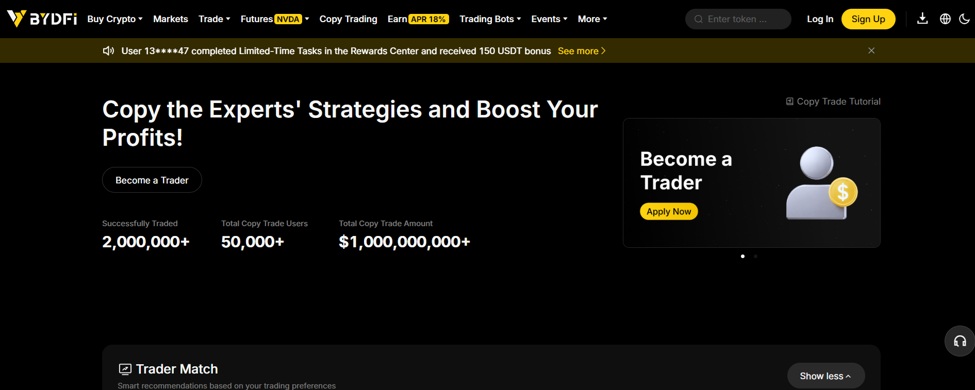
Copy Trading offers another approach by replicating a selected lead trader’s activity. Its profit-sharing rules add a separate cost consideration. The official guide states a default 10% share, subject to positive relevant realized profit and settlement conditions. Following another trader still leaves the follower exposed to the resulting positions.
Assess account controls and everyday use
The official desktop guide documents passkeys for login and withdrawal authorization through supported fingerprint, facial recognition or device-lock authentication. Prospective users should check compatibility with the devices they expect to use. Authentication controls address account access; they do not establish an exchange’s financial condition.
Ease of use also depends on the task. Reviewing a Convert quote involves fewer execution choices than configuring a futures order or grid strategy. Product breadth can be convenient for experienced users, while newcomers may prefer to begin with a small set of functions. Product availability and access conditions should be checked for the user’s location before moving funds.
Weigh the crypto exchange pros and cons
BYDFi makes its strongest case for traders who will use several of these tools and understand their differences. Spot purchases, perpetual orders and automated strategies can support different parts of a trading routine within the same service.
The tradeoffs are the learning required and the need to track costs across products. A buyer seeking occasional purchases has less reason to prioritise futures controls. A frequent trader has more reason to examine maker treatment, funding and the fees generated by automation. Switching makes sense when those specific capabilities improve an existing workflow at an acceptable total cost.