

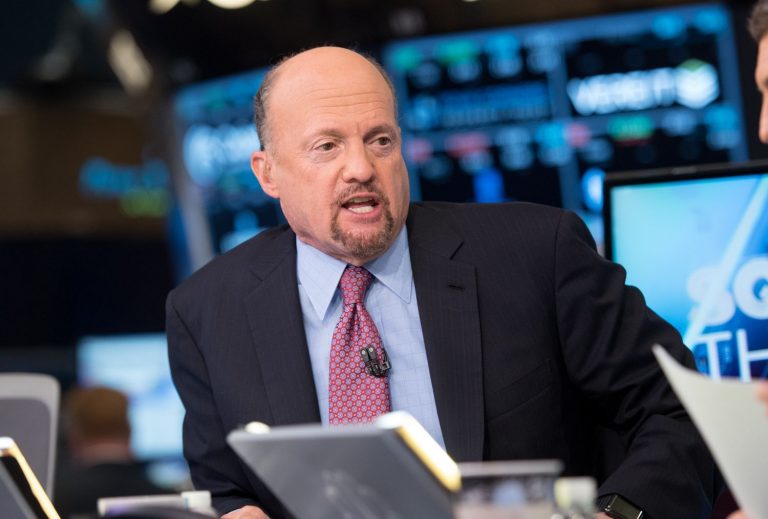
CNBC’s Jim Cramer says Tuesday’s market action offered more than a routine day of sector weakness. It served as an early stress test for what the U.S. economy could face if the war with Iran persists and energy prices remain elevated.
The market action may have ended with only modest index moves, but beneath the surface, it delivered a far more troubling message, according to Cramer.
He highlighted some sector-level signals that suggest investors are beginning to price in something more serious than routine geopolitical volatility: a consumer-led slowdown colliding with renewed inflation pressure.
Register for Tekedia Mini-MBA edition 20 (June 8 – Sept 5, 2026).
Register for Tekedia AI in Business Masterclass.
Join Tekedia Capital Syndicate and co-invest in great global startups.
Register for Tekedia AI Lab.
The major indices masked the weakness. The Dow Jones Industrial Average fell 0.2%, while the Nasdaq Composite managed only a 0.1% gain after spending much of the session under pressure. Reuters reported that U.S. stocks closed mixed as markets remained fixated on President Donald Trump’s deadline for Iran to reopen the Strait of Hormuz, with investors weighing the risk of escalation against faint signs of diplomacy.
“A heck of a lot of bad news,” Cramer’s reading of the tape bluntly said.
He framed the day’s action as evidence of a “weak consumer, coupled with inflation.” That combination is what makes the market signal especially important.

Ordinarily, investors can absorb a geopolitical shock if household demand remains resilient. But when war-driven energy inflation begins to hit consumers already under pressure from high borrowing costs and elevated living expenses, the economic consequences become more systemic.
This is where the retail sector’s performance becomes highly instructive. Cramer pointed first to what he called the “real screamers”: retail stocks. The decline in Walmart Inc., down 3.3%, is notable because Walmart is typically viewed as one of the market’s most defensive consumer names.
Its weakness suggests investors are starting to question whether even value retailers can escape a broader consumption slowdown. Cramer, while praising the company, underscored its importance as an economic barometer.

“Here’s a stock that truly defines the term juggernaut. It is a value-oriented retailer that, out of nowhere, has begun to attract wealthier customers who make over $100,000 a year, but no matter, it’s where the less-than-well-off buy a lot of their food and clothing,” he said.
He then sharpened the point: “Walmart’s been a total runaway train but that has left many other retailers behind. Today, though? It’s saying something different.”
That “something different” appears to be rising concern about the lower-income consumer. The declines in Dollar General and Dollar Tree, down 2.6% and 4.2%, reinforce that concern. This is unusual market behavior as discount chains typically outperform when economic conditions soften because consumers trade down.
Cramer pointed directly to this anomaly, saying, “At least one of these should’ve tilted more positive.”
Then came the broader economic warning: “That’s just plain trouble and bodes badly for tens of millions of people in this country.”
This is perhaps the most consequential insight. If both mainstream retailers and discount chains are under pressure, markets may be pricing not just slower discretionary spending, but deeper stress in household purchasing power, likely worsened by higher gasoline and food prices linked to the conflict. Oil remains above psychologically important levels as the Strait of Hormuz risk persists.
The second major warning signal came from travel. Cramer turned to cruise operators as a proxy for consumer confidence and discretionary demand.
“Not one is holding up,” he said.
The weakness in Royal Caribbean Group, Norwegian Cruise Line Holdings, and Carnival Corporation & plc suggests investors are reassessing the sustainability of post-pandemic leisure spending.
He framed it through the post-COVID spending mindset.
“We know that ever since Covid, many have adopted this mantra ‘ long on money, short on time,” he said. Then, I asked the crucial question: “Is that still the case?”
The market’s answer appears increasingly uncertain. Cruise lines are especially sensitive to fuel costs, consumer confidence, and recession fears. In that sense, their weakness may be an early signal that households are beginning to pull back on big-ticket leisure spending.
The third signal lies in credit.
The decline in Capital One Financial, down 1.6%, matters because of its exposure to subprime and near-prime borrowers. Cramer interpreted this as an early read on deteriorating credit quality if the war persists. This is because credit card issuers often serve as forward-looking indicators of household financial stress. If inflation stays elevated and employment conditions soften, delinquencies could begin to rise.
Cramer summed up the broader picture in two words: “Real weakness.” He added that it is “Getting worse, not better.”
He then turned to pharmaceuticals as an inflation signal. The declines in Merck & Co., Pfizer, and AbbVie led him to a wider macro interpretation.
“[These] tell you not only are things slowing down, but they’re also inflationary,” he said, adding that “When you know that inflation could rage, the group that acts the worst [is] the drug stocks.”
The broader significance of Tuesday’s session is that the market is beginning to sketch a stagflation scenario: slower consumer spending, rising cost pressures, weakening discretionary demand, and potential deterioration in credit quality.
Cramer said in his closing line: “Here’s the bottom line: much like hips, stocks don’t lie.”
But he left room for reversal.
“Of course, the … scenario that looks like it might be coming … can easily be reversed,” he said.
While markets remain highly headline-sensitive to developments in the Iran conflict, Tuesday’s sector performance suggests investors are no longer looking only at the war itself. They are increasingly focused on how a prolonged conflict could ripple through the U.S. consumer, inflation, and earnings outlook.