

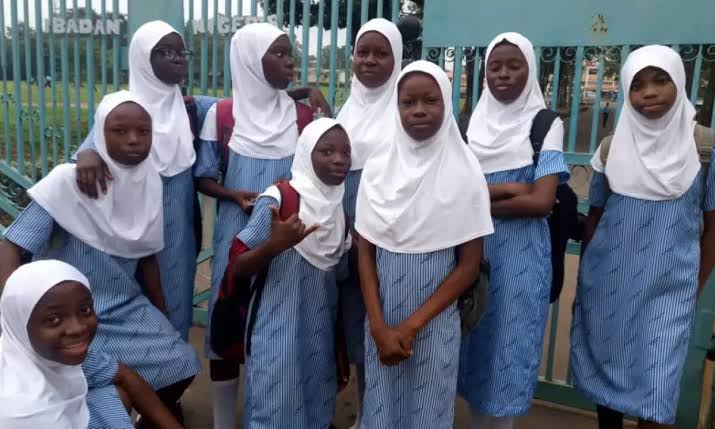
The controversy surrounding the use of the hijab at the International School, University of Ibadan (ISI) has once again exposed one of Nigeria’s enduring social realities: our public debates are rarely about the immediate issue before us. Although the disagreement appears to concern whether female Muslim students should wear the hijab with their school uniform, the public reactions reveal something much deeper. They demonstrate how Nigerians construct the hijab as a symbol of competing ideas about constitutional rights, institutional authority, religious identity, citizenship, and national coexistence.
A review of public comments on the ISI controversy reveals that the hijab is no longer perceived as merely a piece of clothing. Instead, it has become a powerful social symbol onto which different groups project their beliefs and aspirations. For one group, the hijab represents an inalienable constitutional right. Their argument is straightforward: because the University of Ibadan is a federal institution, any school operating under its authority should uphold the constitutional guarantee of freedom of religion. In this construction, denying a student the right to wear the hijab is interpreted not as enforcing a dress code but as restricting religious freedom. Consequently, calls to “fight till the end” are framed as civic responsibility rather than religious activism.
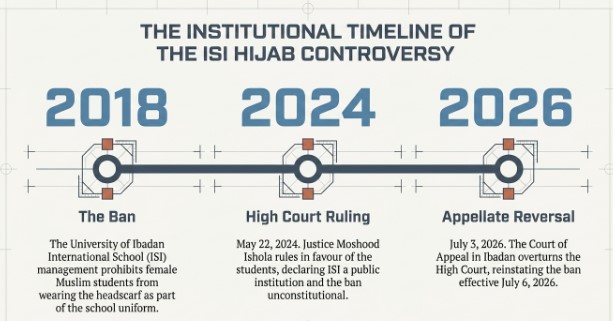
Another group constructs the issue very differently. To them, ISI functions as a private educational institution with the right to determine its admission conditions and uniform policy. Parents, they argue, voluntarily choose the school and should respect its established rules. If the school’s policies conflict with personal religious convictions, the appropriate response is to enrol one’s child in another institution rather than compel the school to alter its regulations. Within this discourse, the hijab becomes less a constitutional question than one of contractual agreement and institutional autonomy.
Register for the next Tekedia Mini-MBA.
Register for Tekedia AI in Business Masterclass.
Join Tekedia Capital Syndicate and co-invest in great global startups.
Between these competing positions lies an unresolved question that repeatedly surfaced in public discussions: What exactly is ISI? Is it a public institution because it is connected to the University of Ibadan, or is it a private entity because it is self-financing and independently managed? This disagreement over institutional identity has become as significant as the debate over the hijab itself. The answer determines whether constitutional obligations or institutional discretion should prevail.
Beyond the legal arguments, the comments also reveal how the hijab is socially constructed in remarkably different ways. For many Muslim contributors, it is an essential expression of religious identity, obedience to God, and constitutional liberty. For others, it is interpreted as an unnecessary religious display within an educational environment that should prioritise uniformity and neutrality. Some commenters went further, portraying the hijab as a source of division, while others viewed resistance to it as evidence of religious intolerance.
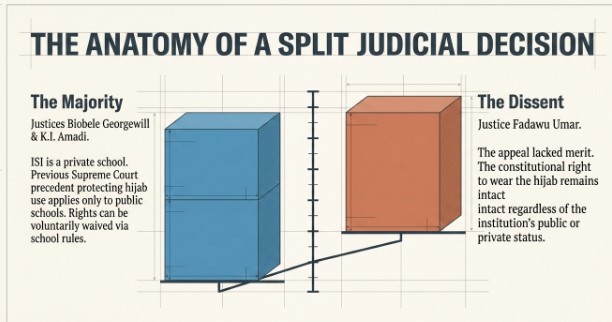
Perhaps most revealing is the fact that the same piece of fabric simultaneously symbolises modesty, resistance, constitutional freedom, institutional disorder, religious commitment, Arab cultural influence, and even political activism. Such diverse interpretations demonstrate that the public is not debating the hijab itself; rather, they are debating what the hijab should mean within contemporary Nigerian society.

The discourse also exposes worrying patterns of religious polarisation. While many contributors advocated peaceful dialogue and mutual respect, others questioned the sincerity of Muslims, criticised Islamic beliefs, or dismissed the legitimacy of religious accommodation altogether. Conversely, some supporters of the hijab framed the issue in ways that suggested religious victory rather than constitutional negotiation. These positions deepen social divisions by replacing civic dialogue with identity-based confrontation.
Yet there were also voices calling for a more inclusive understanding of religious diversity. Some argued that if Muslim students are allowed to wear the hijab, students from other faiths should similarly be permitted to express their religious identities. Others questioned why Nigeria, in an era defined by artificial intelligence, robotics, and biotechnology, continues to expend enormous social energy on disputes over clothing instead of investing in educational innovation and national development.
The ISI controversy demonstrates that educational institutions have become symbolic spaces where broader struggles over religion, law, identity, and governance are negotiated. Whether one supports or opposes the wearing of the hijab, reducing the debate to a simple choice between religion and school rules overlooks the complexity of the issues involved.

As the ISI case continues to shape public conversation, the country has an opportunity to rethink how educational spaces can accommodate diversity while preserving institutional integrity. Ultimately, the future of Nigeria will not be determined by whether the hijab is permitted at one school. It will be determined by whether Nigerians can transform deeply contested symbols into opportunities for dialogue rather than division. That is the real challenge exposed by the ISI debate, and it is one that extends far beyond the gates of a single school.