

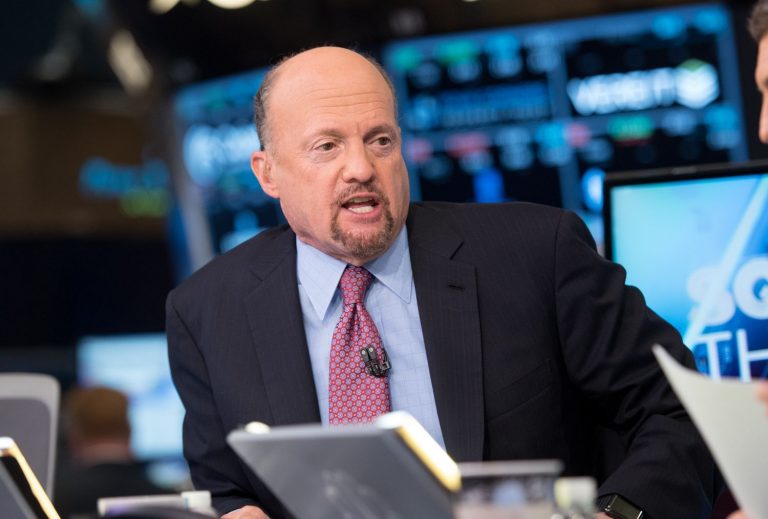
CNBC’s Jim Cramer is calling on Nvidia to dramatically expand its share-repurchase program, noting that the artificial intelligence chipmaker’s extraordinary growth is not being adequately reflected in its stock price.
“I think, from Nvidia’s perspective, there’s nothing more valuable in this market than Nvidia,” Cramer said Monday on CNBC’s “Mad Money.”
His argument comes as Nvidia’s fundamentals continue to strengthen while its shares have delivered comparatively modest gains. The company has repeatedly raised its expectations for future AI demand, yet investors have become increasingly focused on valuation, the sustainability of AI infrastructure spending and Nvidia’s growing involvement in financing the customers that purchase its products.
Register for the next Tekedia Mini-MBA.
Register for Tekedia AI in Business Masterclass.
Join Tekedia Capital Syndicate and co-invest in great global startups.
Cramer believes the company should respond by making its own shares one of its largest capital-allocation priorities.
“I’d quintuple the buyback authorization, announce a monster half trillion dollar buyback and repurchase a tenth of the company in a fairly aggressive fashion, every day, clockwork, and get bigger on the down days,” he said.
Nvidia has already accelerated its buybacks. Its board approved an additional $80 billion authorization in May, without an expiration date, on top of funds remaining under its previous program. The company repurchased nearly $40 billion of its stock during the first two quarters of fiscal 2027, according to FactSet, bringing the pace of repurchases close to the entire amount spent during fiscal 2026. Nvidia bought back roughly $34 billion of shares in fiscal 2025.

Nvidia Chief Financial Officer Colette Kress said on the company’s most recent earnings call that the company was returning more cash to shareholders than its stated target.
“Relative to our plan to return 50% or more of free cash flow, we returned 60% on a year-to-date basis,” Kress said. “And going forward, we intend to increase and return excess free cash flow net of strategic uses.”
The scale of Cramer’s proposal, however, would represent a major escalation. A $500 billion authorization would be several times larger than Nvidia’s existing additional authorization and would potentially allow the company to retire a substantial portion of its outstanding shares if executed at favorable prices.

The attraction for shareholders is straightforward: buying back stock reduces the number of shares outstanding, increasing each remaining shareholder’s proportional ownership of the company and potentially boosting earnings per share.
Nvidia’s growth is accelerating, but the stock is not keeping pace.
Cramer’s argument rests largely on what he sees as a widening gap between Nvidia’s operating outlook and its share-price performance.
Since Nvidia’s October 2025 GTC conference in Washington, the company has provided strong visibility into future AI infrastructure demand. Its latest outlook calls for roughly 70% revenue growth in fiscal 2028, compared with an approximately 45% growth rate that analysts had previously anticipated.
Yet the stock has failed to sustain the gains investors might expect from such an outlook.
Nvidia shares have risen only about 8% since the Oct. 28, 2025 GTC event, according to the figures cited by Cramer, compared with roughly an 11% gain for the S&P 500.
“Whatever Nvidia’s doing, it simply is not being rewarded by Wall Street,” Cramer said.
That disconnect matters because Nvidia’s valuation is increasingly being judged against expectations several years into the future. Investors are no longer simply asking whether AI demand is strong. They are assessing how long hyperscalers will continue spending at extraordinary levels, whether returns on AI infrastructure will justify those investments, and how much of Nvidia’s future growth is already embedded in its valuation.
A large buyback could give Nvidia a way to capitalize on what management believes is a mismatch between the company’s intrinsic value and its market price.
The Circular-Financing Problem
Nvidia’s capital-allocation decision is becoming more complicated because the company has moved beyond simply selling chips into helping finance the broader AI infrastructure ecosystem.
Nvidia has invested in or provided financial support to companies involved in building AI data centers and computing capacity. The arrangements are designed to help customers obtain the enormous amounts of capital required to purchase Nvidia’s GPUs and construct the infrastructure needed to deploy them.
The strategy has raised concerns about so-called circular financing. The concern is that Nvidia could provide capital or financial support to companies that subsequently use that money to purchase Nvidia’s own hardware, creating a feedback loop that makes AI demand appear stronger than it otherwise would.
That issue has become a point of scrutiny as the AI infrastructure boom absorbs hundreds of billions of dollars in capital.
Cramer rejected the idea that Nvidia’s financing activities should automatically be viewed as a vulnerability. He argued that Nvidia’s underlying collateral gives the company an advantage that conventional lenders may not have because its GPUs retain significant value and can potentially be redeployed.
“Worst case scenario, they repossess the GPUs, maybe even at the price they sold them for,” Cramer said.
The argument highlights that Nvidia’s financial exposure is not necessarily equivalent to an unsecured loan to an AI startup. High-end computing infrastructure can retain substantial economic value, although its resale value would depend on the hardware’s age, technological relevance, configuration, and the state of the AI market.
Why Apple Is The Model
Cramer pointed to Apple as an example of how aggressive buybacks can benefit shareholders when management believes the market is undervaluing the company.
Apple has spent hundreds of billions of dollars repurchasing its own shares during Tim Cook’s tenure. According to FactSet, the company has bought back more than $800 billion of stock over Cook’s roughly 15 years as chief executive, reducing the share count by about 40% during that period.
“That’s why they should do like Apple, which also was valued incorrectly, and repurchase a spectacular amount of stock,” Cramer said.
The comparison is relevant but not exact. Apple generates enormous and relatively predictable free cash flow, while Nvidia is operating in a rapidly expanding but more capital-intensive AI ecosystem. Nvidia is simultaneously funding its own research and development, expanding its computing ecosystem and supporting infrastructure investments that could create future demand for its products.
A massive buyback would therefore involve an opportunity cost. Every dollar spent repurchasing shares is a dollar that cannot be deployed toward acquisitions, strategic investments, infrastructure partnerships, or other initiatives that could strengthen Nvidia’s long-term competitive position.
The more important question for Nvidia is consequently not whether buybacks create value. They can, particularly when shares are genuinely undervalued. The question is how aggressively the company should repurchase stock while the AI industry remains in the middle of an unprecedented infrastructure buildout.
For now, Nvidia has indicated that shareholder returns will remain a major use of excess free cash flow. Cramer wants the company to go considerably further, betting that the most effective way to convince investors of Nvidia’s long-term value may be for Nvidia itself to become one of the largest buyers of its shares.
If the company eventually adopts a dramatically larger program, the impact could extend beyond earnings per share. A sustained reduction in Nvidia’s share count would increase the ownership concentration of remaining investors and could provide a powerful signal that management views the stock as undervalued.
But the size and timing of any such program will ultimately depend on how Nvidia balances shareholder returns against the enormous capital requirements of maintaining its dominance in the AI computing market.