

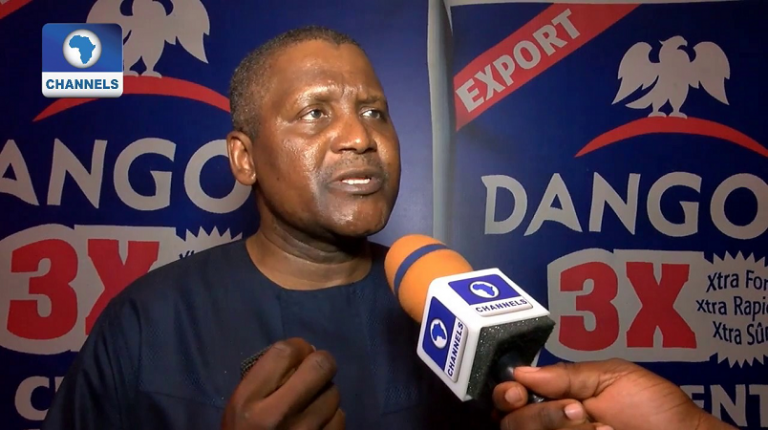
Dangote Cement Plc has signed a $1 billion agreement with Sinoma International Engineering for the construction of 12 new cement projects and the expansion of existing facilities across Africa, marking one of the largest capacity-building initiatives in the continent’s cement industry in recent years.
The Memorandum of Understanding was signed in Lagos and disclosed by MarketForces Africa. The agreement covers new integrated plants, brownfield expansions, and modernization of existing lines, reinforcing Dangote Cement’s strategy to scale production and consolidate market leadership.
Capacity push toward 80 million tons
Aliko Dangote, President and CEO of Dangote Industries Limited, said the projects are central to the company’s ambition to raise installed capacity to 80 million tons per annum (MTPA) by 2030. That production milestone forms part of the Group’s Vision 2030 agenda, which targets $100 billion in annual revenue across its businesses.
Register for Tekedia Mini-MBA edition 20 (June 8 – Sept 5, 2026).
Register for Tekedia AI in Business Masterclass.
Join Tekedia Capital Syndicate and co-invest in great global startups.
Register for Tekedia AI Lab.
He described the agreement as a landmark investment aligned with a long-term growth strategy. According to the MarketForces report, the estimated investment exceeds $1 billion.
The planned expansion will strengthen Dangote Cement’s position in Nigeria, increase clinker and cement exports, optimize asset utilization, and improve operational efficiency across its pan-African footprint. Sinoma is expected to provide engineering, procurement, and construction support for new integrated lines and capacity upgrades in key markets.
The expansion plan spans multiple jurisdictions:

In Nigeria, projects are planned for Itori, Apapa, Lekki, Port Harcourt, Onne, and Northern Nigeria, including a satellite grinding unit. Ethiopia will see a new production line to meet growing domestic demand. Additional markets include Zambia, Zimbabwe, Tanzania, Sierra Leone, and Cameroon.
This geographic diversification serves multiple objectives. First, it reduces reliance on any single market amid currency and regulatory volatility. Second, it positions Dangote Cement to capture infrastructure-driven demand in fast-growing African economies. Third, it strengthens export capability from Nigeria, where excess clinker production can be shipped to deficit markets.
Africa remains structurally short of cement relative to infrastructure needs. Urbanization, housing deficits, and public works projects continue to underpin medium-term demand growth, even as near-term volumes fluctuate due to macroeconomic conditions.

Energy security and cost structure
Beyond physical expansion, Dangote Cement has taken steps to secure energy supply, a critical input in clinker production. The company signed Gas Sales and Purchase Agreements with subsidiaries of Nigerian National Petroleum Company Limited to guarantee adequate gas supply for operations.
Stable gas access supports production reliability and the transition toward cleaner fuels such as Compressed Natural Gas and Autogas. Energy accounts for a significant share of cement manufacturing costs; securing long-term supply contracts reduces exposure to price shocks and supply disruptions.
The company is also deploying energy-efficient technologies across integrated plants and grinding facilities to lower operating costs and reduce carbon emissions. Modern kiln systems, waste heat recovery, and optimized logistics networks are central to improving margins in a capital-intensive industry.
Financial backdrop: strong earnings, improving leverage
The expansion follows a period of strong financial performance. For the nine months ended September 30, 2025, Dangote Cement reported revenue of N3.15 trillion, up 23.2% year-on-year. EBITDA rose 57.2% to N1.43 trillion, with margin expanding to 45.3%. Profit after tax climbed 166.3% to N743.3 billion, while earnings per share increased to N43.82.
Net debt declined sharply to N958 billion from N2.06 trillion, strengthening the balance sheet ahead of large capital expenditures.
Group volumes, however, dipped 2.1% to 20.2 million tons. The divergence between rising earnings and slightly lower volumes reflects stronger pricing in Nigeria and operational efficiency gains.
In Nigeria, revenue increased 42.4% to N2.18 trillion, with volumes marginally higher at 13.2 million tons. Cement and clinker exports rose 23% to 1.1 million tons, underscoring the country’s role as a production hub.
Pan-African operations recorded a 3.4% decline in revenue to N1.06 trillion and a 5% drop in volumes, attributed to political instability and liquidity constraints in certain markets. The new investments are partly aimed at stabilizing and strengthening performance in those regions through modernization and capacity optimization.
The partnership with Sinoma signals continuity in Dangote Cement’s engineering model, which has historically relied on Chinese technical expertise for rapid plant rollout across Africa. Sinoma is one of the world’s leading cement engineering contractors, with extensive experience in large-scale integrated plant construction.
Reaching 80MTPA by 2030 would entrench Dangote Cement as Africa’s largest producer and among the top global players by installed capacity. The strategy positions the company to benefit from continental trade integration under the African Continental Free Trade Area framework, enabling cross-border cement flows with fewer tariff barriers.
At a broader level, the expansion underscores a structural shift: Africa’s cement market is transitioning from import dependency toward regional self-sufficiency. Dangote Cement aims to reduce import bills, improve supply stability, and create employment by building integrated plants and grinding facilities closer to demand centers.
The $1 billion agreement, therefore, represents more than incremental capacity. Many see it as a reflection of a long-term industrial strategy centered on scale, energy security, export growth, and operational efficiency. The company is leveraging current financial strength to reinforce leadership in a sector tightly linked to infrastructure and economic development across the continent.