


The Dangote Refinery was built to be a symbol of industrial pride and energy independence for Nigeria. With a nameplate capacity of 650,000 barrels per day, it was projected to end the long history of fuel import dependence that has drained the nation’s foreign exchange. Yet within a year of its commencement, the refinery has become the centre of disputes that touch on regulation, business rivalry, labour rights, and public trust. What began as a promising shift in Nigeria’s oil landscape has quickly turned into a chain of conflicts that expose deeper structural weaknesses in the downstream sector.
Breaking NNPC’s Monopoly in 2024
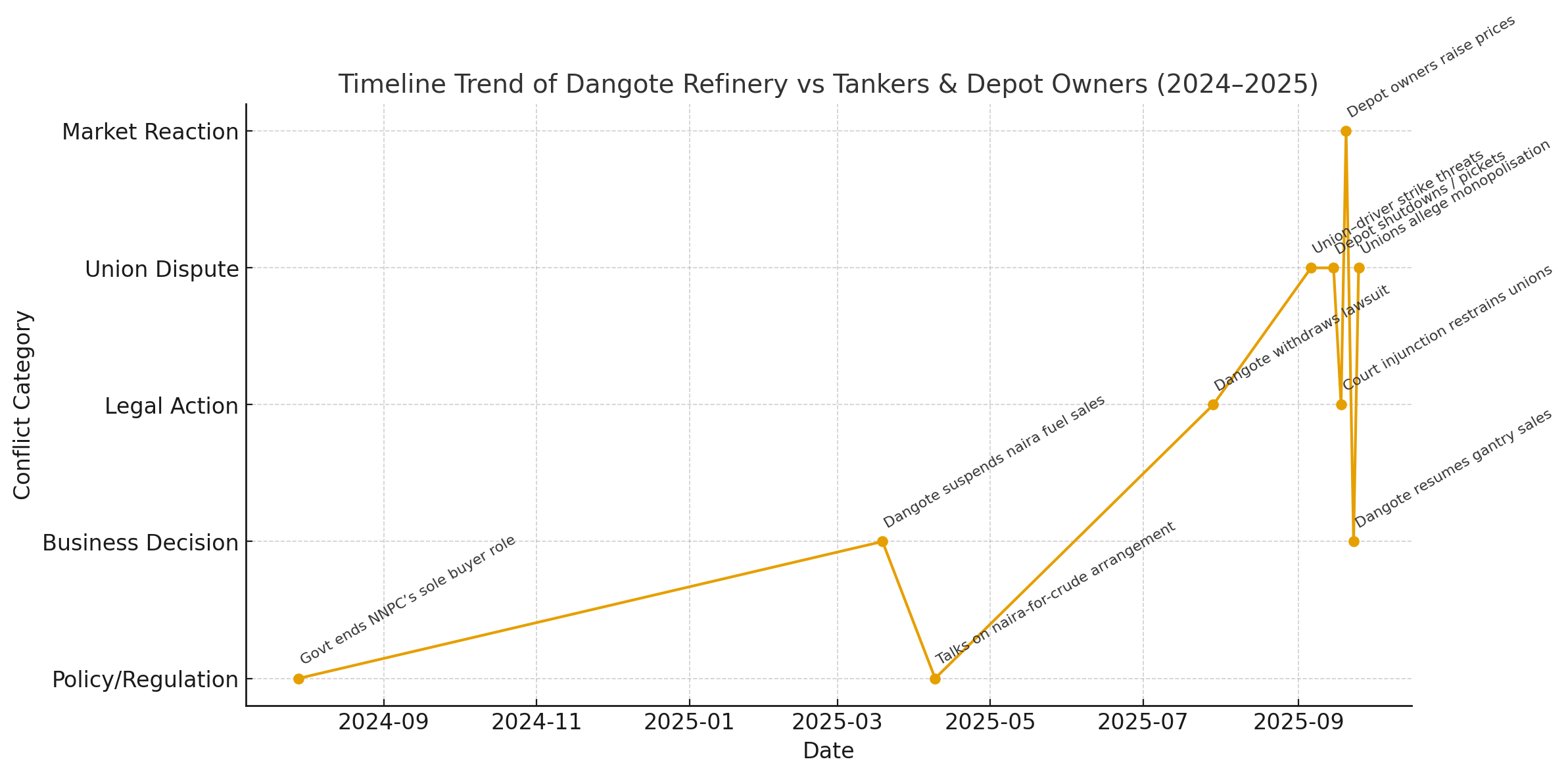
The journey into crisis began in July 2024 when the federal government removed the Nigerian National Petroleum Company as the sole buyer of Dangote refinery products. This policy change opened the door for private marketers to purchase directly from the refinery. On paper, the decision seemed like a liberalisation effort designed to stimulate competition. In reality it unsettled depot owners who had long thrived on intermediated supply chains. By cutting NNPC out of the equation, the government created a more direct market, but it also placed Dangote in a commanding position that immediately drew scrutiny.
Currency Strain and the Naira Suspension
By March 2025 the refinery introduced a decision that inflamed tensions. Management announced the suspension of petrol sales in naira, citing the mismatch between paying for crude oil in dollars and selling refined products in a rapidly depreciating local currency. This decision exposed the fragility of Nigeria’s currency and left marketers scrambling for clarity.
Register for Tekedia Mini-MBA edition 20 (June 8 – Sept 5, 2026).
Register for Tekedia AI in Business Masterclass.
Join Tekedia Capital Syndicate and co-invest in great global startups.
Register for Tekedia AI Lab.
In April 2025 government officials attempted to calm nerves by reviving talks on a naira for crude arrangement. The proposal was meant to ensure a smoother flow of supply while shielding the refinery from exchange rate shocks. However the back and forth only deepened distrust. Marketers and unions began to suspect that Dangote’s market dominance combined with unclear government support could tilt the entire downstream sector in favour of one company.
The Lawsuit That Disappeared
The confrontation shifted into the courts by July 2025 when Dangote filed a lawsuit against regulators and fuel importers over the granting of licences. The case was interpreted as a move to defend market share from external competition. Yet only weeks later Dangote withdrew the suit without explanation. For industry observers this withdrawal suggested that the company was recalibrating its strategy away from legal battles and toward operational and distribution reforms.
Labour Tensions Boil Over
By early September 2025 the crisis entered its most volatile phase. Negotiations between Dangote and tanker drivers collapsed and the drivers through their union NUPENG threatened to strike. Reports of depot shutdowns and picketing spread quickly. The spectre of nationwide fuel shortages hung over the country.

At the heart of the dispute was the question of unionisation. NUPENG accused Dangote of discouraging collective bargaining among tanker drivers and of sponsoring division within the ranks. Dangote on the other hand insisted that its rollout of thousands of new compressed natural gas powered trucks was a modernization initiative. For the union the new trucks threatened jobs and bargaining power. For Dangote it was a matter of efficiency and environmental sustainability.
The Courts Intervene
To prevent a national crisis the National Industrial Court issued an injunction in mid September restraining unions from blocking refinery operations or forcing strikes. The ruling brought temporary relief but it also confirmed that the dispute had crossed the threshold from commercial disagreement into matters of national security.
Depot Owners Push Back
The refinery then made a decision that escalated tensions with another group of stakeholders. In late September 2025 Dangote suspended gantry sales that allowed marketers to self collect products from the refinery. Instead the company sought to push its free delivery model using its own truck fleet. Independent marketers and depot owners reacted angrily. They accused Dangote of trying to control the entire distribution chain. Some depots raised prices and there was growing talk of monopolisation.

Facing mounting criticism Dangote announced on 23 September that it would resume gantry sales, while still promoting its delivery system as the future of distribution. This partial retreat reflected both the power of depot owners and the limits of unilateral change in a politically sensitive sector.
A Narrative of Monopoly and Modernisation
By the close of September 2025 the refinery had become both a symbol of ambition and a lightning rod for controversy. Unions portrayed Dangote as an anti labour giant determined to silence workers. Depot owners saw its distribution reforms as an existential threat to their businesses. Dangote countered that its model represented the future of efficient fuel distribution in Nigeria.
The story of the refinery’s first turbulent year illustrates how a project intended to solve one problem can reveal many others. Currency instability, legal ambiguities, labour relations, and entrenched business interests combined to create a volatile mix.
Nigeria still looks to the refinery as a long term answer to fuel insecurity. Yet the conflicts that have unfolded show that industrial ambition cannot succeed without inclusive negotiation and clear policy. The Dangote Refinery may eventually stabilise the downstream sector, but its early history has already shown that the path from promise to performance is filled with crises born of conflict.