

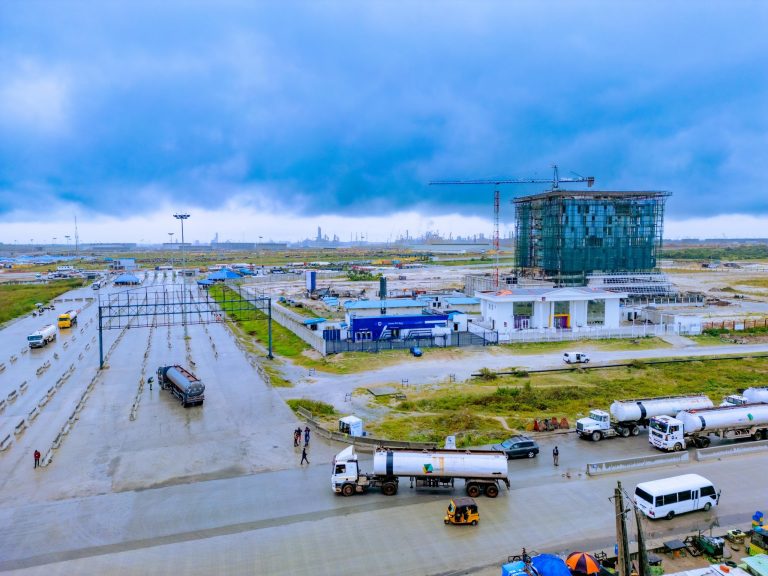
The Dangote Refinery has announced it will commence direct supply of petrol across the country on September 15, with an ex-gantry price fixed at N820 per liter.
The move marks the company’s boldest step yet to dominate Nigeria’s downstream oil sector since its long-awaited refinery began operations.
In a post shared on its official X page Thursday, the refinery said the scheme would launch in 11 states before gradually expanding nationwide.
Register for Tekedia Mini-MBA edition 20 (June 8 – Sept 5, 2026).
Register for Tekedia AI in Business Masterclass.
Join Tekedia Capital Syndicate and co-invest in great global startups.
Register for Tekedia AI Lab.
The initial rollout covers Lagos, Ogun, Oyo, Ondo, Osun, Ekiti, Abuja, Delta, Rivers, Edo, and Kwara States.
According to the refinery, delivery prices will vary slightly by region:
- N841 per liter in Lagos, Ogun, Oyo, Ondo, Osun, and Ekiti.
- N851 per liter in Abuja, Delta, Rivers, Edo, and Kwara.
“All petrol station owners nationwide are invited to register for free delivery and other benefits,” the refinery wrote.

The direct-to-station model marks a departure from Nigeria’s traditional supply chain, where petroleum products pass through middlemen before reaching retailers. Dangote is seeking tighter control over pricing and distribution by cutting out intermediaries.
The company has been scaling up logistics for months. On June 15, it announced the acquisition of 4,000 new compressed natural gas (CNG)-powered tankers to enhance nationwide fuel distribution. Weeks later, on June 29, it unveiled a petroleum distribution scheme it claims could save Nigerians over N1.7 trillion annually by reducing inefficiencies and transport costs.
Labor tensions over CNG trucks
But this logistics overhaul has been met with resistance. The plan to import 4,000 CNG-powered trucks sparked a standoff with the Nigeria Union of Petroleum and Natural Gas Workers (NUPENG), whose members dominate the country’s fuel transportation sector.

Union leaders accused Dangote of sidelining existing tanker drivers by announcing that the new trucks would be operated by freshly recruited drivers who would not be allowed to join any union.
NUPENG described the refinery’s position as an affront to workers’ rights guaranteed under Section 40 of the 1999 Constitution, which upholds freedom of association, as well as a breach of international labor conventions, including ILO Convention 87 on Freedom of Association and Protection of the Right to Organize and ILO Convention 98 on the Right to Organize and Collective Bargaining, both ratified by Nigeria.
The union has threatened to stop fuel loading nationwide if Dangote pushes ahead with the plan, raising fears of another disruption in a sector already prone to strikes and supply bottlenecks.
Analysts weigh risks and opportunities
Analysts say the new supply scheme could provide relief to motorists grappling with high pump prices, as direct supply may stabilize retail costs and reduce artificial markups.
However, the refinery’s entry into full-scale distribution could also disrupt the downstream sector. Independent marketers and existing depots may face reduced margins or be forced to rethink their business models as Dangote takes on both refining and distribution.
For labor unions, the bigger concern is whether Dangote’s model signals a deliberate attempt to weaken organized labor’s role in the sector, a move they warn could set a dangerous precedent if not addressed.
The refinery’s rollout comes at a time when the Nigerian petroleum sector is undergoing unprecedented competition. For decades, fuel importation was dominated by the Nigerian National Petroleum Company Limited (NNPCL), which acted as the sole importer of petrol under a subsidy-driven system.
With Dangote Refinery now producing and directly supplying petrol, the sector is shifting away from an NNPC-dependent trajectory. This transition is already altering the balance of power in the industry, with Dangote positioned not only as a major producer but also as a disruptive distributor.
Energy analysts have welcomed the prospect of alternative supply but remain cautious, noting that while Dangote’s entry has been hailed as a potential game-changer for energy security, pump prices could still rise if global crude prices and exchange rate pressures persist.
A Nigerian parallel to global oil majors
It is believed that Dangote’s strategy increasingly mirrors the vertically integrated model of global oil majors such as ExxonMobil, Shell, and Saudi Aramco. These companies maintain dominance not only by refining crude but also by controlling pipelines, shipping, and retail distribution networks that give them end-to-end control of the value chain.
Dangote is adopting a similar playbook by building Africa’s largest refinery and simultaneously moving into direct distribution through a massive fleet of CNG-powered trucks. This vertical integration allows him to manage margins more effectively, capture value that would otherwise go to intermediaries, and wield greater influence over pricing at the pump.
Analysts point out that while ExxonMobil and Shell built this model over decades with government backing and global reach, Dangote is attempting to replicate it within Nigeria in a matter of months. The refinery’s size and its foray into nationwide retail distribution make it the first serious domestic rival to NNPC’s historical dominance, effectively positioning Dangote as Nigeria’s first oil major in the private sector.
For consumers, this could mean more predictable supply and possibly better pricing in the long run, but for smaller marketers and unions, it signals a consolidation of power that could leave them sidelined in a sector that has long relied on fragmented participation.