

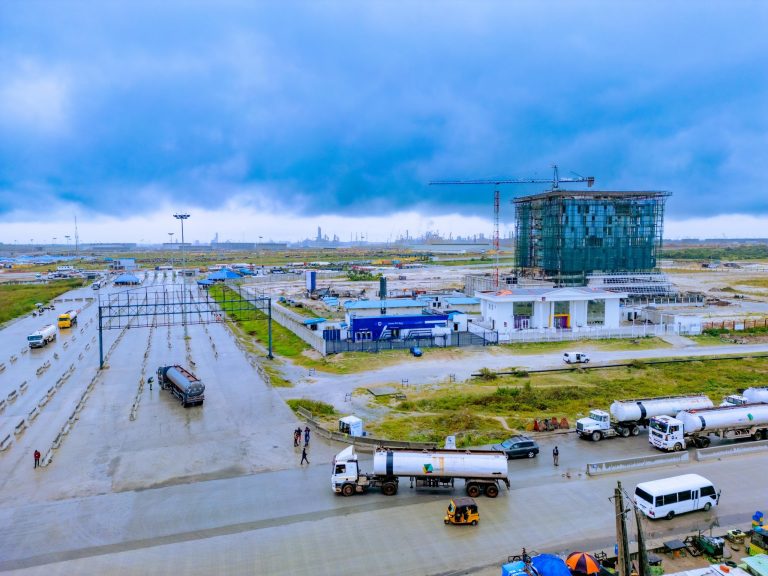
The Dangote Petroleum Refinery says its ambitious nationwide fuel distribution initiative — valued at N720 billion — is set to save Nigerians over N1.7 trillion each year, mainly by cutting logistics costs, lowering pump prices, and easing inflationary pressure.
In a statement issued Sunday, June 30, the company revealed it has begun deploying 4,000 Compressed Natural Gas (CNG)-powered trucks to deliver petroleum products across Nigeria, absorbing more than N1.07 trillion annually in distribution expenses that would typically be passed on to consumers.
The company said the trucks will begin direct delivery of petrol and diesel from August 15, targeting filling stations, industrial facilities, telecom towers, aviation operators, and other high-volume users across the country. The trucks are part of a broader logistics overhaul that includes new CNG filling stations and credit support for marketers.
Register for Tekedia Mini-MBA edition 20 (June 8 – Sept 5, 2026).
Register for Tekedia AI in Business Masterclass.
Join Tekedia Capital Syndicate and co-invest in great global startups.
Register for Tekedia AI Lab.
“This bold step will see the privately-owned refinery absorb over N1.07 trillion annually in fuel distribution costs,” the statement reads. “The initiative is also poised to significantly benefit over 42 million Micro, Small and Medium Enterprises (MSMEs) by reducing energy costs and enhancing profitability.”
Pump Prices Expected to Drop
The refinery estimates that distribution costs alone average N45 per liter, which has long been a burden on marketers and end users, especially amid the non-functionality of Nigeria’s state-owned pipelines.
By removing this cost through direct CNG-fueled deliveries, Dangote’s initiative is expected to help lower pump prices, bring price uniformity across states, and reduce inflation in fuel-dependent sectors such as manufacturing, agriculture, and transportation.

The company reiterated its goal of meeting Nigeria’s daily fuel demand of 65 million liters, made up of 45 million liters of petrol (PMS), 15 million liters of diesel, and 5 million liters of aviation fuel.
Experts, Presidency, and Marketers Applaud the Move
The Presidency and industry stakeholders hailed the announcement as transformative. Tosin Coker, Commercial Coordinator of the Presidential Compressed Natural Gas Initiative (PCNGI), described it as a pivotal endorsement of Nigeria’s gas-powered transport vision.
“Dangote Group’s acquisition of 4,000 CNG trucks is not only impressive in scale but also highly strategic,” Coker said. “It signals to the market that CNG is no longer a distant prospect but a current, practical solution to high energy costs, emissions, and supply chain challenges.”

The Independent Petroleum Marketers Association of Nigeria (IPMAN) welcomed the move as a long-awaited solution to decades-old infrastructure gaps.
“Our pipelines have been non-functional for years. We’ve had to rely on expensive transport from coastal depots. Dangote’s intervention lifts a huge burden off the shoulders of independent marketers,” said IPMAN spokesperson Chinedu Ukadike.
Prominent economist Professor Ken Ife called the initiative a “relief mechanism” for households and businesses already weighed down by post-subsidy inflation. Bismarck Rewane, CEO of Financial Derivatives Company, said the scheme would curb inefficiencies and “remove the parasitic layer of middlemen,” who extract value without investment.
“What Dangote is doing achieves two key objectives: delivering products across the country at a uniform price by eliminating bridging costs, and reducing logistics expenses through CNG-powered distribution,” Rewane said.
He added that the direct-to-station model and extension of credit facilities to marketers would boost liquidity and resuscitate many struggling outlets.
Economic, Environmental, and Job Impacts
Beyond fuel savings, the Dangote Group says its initiative is aligned with Nigeria’s economic diversification and sustainability goals. The use of CNG trucks is expected to cut carbon emissions and promote cleaner transport alternatives, in line with Nigeria’s energy transition targets.
Over 15,000 direct jobs are expected to be created across the logistics chain, including roles for truck drivers, CNG station operators, mechanics, and support personnel. It will also revive dormant filling stations, enhance last-mile delivery, and reduce fuel scarcity in hard-to-reach areas.
Moreover, the scheme aims to curb smuggling, which has surged since the fuel subsidy removal. With fuel being sold at unified, fairer prices nationwide and transported through tracked company channels, the risk of cross-border diversion is expected to reduce drastically.
The Dangote Group’s investment in logistics infrastructure marks a significant pivot from the era of costly third-party distribution, inadequate depots, and pipeline failures that have long plagued Nigeria’s downstream petroleum sector.
The company is not only reshaping fuel pricing but also triggering what some experts see as the first comprehensive market-driven reform in the post-subsidy era, by bearing the fuel transport costs and bringing direct delivery services.