

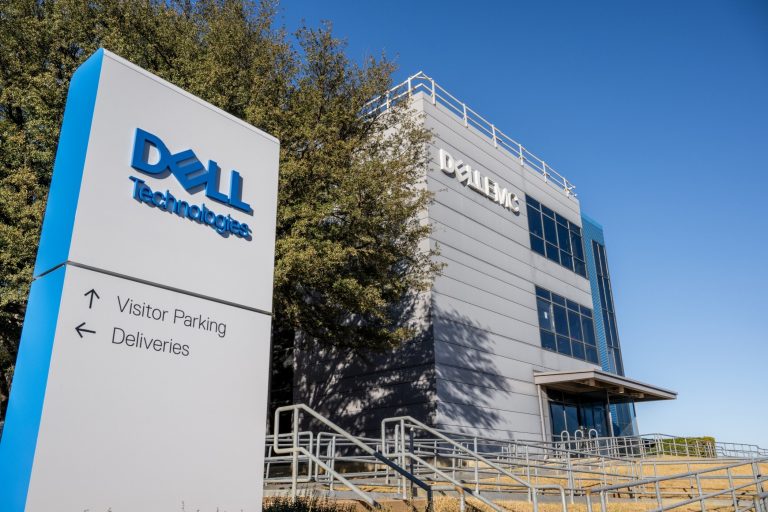
Dell Technologies delivered its strongest earnings report since returning to public markets in 2018, marking loudly how the artificial intelligence spending wave is reshaping the fortunes of once-mature hardware companies and redrawing the competitive market of enterprise technology.
The company’s shares surged about 30% in after-hours trading on Thursday after it posted quarterly results that comfortably exceeded Wall Street expectations, powered by explosive demand for AI infrastructure, servers, and enterprise computing systems tied to generative AI deployment.
Dell reported first-quarter revenue of $43.84 billion, sharply above analyst estimates of $35.43 billion. Earnings per share came in at $4.86, also far ahead of forecasts of $2.94. The stock had already climbed nearly 4% during regular trading, closing at $317.05 before the earnings release triggered a further rally.
Register for the next Tekedia Mini-MBA.
Register for Tekedia AI in Business Masterclass.
Join Tekedia Capital Syndicate and co-invest in great global startups.
The results highlight how Dell, long associated with the personal computer boom of the early 2000s and its famous “Dude, you’re getting a Dell” advertising campaign, has transformed itself into a critical supplier of AI infrastructure for corporations, cloud providers, and governments racing to expand computing capacity.
The company’s resurgence is centered on its rapidly expanding AI server business. Dell disclosed that AI-related revenue surged to more than $16 billion year over year and projected that AI-derived revenue could reach $60 billion in 2026, a figure that would place the company among the biggest beneficiaries of the global AI infrastructure buildout.
The forecast also underlines the extraordinary scale of spending now flowing into data centers, accelerated computing, and networking equipment as enterprises attempt to deploy increasingly complex AI models. Demand for AI servers has become one of the fastest-growing segments in the global technology market, benefiting hardware makers closely aligned with chip giants such as NVIDIA.

Dell also guided full-year company-wide revenue to between $165 billion and $169 billion, signaling confidence that corporate AI spending remains in its early stages rather than nearing a peak.
Legacy infrastructure firms in the tech industry that spent years battling slowing growth are now finding renewed momentum from AI-driven demand. Investors have increasingly rotated back into companies viewed as essential suppliers of the physical backbone underpinning generative AI systems.
That dynamic has fueled sharp rallies across several former internet-era leaders. Cisco Systems shares have climbed 56%, while Intel has surged more than 200% amid growing optimism that AI-related compute demand could revive parts of the semiconductor and networking industry that had struggled through years of cyclical weakness.

Dell’s performance also came off as part of a major change in enterprise purchasing priorities. Corporate customers are now spending aggressively on high-performance servers, storage systems, and networking gear capable of supporting AI training and inference workloads, even as broader IT spending in some traditional areas remains subdued.
The company has positioned itself as a one-stop provider of AI infrastructure, combining servers, storage, cooling systems, and cloud integration services. Analysts say that an integrated approach is helping Dell secure large enterprise and government contracts at a time when organizations are looking for turnkey AI deployment solutions rather than piecing together systems from multiple vendors.
Government demand is emerging as another powerful tailwind. Dell recently secured a nearly $10 billion contract with the U.S. Department of Defense, further strengthening its position in federal technology infrastructure and AI modernization efforts.
The results are also believed to wield broader impacts for financial markets. Investors who once viewed AI primarily as a software or semiconductor story are increasingly recognizing that the boom requires massive investment in physical infrastructure, from data centers and servers to energy systems and advanced networking.
That has widened the pool of AI beneficiaries well beyond chipmakers alone.
Dell’s resurgence became a broad market due to the company’s history. Founder Michael Dell took the company private in 2013 in a controversial deal aimed at restructuring the business away from the pressures of quarterly reporting. The company returned to public markets in late 2018 through a complex financial transaction involving VMware.
At the time, many investors still viewed Dell primarily as a PC maker operating in a slowing market. The latest earnings suggest the company has successfully repositioned itself as a central player in the AI infrastructure economy.
Dell’s comeback also meets the intensifying competition among hardware and cloud providers to capture the next phase of AI spending. Tech companies globally are racing to build AI-ready computing environments as demand accelerates for agentic AI systems, enterprise copilots, and large-scale inference workloads.
Investors now appear to be betting that Dell’s infrastructure footprint gives it an advantage in that race, particularly as organizations seek alternatives to building AI systems entirely through hyperscale cloud providers.
The scale of Dell’s projected AI revenue growth suggests the company expects the current AI spending cycle to persist for years, not quarters. That outlook aligns with forecasts from major technology firms and investment banks that estimate global AI infrastructure spending could reach several trillion dollars over the coming decade.