

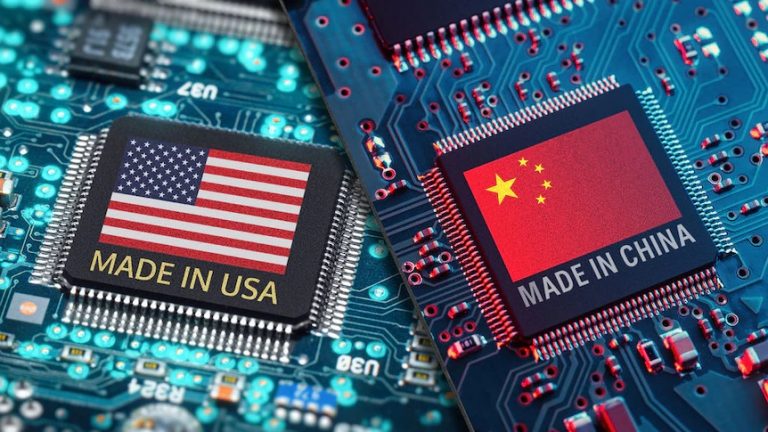
Six Democratic senators have called on President Donald Trump to reverse his decision to allow Nvidia and Advanced Micro Devices (AMD) to resume selling advanced artificial intelligence chips to China in exchange for a 15% cut of revenue from those sales.
The rare open letter, signed Friday by Senate Majority Leader Chuck Schumer (D-N.Y.) and Senators Mark Warner (D-Va.), Jack Reed (D-R.I.), Jeanne Shaheen (D-N.H.), Christopher Coons (D-Del.), and Elizabeth Warren (D-Mass.), sharply criticized the arrangement announced by Trump on August 11. The lawmakers said the deal undermines U.S. national security by trading away America’s technological advantage in sensitive domains for what they described as a mere “commission” on sales.
“Our national security and military readiness relies upon American innovators inventing and producing the best technology in the world, and in maintaining that qualitative advantage in sensitive domains,” the senators wrote. “The willingness displayed in this arrangement to ‘negotiate’ away America’s competitive edge that is key to our national security in exchange for what is, in effect, a commission on a sale of AI-enabling technology to our main global competitor, is cause for serious alarm.”
Register for Tekedia Mini-MBA edition 20 (June 8 – Sept 5, 2026).
Register for Tekedia AI in Business Masterclass.
Join Tekedia Capital Syndicate and co-invest in great global startups.
Register for Tekedia AI Lab.
At the heart of the dispute are Nvidia’s H20 chip and AMD’s MI308 chip, both of which had been restricted under U.S. export controls because of their potential dual-use applications in civilian and military systems. Lawmakers warned that providing these high-end chips could strengthen China’s defense capabilities.
Nvidia has pushed back on that claim. In a statement to CNBC, the company said: “The H20 would not enhance anyone’s military capabilities, but would have helped America attract the support of developers worldwide and win the AI race. Banning the H20 cost American taxpayers billions of dollars, without any benefit.”
But beyond the national security debate, questions are now being raised over the legality of the 15% revenue arrangement itself. Article 1, Section 9 of the U.S. Constitution — the “export clause” — prohibits taxes or duties on goods exported from any U.S. state. The Supreme Court has previously struck down attempts to collect fees or taxes on exports, notably in United States v. IBM (1996) and United States v. United States Shoe Corp. (1998). In both cases, the Court sided with businesses, ruling that such levies violated the export clause.

Also, several analysts have argued that the plan may be unconstitutional, since the power to impose tariffs, duties, and taxes on foreign trade lies with Congress, not the executive branch. The legal argument is that while presidents have broad authority under national security statutes to restrict exports, there is no clear provision that allows them to monetize those restrictions through direct revenue-sharing with private companies.
The senators have demanded that the Trump administration provide a detailed explanation of the Nvidia and AMD arrangement, along with any similar deals under consideration, by August 22. They also urged the White House to “quickly reverse course and abandon this reckless plan to trade away U.S. technology leadership.”
The Trump administration, however, has brushed off both the constitutional concerns and the national security warnings. White House spokesman Kush Desai dismissed the letter, framing it as political posturing.

“It’s quite rich to see Democrats and irrelevant ‘experts’, who were totally MIA when Joe Biden’s autopen administration let H20 chips and other advanced technologies freely flow to China, now pretend to care about our national and economic security,” he said.
Even with Trump reopening the door for Nvidia and AMD, early signs suggest that Beijing is not eager to welcome the companies back. According to Bloomberg, Chinese regulators have instructed domestic firms to avoid purchasing U.S. chips. Qingyuan Lin, a senior semiconductor analyst at Bernstein, told CNBC that authorities are actively halting additional orders of Nvidia’s H20 chips for certain companies.
Separately, The Information reported that China’s regulators have ordered major tech firms, including ByteDance, Alibaba, and Tencent, to suspend Nvidia chip purchases until a national security review is completed.
The clash underscores the deep tension in U.S.–China technology relations. On one hand, Washington is trying to balance domestic industry competitiveness with national security concerns. On the other hand, China is doubling down on efforts to reduce its reliance on U.S. suppliers, signaling that even when restrictions are relaxed, American chipmakers face an increasingly hostile market.
The controversy over the 15% deal not only puts Trump’s semiconductor strategy under scrutiny but also opens the possibility of a looming legal battle in U.S. courts, one that could further complicate the already turbulent technology cold war between Washington and Beijing.